
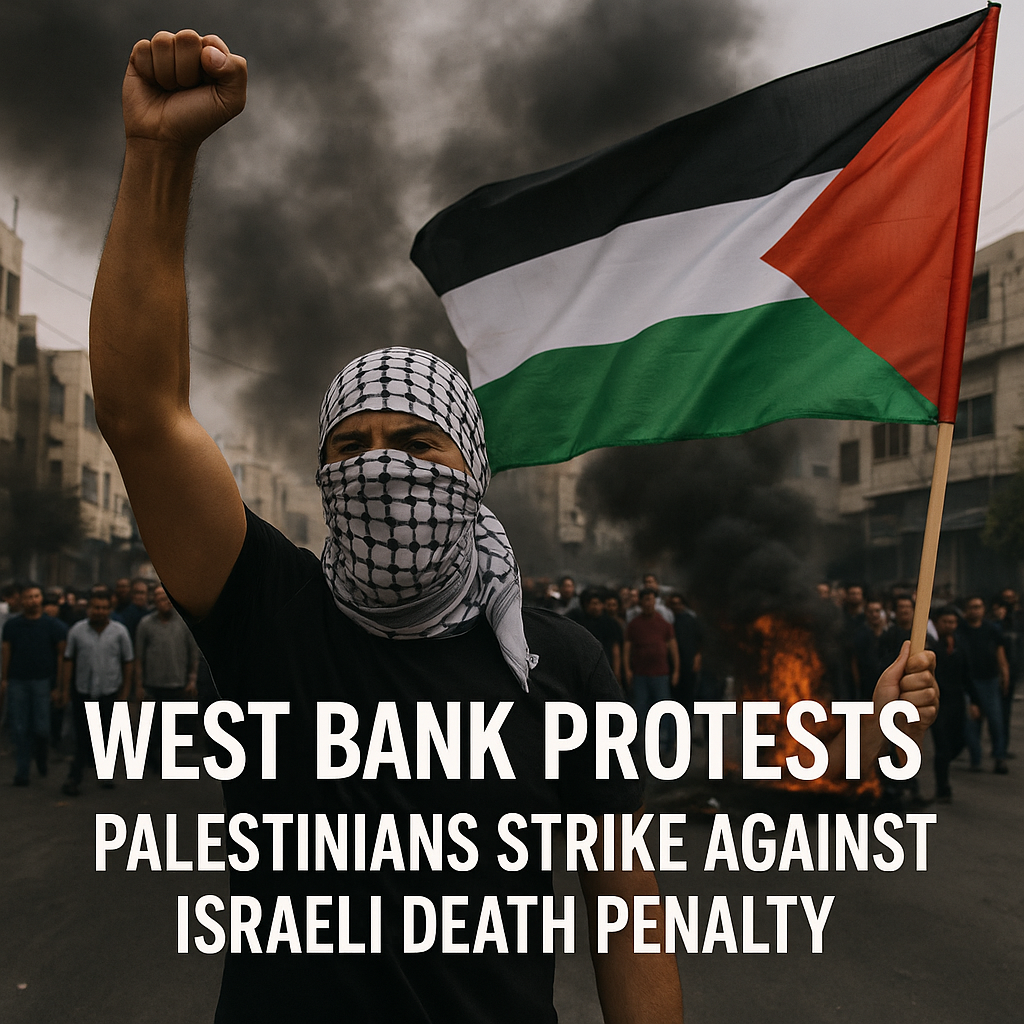
West Bank Protests: Palestinians Strike Against Israeli Death Penalty
West Bank Protests: Palestinians Strike Against Israeli Death Penalty
In recent weeks, the West Bank has become a focal point of tension as Palestinians have staged widespread protests against a controversial Israeli law that advocates the death penalty for certain crimes. This significant move has ignited a mix of sentiments, as community members rally against potential changes to the justice landscape in the region, shifting the discourse on human rights amidst a backdrop of longstanding conflict.

The Context of the Protests
The protests emerged as a reaction to proposed legislation in Israel that would allow for the death penalty for individuals convicted of terrorism and murder. While the Israeli government argues that this law is essential for deterrence against violent acts, many Palestinians view it as an infringement on human rights and a reinforcement of existing oppressive measures. Notably, this proposed legislation stirs fears of further expansion of punitive policies targeting the Palestinian population.

In a poll conducted by Al Jazeera, a considerable number of Palestinians expressed concerns that such a law could be used against them, highlighting a distressing climate where fear of authoritarian measures feels more palpable. This perspective resonates deeply, as many cite the ongoing uncertainty stemming from Israel’s occupation and the application of military law in Palestinian territories.

Diverse Perspectives on Deterrence and Justice
Supporters of the death penalty within Israel often emphasize that such harsh measures are vital for national security. They believe that the proposed law would act as a strong deterrent against terrorist activities and promote a sense of justice for the families of victims. Figures such as Israeli Minister of National Security Itamar Ben Gvir have voiced strong support for the measure, stating that “terrorists deserve the maximum punishment,” reflecting a viewpoint that prioritizes retribution amidst the dire security concerns in the region.
In stark contrast, Palestinian leadership and human rights advocates reject this line of reasoning, arguing that the law would only exacerbate the cycle of violence and injustice. They highlight that such measures would disproportionately affect the Palestinian community, effectively increasing tensions and retaliatory responses. This perspective underscores a broader critique of punitive justice systems, suggesting that they often overlook the socio-political contexts that underlie criminal behavior.
Those participating in the protests have articulated their frustrations through various expressions, from speeches emphasizing rights to peaceful demonstrations, reflecting a collective call for justice that pivots away from violence. The protesters argue for reform that is rooted in human rights rather than punitive measures that potentially perpetuate cycles of violence.
The Complexity of the Situation
In examining the dynamics of the protests, it becomes clear that there is no easy consensus. While some Israelis see the death penalty as a necessary tool against rising violence, many Palestinians view it as a legislative extension of existing repression. The complexity of this situation also highlights a deeper context surrounding feelings of security and justice.
A recent piece from Sky News noted that “the death penalty is not widely implemented elsewhere in democratic nations,” suggesting that the push for such legislation could compromise Israel’s democratic standing on the global stage. Critics argue that the law might further alienate the international community and undermine Israel’s global reputation, especially regarding human rights advancements.
Interestingly, some reports indicate divisions even within Israeli society regarding support for the death penalty. While hardline elements support the legislation, there are voices from the legal community who warn that it might lead to wrongful convictions and expand the state’s power over individual rights.
The Call for Dialogue
As protests continue, there is an evident call for dialogue and a more nuanced approach to security and justice in the region. Analysts emphasize that simply adopting punitive measures will not address the underlying issues fueling violence and resentment. Instead, constructive solutions focused on socio-economic development, political representation, and empathy might provide pathways to a more peaceful co-existence.
Organizations such as Human Rights Watch have urged the international community to pay close attention to the implications of the proposed death penalty law, emphasizing that security cannot come at the expense of fundamental human rights. They stress that fostering an environment conducive to dialogue may be essential in easing tensions and promoting peace.
Conclusion
The ongoing protests in the West Bank against Israel’s proposed death penalty law symbolize more than just opposition to legislation; they reflect a complex interplay of fear, mistrust, and a yearning for justice among Palestinians. While proponents of the law argue from a standpoint of security, the counter-arguments presented by Palestinian voices underscore the critical need for an approach that prioritizes human rights. As this situation develops, the path forward may require rethinking strategies rooted in punishment in favor of paths that emphasize reconciliation and mutual understanding. Only then can there be hope for a more peaceful resolution to the entrenched hostilities that have characterized the region for decades.















