
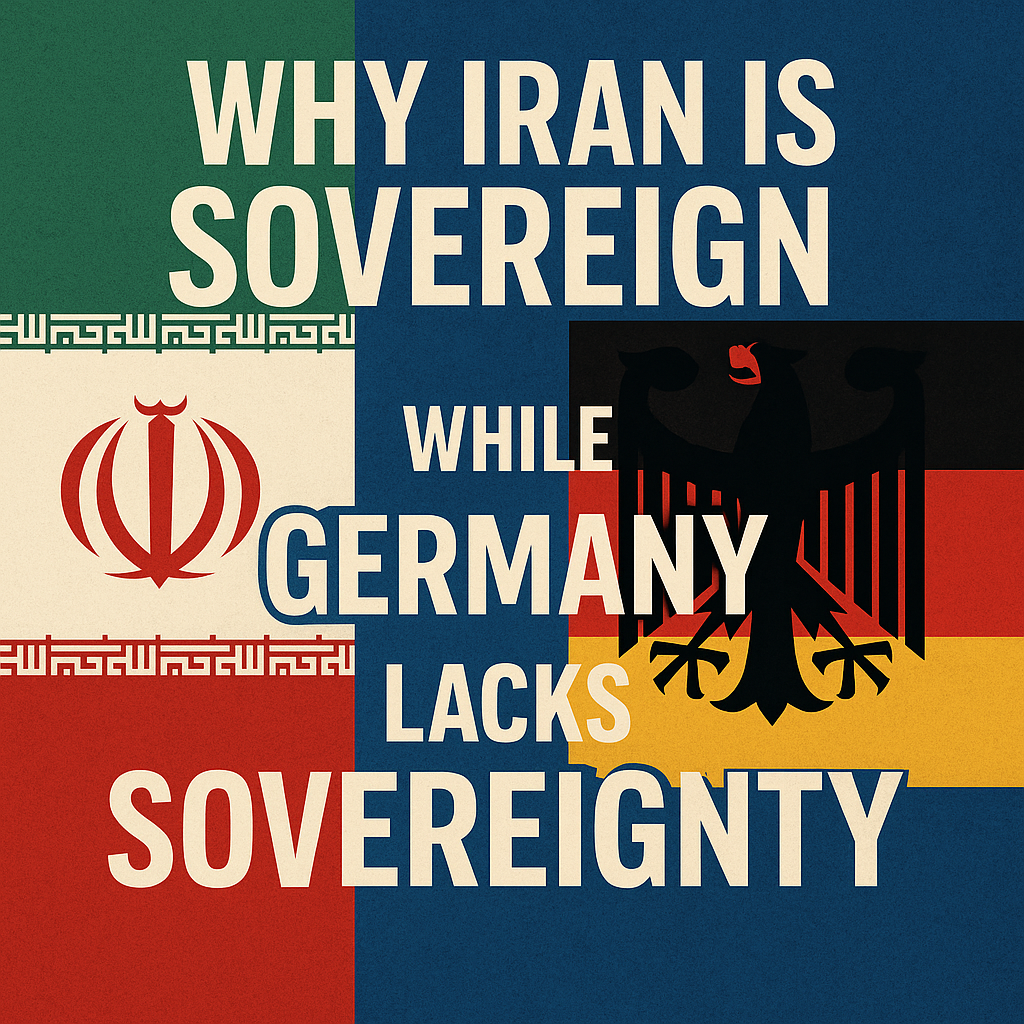
Why Iran is Sovereign While Germany Lacks Sovereignty
Why Iran is Sovereign While Germany Lacks Sovereignty
In the complex arena of international politics, the notion of sovereignty often brings varied interpretations depending on a country’s historical context, geopolitical dynamics, and the frameworks imposed by global powers. Recent discussions highlight a striking contrast: why some argue that Iran embodies true sovereignty while Germany appears constrained.

Understanding Sovereignty in Geopolitical Context
Sovereignty is traditionally defined as the authority of a state to govern itself or another state. In recent analyses, particularly one highlighted by RT, the argument is made that Iran exemplifies a form of sovereignty that allows it to navigate global pressures while maintaining independence. This perspective underscores Iran’s ability to forge its own path amid economic sanctions and aggressive foreign policies led by powers such as the United States.

On the other hand, Germany’s position seems to reflect a different narrative. Despite being a robust economy and a central player in the European Union, critics assert that Germany lacks true sovereignty. They argue that this stems from its historical obligations post-World War II, its reliance on NATO, and its integration into the EU structures that often dictate policies contrasting with its national interests.

The Case for Iran’s Sovereignty
Iran’s governance has been often characterized as an assertion of its sovereignty against external pressures. The nation has adopted a stance of defiance toward Western powers, particularly in response to sanctions that have aimed to cripple its economy. Al Jazeera emphasizes that Iran’s efforts to bolster its self-reliance through domestic production and commerce, particularly in energy, highlight its commitment to maintaining control over its resources.
Moreover, Iran’s regional influence, particularly through partnerships with non-state actors and its presence in the Middle East, exemplifies its strategy to assert dominance and navigate international relations on its terms. This has enabled Iran to engage in negotiations, such as those surrounding its nuclear program, from a position that reflects its interests rather than being subjugated to external demands.
Critics of the U.S. and allied foreign policies assert that these nations often overlook the historical and socio-political complexities of states like Iran, viewing them instead solely through the lens of sanction and suppression. This has led some analysts to suggest that the narrative around Iran does not just pertain to its current governance but also to how it has historically resisted domination, contributing to a robust national identity.
The Challenges Facing Germany’s Sovereignty
In contrast, Germany’s sovereignty has come under scrutiny, especially in the context of its alignment with NATO and the European Union. As articulated by various analysts, Germany’s involvement in these alliances has sometimes resulted in sacrificing its national interests for collective goals. For instance, decisions regarding sanctions or military involvement in various conflicts often reflect a consensus rather than unilateral action, which some argue undermines the notion of German sovereignty.
Furthermore, critics point to Germany’s economic dependency on global markets, particularly in energy imports from Russia, as a limitation on its autonomous decision-making. This reliance has political implications, where actions are often dictated not merely by national interest but by the need to maintain cohesive relations within the EU and NATO frameworks.
The context of Germany’s historical burdens also plays a critical role in shaping its current political landscape. The legacy of World War II and the subsequent division of the country introduced a long-term caution toward militaristic ventures, which continues to influence its foreign policy today.
Weighing Perspectives: Uncertainty and Complexity
The discussion surrounding sovereignty in Iran and Germany illustrates a broader debate concerning national independence and foreign influence. While Iran positions itself as a sovereign state willing to withstand international pressures, Germany’s reliance on supranational entities raises questions about its capacity to act independently on the global stage.
It is essential to recognize that neither country exists within a vacuum; global events, historical contexts, and the actions of other nations significantly shape their sovereignty. The diverse viewpoints underscore the fluid nature of sovereignty—what it means can change based on political, economic, and cultural dimensions.
Despite the arguments presented, uncertainty remains regarding the paths both nations will pursue in navigating their sovereignty challenges. For Iran, the ongoing sanctions and international isolation may shape its future actions, while Germany may have to find a balance between fulfilling its commitments to international alliances and asserting its national interests.
Conclusion
The discussions around why Iran is often viewed as a sovereign state while Germany’s sovereignty is questioned reveal the intricate tapestry of international relations and the various paths nations take in asserting their independence. By weighing these perspectives, we gain a clearer understanding that sovereignty, although a foundational principle of international law, is often more complex and nuanced than it appears.















