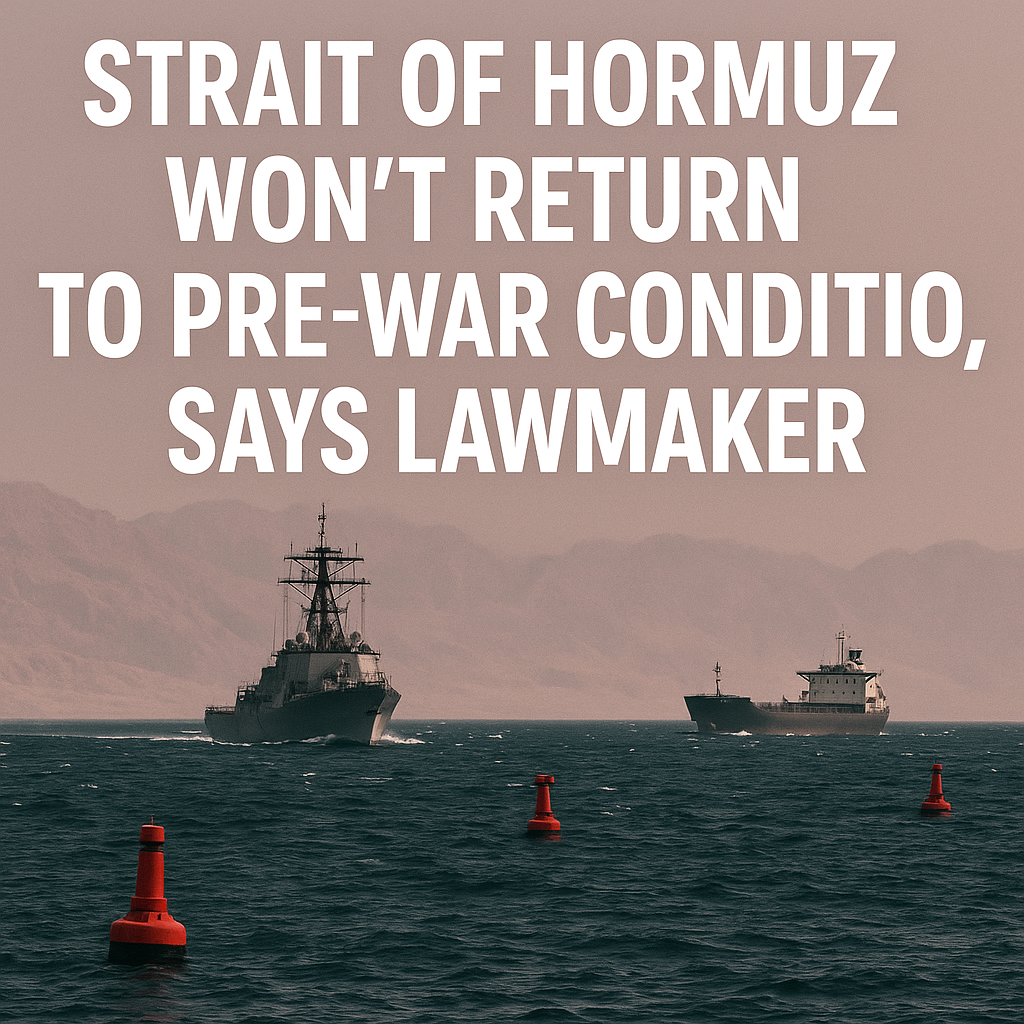
Strait of Hormuz Won’t Return to Pre-War Conditions, Says Lawmaker
The Future of the Strait of Hormuz: A Complex Landscape Ahead
The Strait of Hormuz remains a pivotal maritime corridor, and recent statements indicate that the geopolitics surrounding it will not revert to a pre-war status quo. This essential waterway, through which nearly a fifth of the world’s oil supply passes, is at the heart of ongoing tensions involving Iran and other regional and global powers.

The Context of Current Tensions
Recent remarks from Iranian lawmakers suggest that military posturing and maritime confrontations will persist in the Strait of Hormuz. An Iranian lawmaker, speaking on behalf of government interests, asserted that “the Strait of Hormuz will not return to pre-war conditions.” Such a statement significantly raises the stakes in a region already fraught with geopolitical instability.

The Iranian Perspective
Iran maintains a robust military presence in the Strait, viewing it not merely as a critical economic passage but also as a national sovereignty issue. The Iranian government sees the potential for economic sanctions and military actions against its shipping activities as directly linked to its broader security.

Reports from Al Jazeera highlight that Iran’s naval capabilities have been enhanced recently, showcasing new technology and a willingness to defend its interests vigorously. This perspective underscores Tehran’s intention to leverage its geographical advantage not only as a passage for oil but also as a strategic bargaining chip in international relations.
Contrasting Global Perspectives
Contrasting opinions arise when examining viewpoints from Western nations and their allies, who prioritize the freedom of navigation in international waters. The United States, for example, has often deployed naval forces to ensure secure passage for commercial shipping, linking maritime security to broader regional stability.
Reports from RT have emphasized how Western military presence has inflamed tensions, with analysts arguing that these actions risk escalating confrontations further. The belief among some military experts is that the provocative presence of foreign naval forces may lead Iran to intensify its defensive measures, thereby creating a potentially volatile military environment.
Economic Implications and Global Reactions
The ramifications of ongoing instability in the Strait of Hormuz extend far beyond regional players. Disruptions to oil tankers passing through could send shockwaves through global markets, affecting prices worldwide. Even a transient disruption could cause a significant spike in oil rates, determining economic conditions in various nations.
The Global Economy Takes Note
Economists and analysts are increasingly concerned that a long-term military standoff could undermine confidence in supplies moving through the Strait. Sky News has reported that major oil-producing nations are already beginning to explore alternative routes and enhance their energy security strategies—indicating a possible shift in how global energy is sourced and transported.
In this context, several countries, including Saudi Arabia and the UAE, have signaled intentions to diversify their oil export routes, adding complexity to the existing geopolitical panorama. This not only reflects a growing unease but also points toward a potential reconfiguration of energy supply chains.
The Path Forward: Uncertainties Abound
While various reports highlight distinct viewpoints, one constant is the element of uncertainty surrounding future conditions in the Strait of Hormuz. There are palpable divisions on potential resolutions. On one hand, diplomatic attempts to mitigate conflict and secure maritime routes are underway; on the other, military readiness and preparations for confrontation remain prevalent.
Experts suggest that dialogue is essential but fraught with challenges, especially when national pride and survival intersect with economic imperatives. A focus on both military readiness and diplomatic engagement may be the dual strategy needed to navigate these treacherous waters.
Conclusion: Preparing for a New Norm
As we look toward the future, it is crucial to recognize that the Strait of Hormuz will likely not return to its pre-war state. Instead, we may face a “new norm,” shaped by a complex interplay of military, economic, and diplomatic factors. The statements from Iranian lawmakers resonate deeply, embodying a stalemate where neither side appears willing to yield.
In light of these developments, stakeholders in global energy markets must adapt to the evolving landscape. Whether through pursuing alternative supply routes or engaging in diplomatic dialogues, the future of the Strait of Hormuz remains a critical focal point that demands our attention.
In conclusion, the complexities of the Strait of Hormuz and surrounding geopolitical dynamics illustrate that the pathway ahead is anything but clear. Understanding these currents will be essential for navigating the emerging realities in this vital maritime region.