
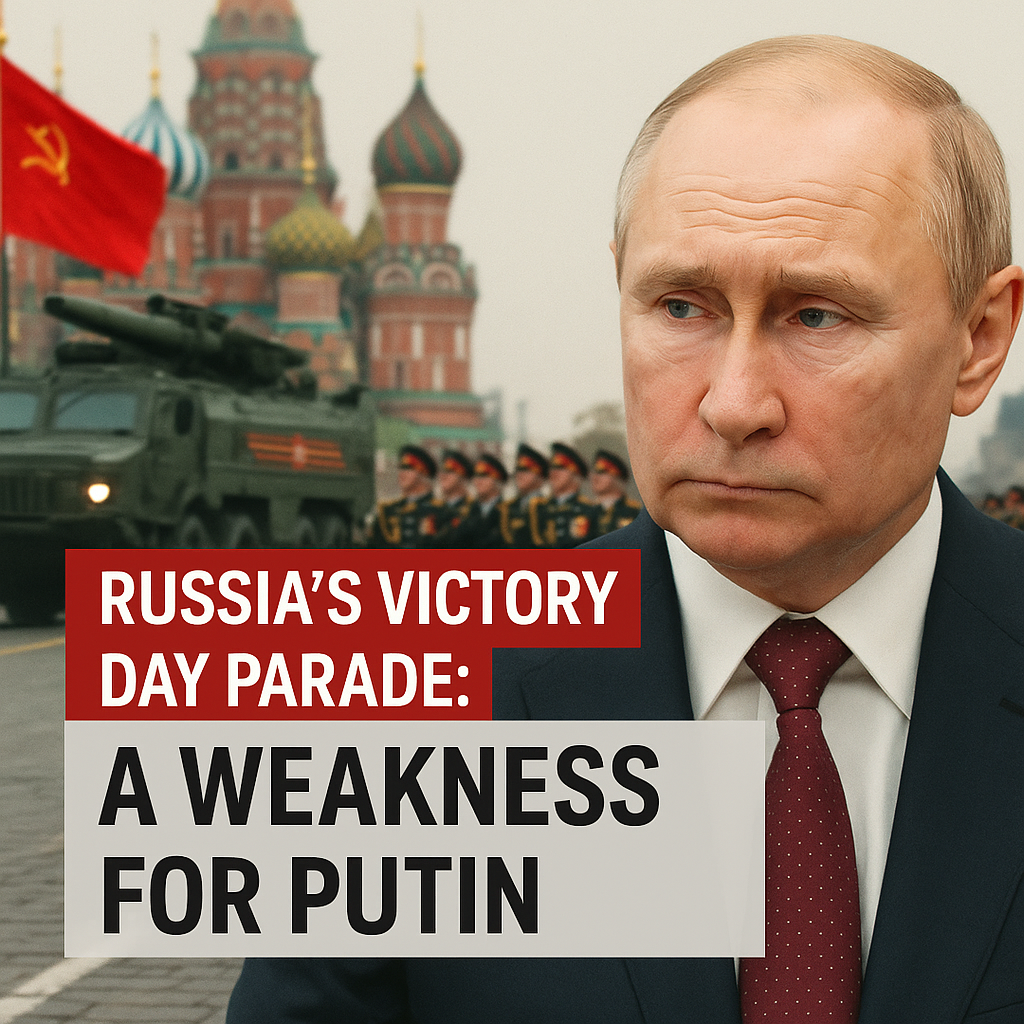
Russia’s Victory Day Parade: A Weakness for Putin
Russia’s Victory Day Parade: A Reflection of Vulnerability for Putin
The annual Victory Day parade is typically a highly anticipated event in Russia, celebrating the defeat of Nazi Germany and showcasing the Kremlin’s military prowess. However, in 2023, the spectacle felt markedly different, casting a long shadow of uncertainty over President Vladimir Putin’s leadership rather than reinforcing his previous displays of strength.

A Scaled-Down Show of Force
This year, the parade in Moscow was significantly scaled back due to ongoing military conflicts and mounting international scrutiny. Instead of the usual grand display of military might, Russians witnessed a muted procession, described by many observers as a “show of weakness.” Analysts have pointed out that the absence of heavy military hardware, due to their utilization in the war in Ukraine, accentuated Moscow’s current military constraints.

Sky News reported that the stripped-down ceremony was a stark reminder of the costs implicating Russia’s ongoing conflict. While 2023 marked the global recognition of WWII’s conclusion, it also served as a dismal reminder of Russia’s struggles, where the military resources that could have shown off were instead depleted on foreign battlefields. The absence of typical fanfare and a heavy military presence underscored not only a logistical weakness but also a thematic vulnerability that fewer soldiers were available to march in honor of their inherited legacy.

Public Sentiment and International Perspective
The mood at the parade was reportedly subdued, reflecting broader discontent among the Russian populace, who, after years of patriotic propaganda, now face the harsh realities of war. The reduced scale, coupled with economic strains exacerbated by sanctions, has led to questioning among citizens regarding the legitimacy of continuing military engagement. A stark contrast has emerged between state rhetoric and public sentiment, as people grapple with the implications of a prolonged conflict.
Internationally, perceptions of the event have varied. Some political analysts argue that the lesser spectacle serves to highlight Putin’s delicate grip on power amid increasing dissent. Al Jazeera reported diverse reactions globally, suggesting that while the parade might have decreased in grandeur, it remains a vital tool for propagating national pride and justifying the war in Ukraine. Those in favor of this position underscore that even a diminished display serves to rally patriotic sentiments, albeit with increasing skepticism domestically.
Conversely, critics maintain that the reduced parade symbolizes a president who is wrestling with internal and external pressures, raising critical points about the durability of Putin’s authority. Some experts suggest that this adaptation of Victory Day could signify a need for Putin to recalibrate his approach in light of a not-so-distant legacy of overwhelming force.
Conclusion: Navigating Complexity
The 2023 Victory Day parade encapsulates a complex narrative around Putin’s leadership amid war and shifting political landscapes. What was once a bold display of military strength has transformed into a layered commentary on vulnerability and the challenges facing the Kremlin.
As the conflict in Ukraine continues to deplete resources and morale, Russian citizens are left to navigate an increasingly difficult reality. The mixed perspectives surrounding this year’s parade illustrate a powerful intersection of national pride and the stark impacts of military engagement. While the theme of victory remains pivotal, it is now intertwined with a growing recognition of the costs involved.
The ultimate outcome of these sentiments remains uncertain, as Russia grapples with its national identity in these tumultuous times. The future narrative of Putin’s strength might hinge less on parades and more on the realities confronting an embattled nation.















