
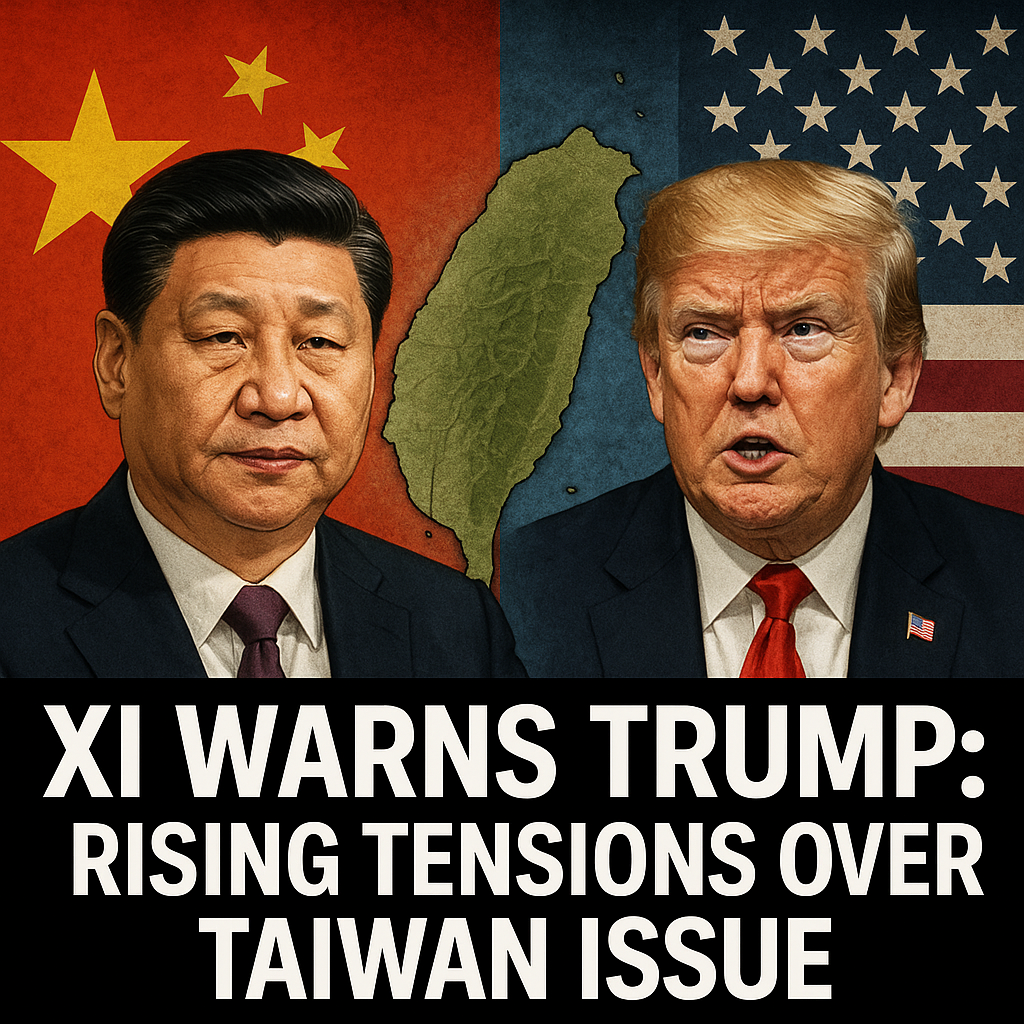
Xi Warns Trump: Rising Tensions Over Taiwan Issues
In the complex interplay of global geopolitics, recent statements from Chinese President Xi Jinping regarding Taiwan and the potential implications for U.S. relations have become increasingly significant. With rising tensions, particularly in light of former President Donald Trump’s criticisms toward China, Xi’s warnings present a critical narrative that underscores the fragility of international stability in East Asia.

The Central Issue: Taiwan’s Status
China regards Taiwan as part of its territory, maintaining a firm stance against any moves towards independence. President Xi has reiterated this position, asserting that any steps taken by the U.S. that might bolster Taiwan’s claims to sovereignty will be met with stern opposition. Xi stated, “Those who play with fire will get burned,” cautioning against actions that could escalate military tensions in the Taiwan Strait. This statement reflects Beijing’s view that U.S. support for Taiwan undermines China’s territorial integrity and fosters an atmosphere ripe for conflict.

President Trump, on the other hand, has adopted a combative approach toward China, particularly emphasizing human rights issues and promoting the idea of a robust U.S. engagement in Asia. Analysts have noted that Trump’s rhetoric often plays to domestic sentiments that are wary of China’s rising influence, and his criticisms could provoke a more assertive response from Beijing. The tension is amplified by the perception that a strong U.S. stance on Taiwan could embolden separatist movements, contradicting hopes for peace in the region.

Diverging Views on U.S.-China Relations
American Perspectives
From an American standpoint, the situation is complicated by differing political views. Some experts believe that a strong U.S. support system for Taiwan is necessary to prevent Beijing from pursuing aggressive action. The U.S. has maintained a policy of strategic ambiguity, supplying Taiwan with defensive weapons while stopping short of formally recognizing its independence. This delicate balance is seen as essential for deterring Chinese aggression; however, it remains controversial within the political landscape.
The Biden administration has also continued to provide military assistance to Taiwan, which some interpret as a commitment to counter Chinese influence in the region. Critics argue that this could inadvertently escalate tensions rather than stabilize them. The prevailing concern is whether the Biden administration’s approach will lead to a broader conflict, particularly if military confrontation occurs as a result of misunderstandings or miscalculations.
The Chinese Narrative
On the other side, Chinese state media has reacted fiercely to any perceived slights regarding Taiwan. Officials in Beijing argue that interference from the U.S. undermines China’s sovereignty and emboldens separatist ambitions within Taiwan. The government emphasizes national unity, framing the Taiwan issue not just as a political matter but also a core aspect of Chinese identity.
Moreover, responses from Beijing indicate a willingness to use force if deemed necessary. Experts contend that this rhetoric serves to bolster Xi’s domestic standing by rallying nationalistic sentiment and projecting strength. Meanwhile, Xi’s warnings reflect a strategy that seeks to deter U.S. intervention while consolidating control over Taiwan by fostering a narrative of inevitability regarding its reintegration with the mainland.
Navigating Uncertainty: The Future of U.S.-China Relations
As tensions rise, the future of U.S.-China relations remains uncertain. The delicate balance hinges on actions taken by both nations, with potential flashpoints existing around military maneuvers in the Taiwan Strait, trade disputes, and broader security alliances in Asia. While there are calls for dialogue to de-escalate tensions, mutual distrust complicates the prospects for resolution.
Some analysts suggest that both nations could benefit from clearer communication to prevent unnecessary escalation. Others contend that as both Xi and Trump utilize Taiwan as a point of leverage in their respective domestic and geopolitical narratives, the potential for misunderstanding remains high.
Conclusion: A Path Forward
In light of Xi’s recent warnings, the international community faces a critical question: how will the U.S. and China navigate the choppy waters of Taiwan-related tensions? The divergence between American support for Taiwan and China’s adamant stance against any form of independence lays a complex foundation for the relationship moving forward.
The balancing act requires not only prudent policy decisions but also an understanding of the historical context and the emotional resonance of the Taiwan issue within both nations. As the world watches, the hope is that diplomatic efforts can prevail over aggressive posturing to foster stability in a region where the stakes have never been higher.















