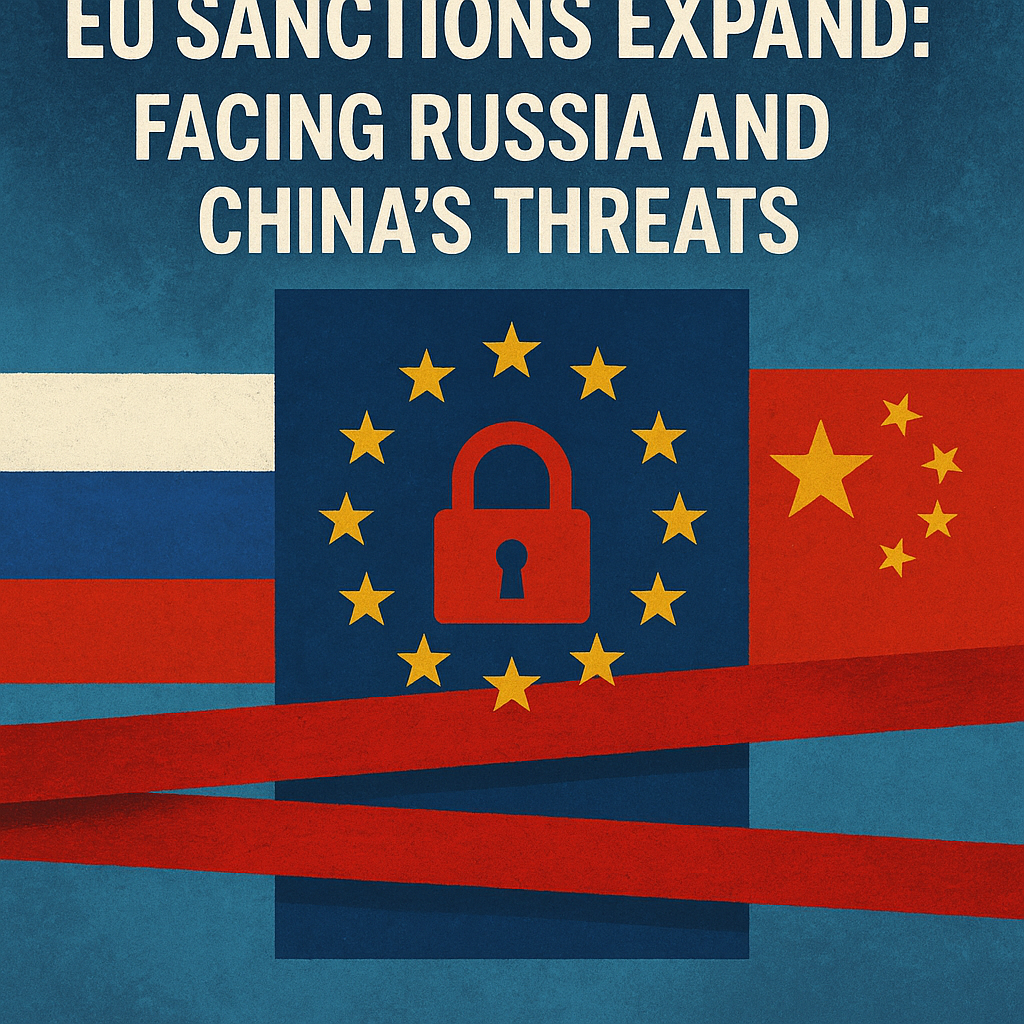
EU Sanctions Expand: Facing Russia and China’s Threats
Expanding EU Sanctions: Navigating the Nexus of Threats from Russia and China
As geopolitical tensions escalate, the European Union (EU) is expanding its sanctions framework to tackle the increasing threats posed by both Russia and China. This pivotal shift reflects a growing consensus among member states about the necessity of a robust, unified stance in face of external pressures complicating regional and global stability.

The Context Behind EU Sanctions
The EU’s decision to intensify sanctions stems largely from ongoing conflicts and security dilemmas involving Russia and China. In the case of Russia, the sanctions are primarily a response to its continued military aggression in Ukraine. According to RT, recent updates suggest that proposed measures could target sectors like technology and finance, aiming to curb Russia’s ability to fund its military operations effectively. Additionally, the EU’s sanctions are designed to stifle economic channels that support Russia’s war efforts and destabilize Ukraine.

Conversely, the sanctions against China address concerns over human rights violations and trade practices that undermine global equity. Reports from Al Jazeera highlight significant apprehensions concerning China’s influence in the Pacific, particularly in relation to Taiwan and its assertiveness in the South China Sea. The EU is contemplating sanctions that would address issues such as forced labor practices and intellectual property theft.

Diverging Perspectives on Effectiveness
While many EU leaders argue that sanctions are essential to hold aggressive states accountable, the effectiveness of these measures is a topic of considerable debate. Supporters claim that previous sanctions have resulted in substantial economic costs for Russia, diminishing its ability to wage war. For instance, the economic isolation has reportedly led to a contraction in Russian GDP, as noted by various analyses.
However, skepticism remains. Critics argue that the impact of sanctions may not uniformly affect the targeted states. For Russia, the nation has sought to pivot towards alternative partnerships, particularly with nations like China and India, to mitigate the financial repercussions. According to Sky News, these nations have increased trade with Russia, effectively countering the narrative that sanctions uniformly weaken aggressor states.
The situation with China also presents unique challenges. The scale of the Chinese economy and its integrated role in the global supply chain complicate the imposition of sanctions. Experts caution that while the EU may succeed in penalizing specific sectors or entities, the broad impacts on the economy and international relations need careful navigation. Should the EU choose a more confrontational approach, there are concerns it could inadvertently harm its own economic interests given the depth of trade ties between European nations and China.
The Road Ahead: Balancing Security and Diplomacy
As the EU considers its expanded sanctions regime, it faces the dual challenge of ensuring security while maintaining diplomatic channels open. Diplomats underscore the importance of a cohesive strategy that combines both punitive measures and dialogue. This dual approach may enhance the EU’s position on the global stage as a defender of democratic principles, while also wrestling with realpolitik considerations.
Moreover, there is an emerging discourse within the EU advocating for a more comprehensive foreign policy that balances economic interests with ethical imperatives. A successful long-term strategy should consider the geopolitical dynamics and the role of international partnerships in effectively countering the threats posed by both Russia and China.
Conclusion: A Complex Geopolitical Landscape
The expansion of EU sanctions targeting Russia and China represents a significant moment in international relations, shaped by a myriad of factors that influence both global security and economic stability. As tensions rise, the effectiveness of these sanctions will depend not only on their immediate impacts but also on the EU’s strategic maneuvering in an increasingly multi-polar world.
While the path forward remains laden with uncertainty, the EU must navigate these geopolitical challenges with a balanced approach that integrates sanctions with diplomatic initiatives. The world is watching closely, and how the EU manages these complex relationships could set important precedents for international diplomacy in the years to come.