
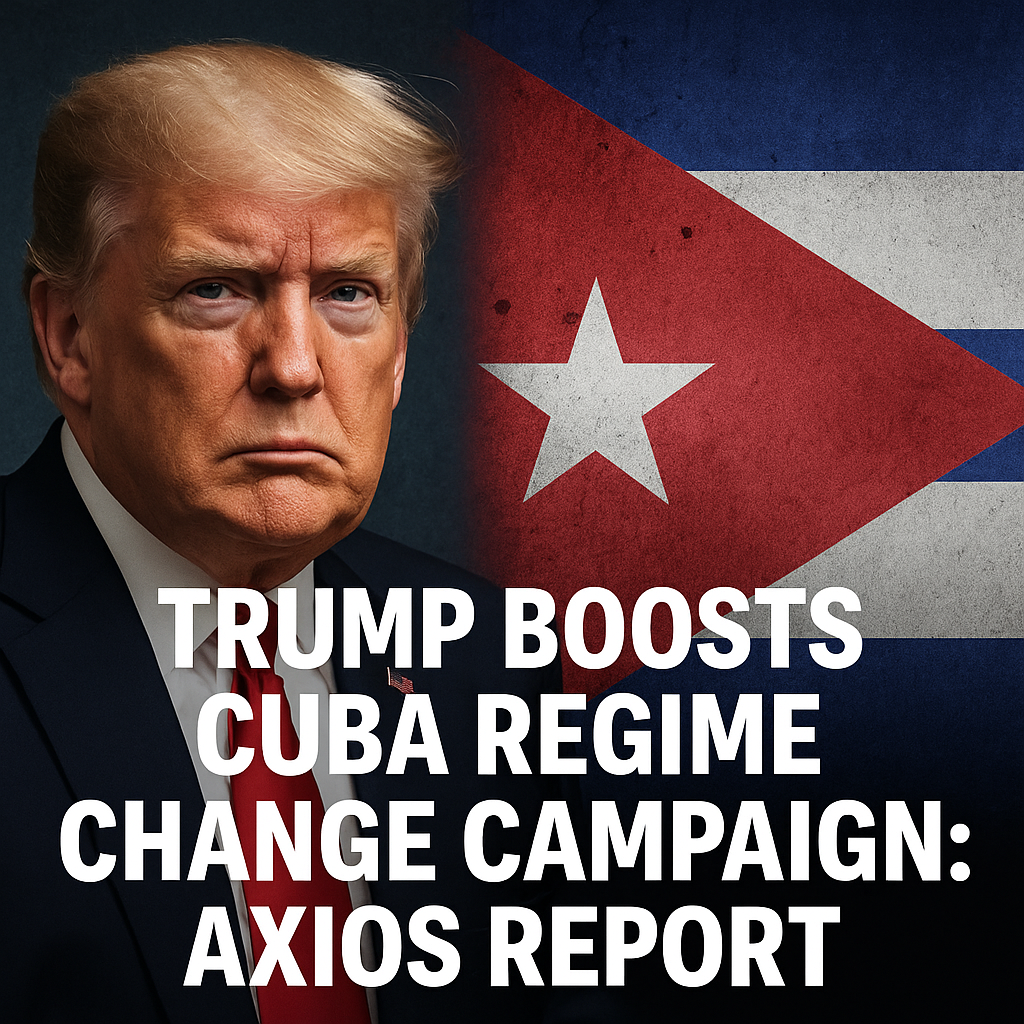
Trump Boosts Cuba Regime Change Campaign: Axios Report
Understanding Trump’s Cuba Regime Change Campaign
Former President Donald Trump has reinvigorated discussions surrounding a potential regime change in Cuba, an objective he interprets as key to supporting human rights and democracy on the island. Axios recently reported that Trump is looking to strengthen efforts against the current Cuban government, raising complex questions about the feasibility and implications of such a strategy.

Historical Context and Current Dynamics
The relationship between the United States and Cuba has been fraught with tension for decades, deeply rooted in the Cold War era. Following the Cuban Revolution in 1959, which brought Fidel Castro to power, the U.S. implemented a series of sanctions designed to destabilize the new regime. Although previous administrations, including Barack Obama’s, attempted to thaw relations with Cuba, Trump’s presidency marked a hardline approach that emphasized isolation over engagement.

Currently, the Cuban government faces significant internal challenges. Economic hardship has been exacerbated by the COVID-19 pandemic, leading to widespread discontent among the population. Recent protests in 2021 highlighted the Cuban people’s frustrations, with many calling for drastic reforms or governmental changes. Trump’s renewed focus on Cuba taps into this ongoing unrest, seeking to leverage domestic discontent to push for a regime change.

Diverging Perspectives: Support for and Opposition to Regime Change
While some advocate for Trump’s measures, viewing them as a necessary response to human rights violations, others argue that such an approach is misguided and unlikely to yield constructive outcomes.
Supporters of the Regime Change Approach:
1. Human Rights Advocacy: Proponents argue that the Cuban government represses its citizens, illustrating a pressing need for U.S. intervention to promote democracy.
2. Aid for Activists: Many believe that increased support and funding for dissident groups could empower those seeking change within Cuba, potentially destabilizing the current regime in a positive way.
Critics of the Regime Change Strategy:
1. Historical Failures: Critics emphasize that past U.S. efforts to overthrow foreign regimes often resulted in chaos rather than stability. The notion of exporting democracy through force tends to backfire, as seen in Iraq and Libya.
2. Potential Backlash: There is concern that external intervention could lead to heightened nationalism among Cubans, possibly uniting them against perceived U.S. aggression rather than opening avenues for reform.
Weighing the Evidence and Looking Ahead
The contrasting viewpoints highlight the complexities of U.S.-Cuba relations today. Trump’s advocacy for regime change could be seen as a political maneuver aimed at galvanizing his base, particularly among Cuban-Americans in Florida—a crucial demographic leading into upcoming elections. However, the effectiveness of such a campaign remains contentious.
Moreover, the potential real-world implications of a new U.S. policy toward Cuba cannot be overlooked. Increased aggression could destabilize the already fragile Cuban economy and lead to further humanitarian crises. The question remains: is the U.S. equipped to responsibly manage what could be a volatile outcome if regime change were to occur?
Conclusion: Navigating a Complex Landscape
Trump’s renewed focus on Cuba reflects a persistent tension between ideals of democracy promotion and the realities of foreign policy. As the U.S. debates its role in Cuba, it is essential to consider both the lessons of history and the evolving dynamics on the ground. Finding a balance between supporting human rights and avoiding destabilizing interventions is key to any future strategy.
Moving forward, the U.S. must engage with a multitude of voices—both domestically and within Cuba itself—to develop an approach that is informed, nuanced, and sensitive to the intricate tapestry of Cuban society and politics. Only then can meaningful progress be achieved, steering clear of the pitfalls that have marred past interventions.















