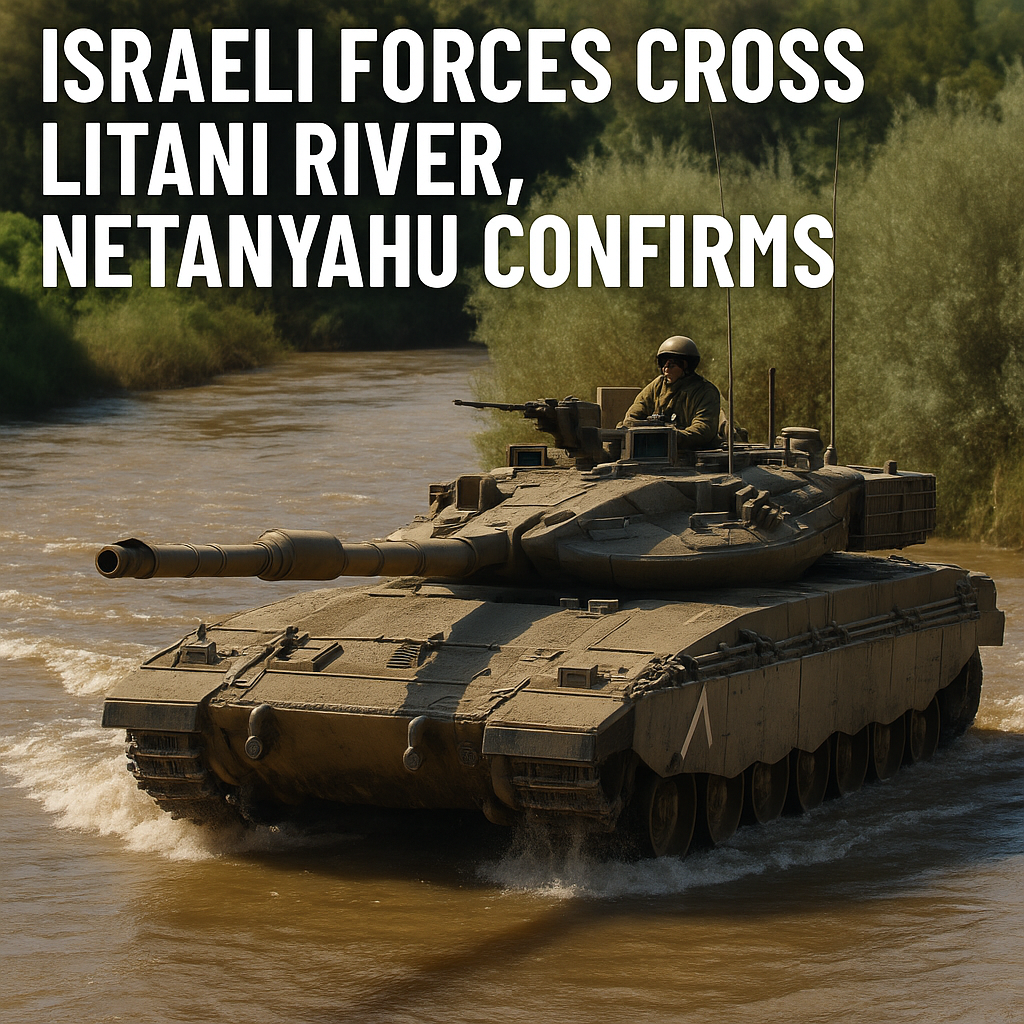
Israeli Forces Cross Litani River, Netanyahu Confirms
Israeli Forces Cross Litani River: A New Escalation
In a significant and contentious development in the Middle East, recent reports indicate that Israeli forces have crossed Lebanon’s Litani River, a move confirmed by Israeli Prime Minister Benjamin Netanyahu. This crossing has sparked widespread commentary and concern regarding the potential implications for regional stability and the ongoing Israel-Lebanon relationship.

Context of the Crossing
The Litani River has long served as a geographical and symbolic boundary in the Lebanon-Israel conflict. Historically, military operations in this area have raised fears of broader engagements between Israeli forces and Hezbollah, the powerful Lebanese militant group. Netanyahu’s assertion comes amidst escalating tensions between Israel and Hezbollah, especially following recent military exchanges that have reflected the fraught atmosphere in the region.

Analysts note that this latest development is not merely a tactical maneuver but appears to be part of a broader strategy by Israel to exert pressure on its northern neighbor. Urging international observers to take “necessary actions,” Netanyahu emphasized Israel’s commitment to its security, stating that “we have no choice but to act decisively.” This rhetoric suggests a pivot toward a more aggressive military posture that could invite escalatory dynamics.

Diverse Reactions and Implications
Reactions to this crossing have been notably polarized. On one hand, Israeli officials argue that the move is a necessary precaution against what they claim is a heightened threat from Hezbollah. They assert that control over the Litani region would help reinforce Israeli defenses and potentially dismantle Hezbollah’s military capabilities, which they view as a direct threat to Israeli sovereignty.
Conversely, Lebanese officials have condemned the incursion, viewing it as a provocative act that jeopardizes the fragile ceasefire that has largely held since the 2006 Lebanon War. The Lebanese state, alongside Hezbollah representatives, maintains that any Israeli military action will prompt a robust response. Sources indicate that Hezbollah’s leadership has signaled readiness to defend Lebanese territory, escalating fears of a broader conflict. This view is echoed by international observers, who warn that such military actions could destabilize the region further.
A Complex Web of Interests
The situation is further complicated by geopolitical dynamics. Both the United States and Iran, key players in the region, have vested interests in the unfolding events. The U.S. has been historically supportive of Israel, often providing military aid and backing its right to defend itself. Iran, meanwhile, is a staunch ally of Hezbollah and has expressed solidarity with Lebanon in this conflict. This rivalry escalates the risk of a proxy conflict, where actions in Lebanon are mirrored by reactions from external powers, adding layers of complexity to the already intricate situation.
News reports have highlighted that diplomatic channels remain open but strained. The U.N. has called for restraint, advocating for dialogue to prevent a military escalation. However, the prevailing sentiment among local populations is one of exhaustion and frustration, with many demanding an end to cycles of violence that regularly disrupt their lives.
The Path Ahead
As Israeli forces establish a foothold beyond the Litani River, a host of questions loom about the future of peace in the region. Analysts are divided on whether this action will lead to renewed military engagements or whether it will serve as a negotiating leverage point for Israel in future peace talks. The passage of time will likely reveal more about the strategic calculus behind this maneuver.
In conclusion, the crossing of the Litani River by Israeli forces underscores the fragility of peace in the region. With multiple layers of historical grievances, international influence, and impending military considerations, the situation remains fluid and precarious. Moving forward, the critical challenge for all stakeholders will be to navigate this landscape with diplomacy and caution, lest they fall into a cycle of violence that has long plagued the region.