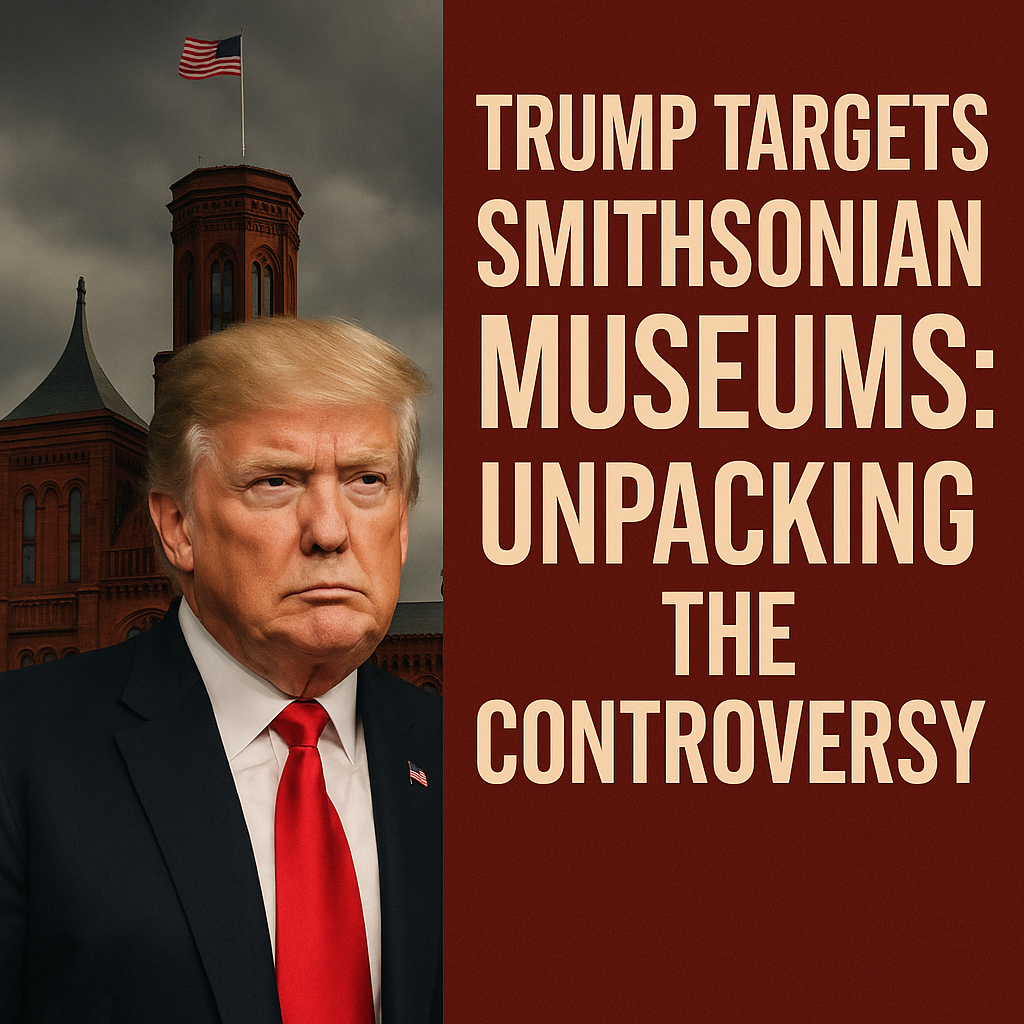
Trump Targets Smithsonian Museums: Unpacking the Controversy
Trump Targets Smithsonian Museums: Unpacking the Controversy
The recent criticisms from Donald Trump regarding Smithsonian museums have stirred a complex debate about culture, history, and the role of such institutions in contemporary society. As the former president aims his ire at these treasured establishments, the ramifications extend beyond mere politics and touch on fundamental questions of representation, education, and national identity.

Historical Context and Recent Critiques
Trump’s targeting of Smithsonian museums stems from a perception that they harbor a liberal bias and fail to adequately represent certain historical narratives. According to a report from Al Jazeera, he argues that the exhibits do not fully capture the contributions of all Americans, particularly those aligned with conservative values. His statements suggest a broader criticism of the way history is narrated, emphasizing a need for more balanced representations.

However, this viewpoint faces considerable pushback. Critics assert that Trump’s descriptions overlook the detailed, nuanced work undertaken by these institutions. For example, the Smithsonian serves an educational purpose, aiming to reflect the diversity of American history. Many fear that these recent criticisms may pose a threat to historical accuracy and integrity. This divide reveals how cultural institutions like the Smithsonian become battlegrounds for ideological contests, with each faction vying for control over narrative.

The Role of the Smithsonian in Cultural Preservation
The Smithsonian Institution comprises multiple museums and research facilities, dedicated to collecting, preserving, and interpreting significant artifacts and artworks. Its mission is categorically educational; aimed at broadening understanding of diversity in American and world histories. Various museums under its umbrella, like the National Museum of African American History and Culture, specifically address historical narratives often marginalized in mainstream dialogue. As a result, many argue that Trump’s assertions do a disservice to the complexities these institutions explore.
Supporters of Trump’s critique may argue that many cultural elites prioritize narratives that fuel contemporary political agendas over balanced historical representation. Some commentators argue that institutions funded by taxpayer money should reflect a wider array of perspectives, essentially calling for what they see as a more inclusive approach to national narratives. This challenge to the Smithsonian’s authority raises questions about who gets to tell history and whose perspectives are deemed valid.
The Public Response and Implications
Public response to Trump’s comments showcases a divided populace. Supporters laud him for challenging perceived biases and advocating for “American values,” while opponents view it as an irresponsible attack on important cultural institutions. According to data from Sky News, discussions on social media platforms reveal a stark contrast in sentiments; many users echo Trump’s sentiments, while others vehemently defend the need for ongoing historical discourse that incorporates all voices.
Despite the polarized debates surrounding these issues, it’s essential to consider whether these conversations lead to constructive outcomes. Some advocates for a more balanced perspective argue for inclusive exhibits that not only honor diverse contributions but also acknowledge the complicated and painful aspects of history.
Navigating the Discourse
Navigating this complex web of opinions requires understanding that debates over historical representation are often tinged with emotion. Some Americans see the potential for Trump’s criticisms to lead to a more comprehensive portrayal of history. Others caution that if such critiques lead to the erasure or simplification of complex narratives, society may lose invaluable lessons from the past.
The contrasting perspectives prompt an important question: Is it possible to create a narrative that honors a multitude of viewpoints without compromising the integrity of historical scholarship? The debate is ongoing, and Trump’s recent focus on such cultural institutions exemplifies the broader stakes involved in any discussion of representation.
In conclusion, the controversy surrounding Trump’s criticisms of Smithsonian museums reflects deeper societal tensions regarding history and identity in America. As these conversations evolve, they lay bare the complexities of narrative formation and the importance of historical accuracy. Participation in these dialogues must be informed and thoughtful, challenging the notion of orthodoxies while respecting the foundational values of education, diversity, and historical integrity.