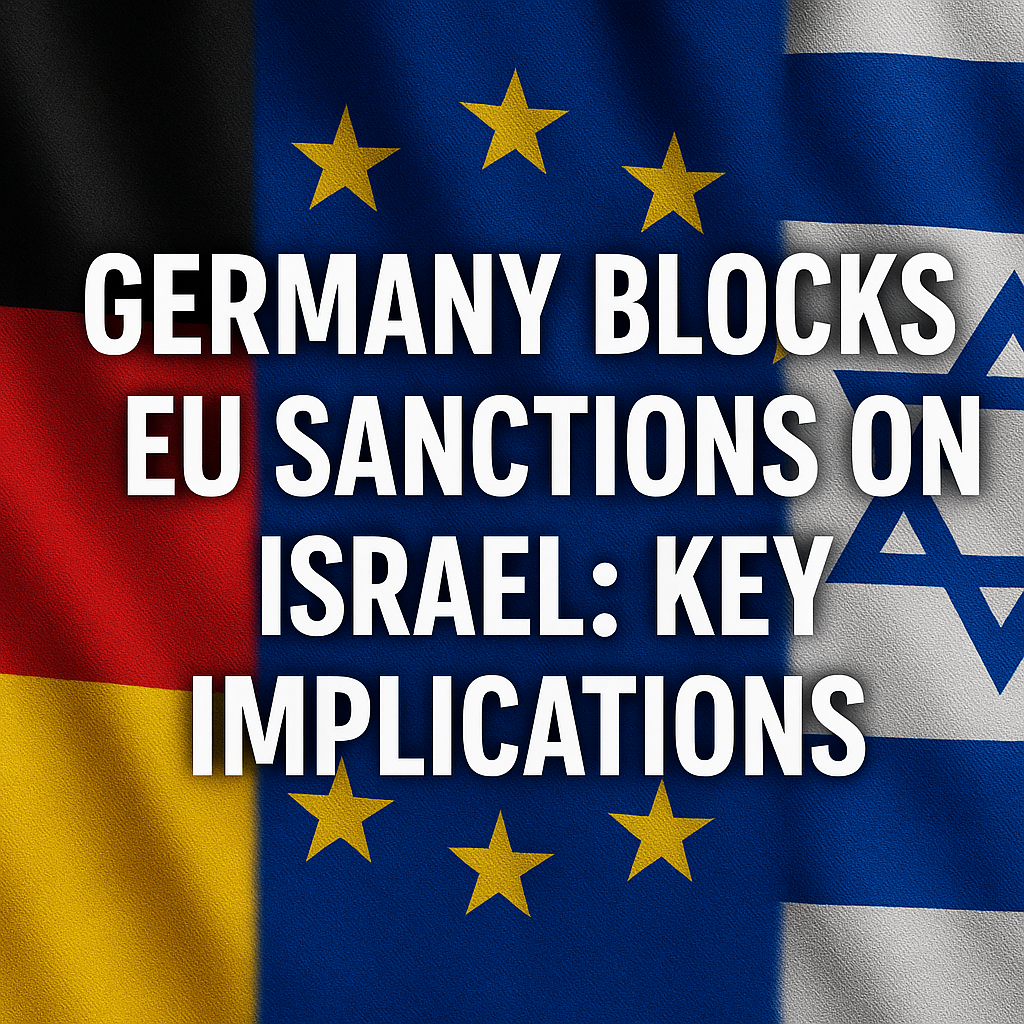
Germany Blocks EU Sanctions on Israel: Key Implications
Germany Blocks EU Sanctions on Israel: Key Implications
In a significant political development, Germany has recently taken a stance to block EU sanctions aimed at Israel. This decision carries profound implications for European diplomacy, international relations, and the long-standing Israeli-Palestinian conflict.

The Context of Germany’s Decision
The action by Germany comes amidst a complex backdrop of ongoing tensions in the Middle East. The sanctions in question were proposed in response to Israel’s expansion of settlements in the West Bank, which many in the international community view as a violation of international law.

Diverse Perspectives on the Issue
Germany’s decision has sparked a flurry of reactions across different quarters. Proponents of the sanctions argue that they are a necessary measure to hold Israel accountable for its actions, which they claim undermine the possibility of a viable two-state solution. They maintain that European intervention is crucial in pushing forward peace negotiations and ensuring that international laws are respected.

Conversely, supporters of Germany’s position underscore the country’s historical relationship with Israel. They argue that Germany has a unique responsibility stemming from its past, which may compel it to act in ways that promote stability rather than confrontation. As noted in an article from RT, Germany’s Foreign Minister Annalena Baerbock emphasized maintaining open channels of dialogue with Israel, framing the move as a way to foster peace rather than alienate a key ally.
Key Implications of Germany’s Move
Impact on European Unity
One of the immediate implications of Germany’s decision is the potential strain it places on European unity regarding foreign policy. The EU has historically aimed for a cohesive response to international conflicts, and Germany’s action could sow discord among EU member states.
– Internal Divisions: Some EU nations have been more vocal in their criticisms of Israeli policies, particularly concerning settlement expansions. Germany’s unilateral stance may prompt discussions about a reassessment of EU foreign policy towards Israel.
– Potential Backlash: Member states that advocate for a stronger stance on Israel may perceive Germany’s actions as undermining their efforts, leading to an increased polarization on the issue within the EU.
Broader Diplomatic Consequences
Germany’s decision may also resonate far beyond European borders, affecting Israel’s relationships with other nations and international organizations.
– International Relations: Countries like the United States, which often support Israel’s right to self-defense while acknowledging the need for peace, may view this as an opportunity to recalibrate their diplomatic strategies in the Middle East. The U.S. has long been a mediator in Israeli-Palestinian relations, and they may need to reconsider an approach that balances Israel’s interests with those of Palestinian aspirations.
– Increased Tensions: On the ground, the Palestinian response could escalate tensions. If they perceive the EU’s actions as ambiguous or unsupportive, there could be greater unrest. Leaders in the Palestinian Authority have often called for stronger international intervention to end Israeli settlements, and Germany’s decision alters the landscape of potential support they could have depended on from the EU.
Navigating Future Challenges
As this situation evolves, it will be crucial for Europe and the global community to consider the broader ramifications of Germany’s decision. The Israeli-Palestinian conflict is deeply intertwined with historical grievances, national identities, and geopolitical interests.
The Role of Diplomacy
Fostering dialogue and finding common ground will be essential going forward. There may need to be a renewed commitment to peace negotiations, with Germany possibly taking a mediator role rather than a confrontational one.
– Instilling Confidence: Germany’s approach may involve encouraging both sides to return to the negotiation table, promoting dialogue that aims to address core issues rather than amplifying divisions.
– Exploring New Avenues: In light of blocked sanctions, alternative measures could be explored to apply pressure for peace while upholding relationships. This could include increasing economic ties that promote cooperation or developing joint projects aimed at shared community benefits.
Conclusion
Germany’s decision to block EU sanctions against Israel raises critical questions about international diplomacy and the effectiveness of sanctions as a tool for peace. By balancing past obligations to Israel with the ideals of European unity and peace, Germany finds itself at a crossroads. The unfolding events will likely demand a nuanced, careful approach that balances competing interests while striving for a sustainable resolution to one of the world’s most enduring conflicts.
As the situation develops, the international community, particularly within Europe, must navigate these choppy waters with foresight, hoping to foster a climate conducive to lasting peace.