
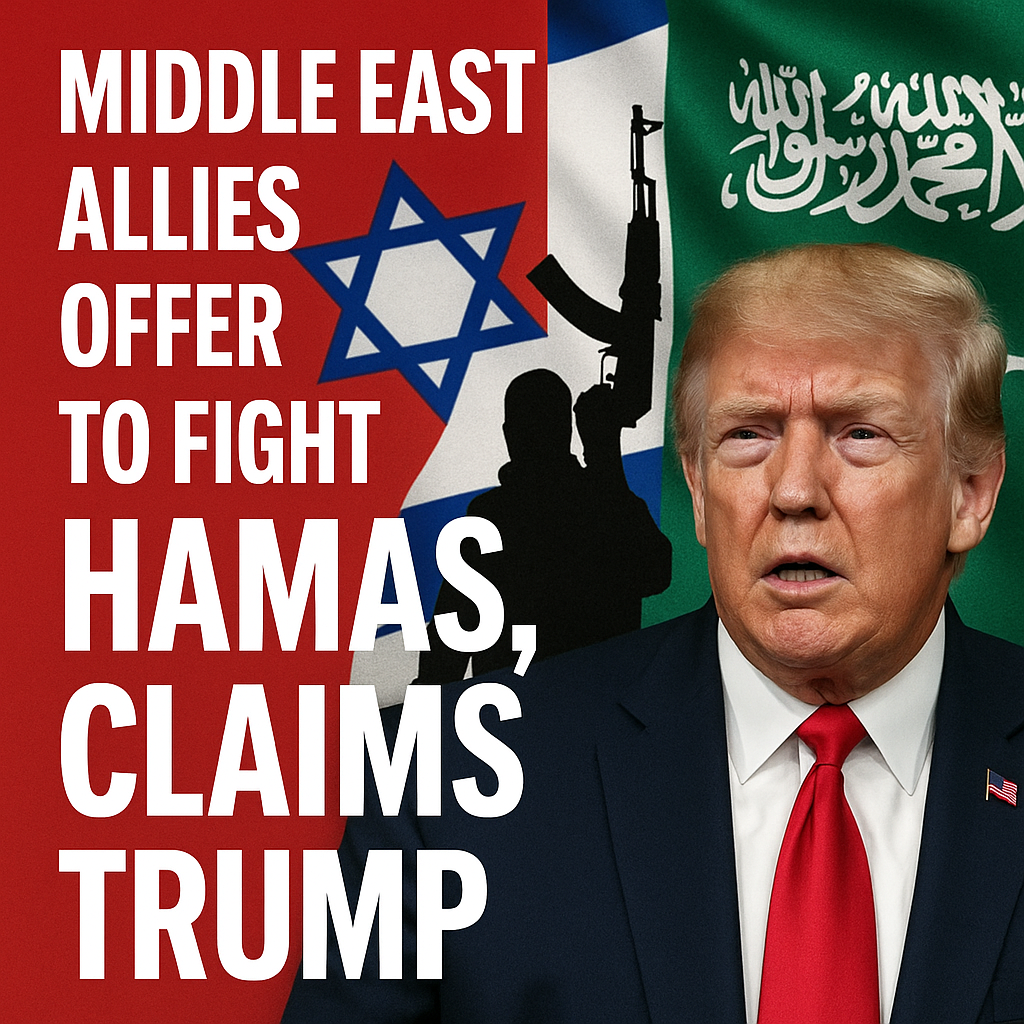
Middle East Allies Offer to Fight Hamas, Claims Trump
Middle East Allies Offer to Fight Hamas, Claims Trump
In recent statements, former President Donald Trump has claimed that certain countries in the Middle East have expressed a willingness to join the fight against Hamas in Gaza. This assertion comes amid heightened tensions in the region and raises questions about the geopolitical alliances at play, the motivations behind these offers, and the complex dynamics that involve both military and diplomatic considerations.

The Geopolitical Landscape
The prospect of Middle Eastern allies engaging in military action against Hamas is not just about the conflict in Gaza; it’s part of a broader tapestry of alliances and rivalries that have defined the region for decades. Trump’s comments have sparked a range of interpretations and responses.

For instance, analysts suggest that Trump’s assertions could be rooted in the evolving partnerships between Israel and some Arab states, particularly those that have signed normalization agreements following the Abraham Accords. Countries like Saudi Arabia and the United Arab Emirates (UAE) have shown an interest in balancing power in the region, often viewing Iran’s influence—and, by extension, groups like Hamas—as significant threats.

However, it is essential to clarify that these “offers” to fight Hamas, as posited by Trump, lack substantial evidence in the form of official announcements from these nations. Reports from Al Jazeera emphasize this ambiguity, noting that while countries may express rhetorical support for combating terrorism, actual military involvement typically involves multiple layers of negotiation, strategy, and, crucially, domestic considerations.
Divergent Perspectives on Military Involvement
Opinion within international relations circles is mixed when it comes to the potential for Arab nations to militarily engage with Hamas. Some experts argue that direct confrontation could further escalate hostilities, while others point out that a more unified front against Hamas might deter future aggressions and lead to a more stable region.
– Support for Engagement: Proponents of military action contend that fighting Hamas could affirm the resolve of moderate Arab states to confront terrorism openly. This view is particularly essential in the context of public sentiment within those countries, where citizens might favor stable governance over radicalized factions.
– Concerns Over Escalation: Conversely, critics warn that military action could lead to a cycle of retaliation. As noted by Sky News, some analysts argue that military solutions often fail to address the underlying issues driving the conflict, including humanitarian crises and economic despair in Gaza, which could potentially breed further extremism.
The Humanitarian and Diplomatic Dimensions
As these nations consider their options, the humanitarian implications of military intervention cannot be overlooked. The Gaza Strip has faced significant challenges, including a dire humanitarian situation exacerbated by ongoing blockades and conflicts. Reports indicate that more than half of Gaza’s population relies on international aid to survive, highlighting the necessity of a diplomatic approach alongside any military considerations.
Diplomatically, the challenges are immense. The United States, an ally of both Israel and several Arab states, has traditionally played a mediating role in the Israeli-Palestinian conflict. However, recent developments—such as fluctuating U.S. foreign policy under different administrations—have complicated these relationships.
Moreover, the complexity of regional politics means that any offer to engage militarily against Hamas could be met with resistance from various factions within the territories. As RT reports, the internal Palestinian divides, primarily between Hamas and the Palestinian Authority, complicate the landscape further. Any military action must be cognizant of these dynamics, as miscalculations could exacerbate the already fragmented Palestinian governance structure.
Uncertainties in the Path Forward
While Trump’s claims may reflect emerging realities in Middle Eastern diplomacy, the lack of clarity regarding the specifics of any military cooperation illustrates the unpredictability of the region. The absence of explicit commitments from involved countries also raises questions about the underlying motivations—whether they are strategic, political, or driven by domestic pressures.
– No Unified Stance: The absence of a clear, unified stance among Arab nations regarding direct intervention against Hamas indicates significant uncertainties. Countries are likely balancing their relationships with the West, domestic public opinion, and their potential responses to Israeli actions.
– Acknowledgment of Uncertainties: Given the volatile nature of Middle Eastern politics, analysts maintain that discussions around military cooperation should be approached with caution. The possibility that such alliances might not materialize as proposed cannot be overlooked.
In conclusion, while Trump’s assertion that Middle East allies are ready to combat Hamas may resonate with certain narratives of regional normalization, it is crucial to approach the idea with a balanced perspective. The complexities of military and humanitarian realities, domestic politics, and longstanding regional tensions demand a nuanced understanding that acknowledges both the potential for unity and the risks of escalation. As the situation evolves, the focus should remain on seeking solutions that prioritize stability, peace, and humanitarian considerations for the people of Gaza and the broader region.















