
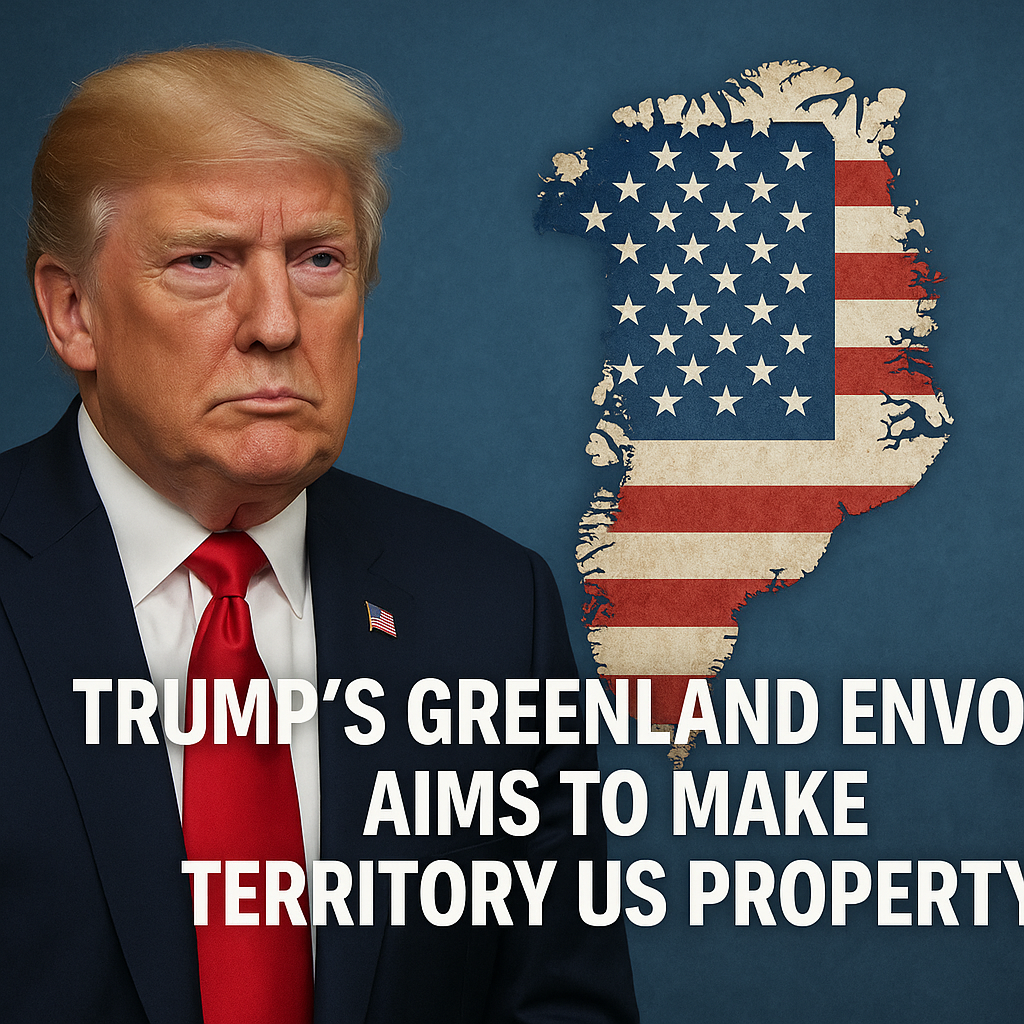
Trump’s Greenland Envoy Aims to Make Territory US Property
Trump’s Greenland Envoy Aims to Make Territory US Property
The recent appointment of an envoy to Greenland by former President Trump reignites a complex discussion surrounding American interests in the territory. Greenland, the world’s largest island, has long been seen as a strategic asset due to its vast natural resources and geographic location between North America and Europe. The intent to make this territory a part of the U.S. has elicited a range of opinions, touching on nationalism, geopolitics, and the broader implications for Greenlandic sovereignty.

The Historical Context of Greenland and U.S. Relations
Historically, Greenland has served as a focal point for international interest, particularly during the Cold War era, when the U.S. established military bases there. The strategic location of Greenland has not diminished over the decades, especially given rising tensions between global powers like the U.S., China, and Russia.

In 2019, Trump’s infamous proposal to buy Greenland from Denmark was met with a mix of disbelief and ridicule. However, the notion was rooted in a serious appreciation for the island’s resources, including rare earth minerals and the potential for military bases that would enhance U.S. standing in the Arctic region. The recent appointment of an envoy suggests that the administration is not only revisiting this idea but is intent on laying the groundwork for further exploration of territorial acquisition.

Diverging Viewpoints: Support and Skepticism
The appointment of an envoy has sparked varied reactions in political and public forums. On one side, supporters argue that integrating Greenland into the U.S. could provide economic benefits to both regions. Proponents believe this move could create jobs and utilize Greenland’s natural resources more effectively under American stewardship. The sentiment resonates with a nationalism that champions American expansionism as a vehicle for prosperity.
However, this perspective is met with skepticism. Critics highlight the ethical ramifications of such an endeavor, particularly regarding Greenland’s autonomy. Greenland is an autonomous territory of Denmark, and any push toward annexation could set a concerning precedent for land acquisition in the wake of colonial histories. Moreover, there are worries about the cultural and political ramifications for Greenland’s indigenous population, whose voices may be marginalized in the process of an annexation effort.
Geopolitical Implications of U.S. Interest in Greenland
The geopolitical stakes in Greenland extend beyond mere territorial ambition. With the Arctic becoming a focal point due to climate change, melting ice caps are opening new shipping routes and unlocking untapped energy resources. The U.S., alongside countries like China and Russia, has recognized the potential for economic exploitation in the region. This competitive race for resources is likely to further complicate international relations.
The U.S. position is further stressed by recent statements from Danish officials, who have reaffirmed their commitment to maintaining Greenland’s autonomy while collaborating with the U.S. on mutual interests such as climate issues and economic development.
Simultaneously, the Russian Federation has been assertively positioning itself in the Arctic, conducting military drills and making claims that further underline the urgency of U.S. action. Seeking closer ties with Greenland may be perceived as a necessary strategic maneuver to counterbalance Russian influence in the region.
Assessing the Path Forward
While the appointment of an envoy may signal a renewed interest in Greenland, the practicalities of territorial acquisition remain murky. Questions arise about how a potential annexation could be structured — legally, politically, and economically. Would it involve buying the island outright, or would negotiations with Denmark and Greenland be required in order to establish a new power dynamic?
Moreover, the Biden administration is expected to navigate this issue with different priorities. The focus may shift toward fostering cooperative international relations rather than unilateral territorial ambitions, reflecting recent trends in U.S. foreign policy focused on building alliances rather than expansionism.
In conclusion, Trump’s Greenland envoy initiative highlights a multifaceted issue steeped in history, ethics, and geopolitical strategy. While proponents view annexation as a plausible route to economic stability and global competitiveness, critics warn of the potential usurpation of indigenous rights and sovereignty concerns. The road ahead will likely involve nuanced negotiations that consider not only strategic interests but also the voices of the Greenlandic people themselves, ensuring that any move is respectful of their history and autonomy.
As the international community watches these developments closely, an understanding of the complex interplay of interests will be crucial in shaping the future of U.S.-Greenland relations and, by extension, Arctic geopolitics as a whole.















