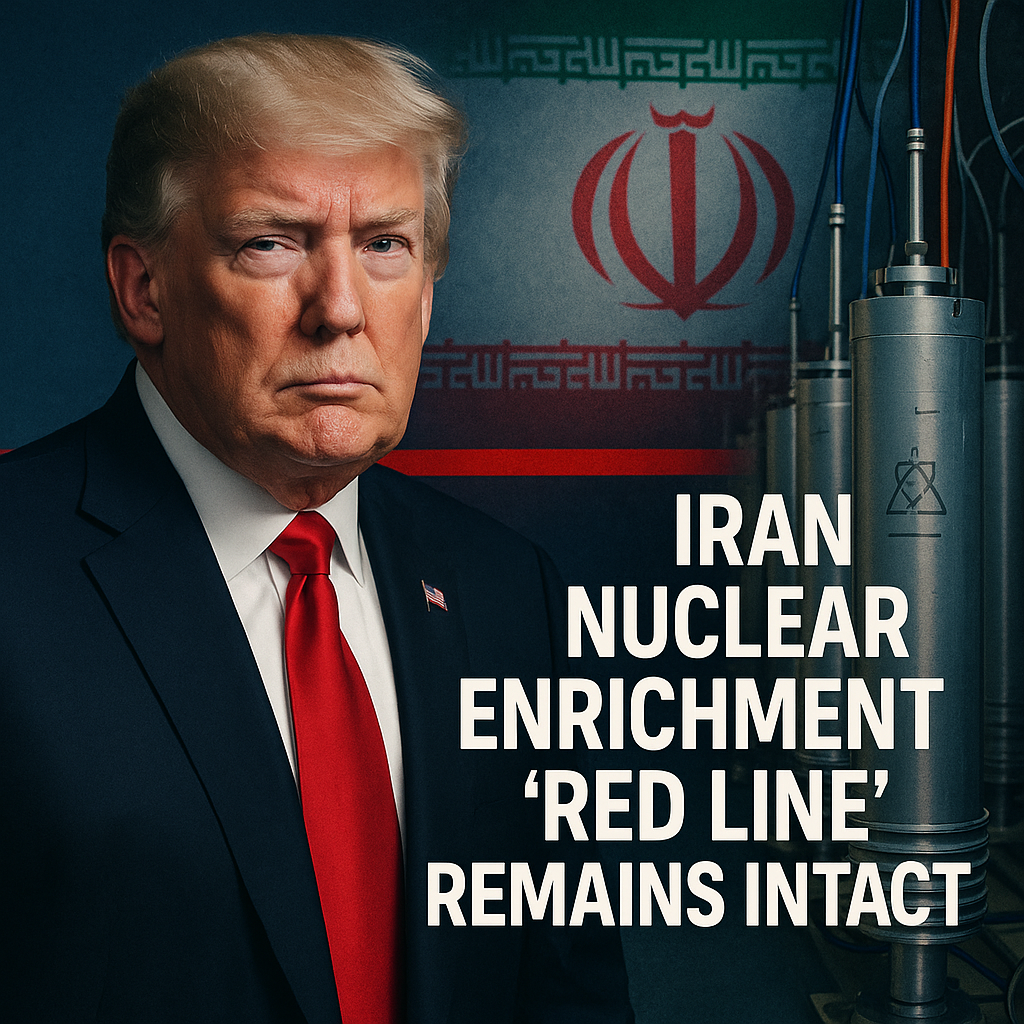
Trump’s Iran Nuclear Enrichment ‘Red Line’ Remains Intact
Trump’s Iran Nuclear Enrichment ‘Red Line’ Remains Intact
The complexities surrounding global nuclear politics often pivot around carefully drawn lines of red, none more pronounced than those established by former President Donald Trump concerning Iran’s nuclear capabilities. Following recent discussions, it appears that Trump’s “red line” against Iranian nuclear enrichment remains firmly in place, reverberating through both political and diplomatic channels.

Context of the Red Line
In 2018, Trump made headlines by withdrawing the United States from the Joint Comprehensive Plan of Action (JCPOA), commonly known as the Iran nuclear deal. This agreement was aimed at limiting Iran’s nuclear enrichment activities in exchange for the lifting of economic sanctions. Trump’s exit from the accord was steeped in claims that Iran was violating the spirit of the agreement and pursuing nuclear capabilities with malign intent. Obama-era proponents of the deal argued that it was a key framework for preventing a nuclear Iran, offering a stabilizing effect on both regional and global security.

In the aftermath of this withdrawal, the U.S. reinstated heavy sanctions on Iran, exacerbating tensions. Fast forward to 2023, the White House has reiterated that the core “red line” — a threshold beyond which U.S. patience descends into serious consequence — remains active. As indicated in a recent Al Jazeera report, officials from the current administration emphasize that significant nuclear enrichment activities by Iran would prompt a strong response, reflecting Trump’s longstanding position on non-proliferation.

Diverging Stances on Iran’s Nuclear Capabilities
The views on how to tackle Iran’s nuclear ambitions diverge considerably among political spheres. On one hand, proponents of diplomatic engagement assert that negotiation is the only viable route to defuse the situation. Expert commentators emphasize that maintaining open channels of communication is essential, particularly as Iran continues to enrich uranium at levels exceeding those permitted by the JCPOA. They advocate for a return to the negotiation table to mitigate the perceived threats posed by Iran’s nuclear program.
On the other hand, hardline critics within the U.S. political landscape maintain that the red line must be strictly enforced. A recent report by Sky News highlighted remarks from several Republican leaders who argue that any further enrichment by Iran would justify military intervention. This viewpoint aligns closely with Trump’s original stance and fears that failing to act decisively may embolden Iran’s assertiveness in the region.
The Stakes Involved
The ramifications of Iran’s nuclear enrichment are profound and multi-dimensional. Iran asserts its right to enrich uranium for peaceful purposes, a claim contested by countries like the U.S., Israel, and Saudi Arabia, who suggest that such activities are a cover for developing nuclear weapons capabilities. The situation is further complicated by Iran’s regional actions, including its influence across various Middle Eastern conflicts.
Public opinion varies as well, with some U.S. citizens favoring a renewed diplomatic approach and others supporting a show of military strength. Moreover, many analysts note that any escalation could lead to wider regional instability, potential military confrontations, and global economic repercussions reflected in oil markets.
Conclusion: The Path Forward
In conclusion, Trump’s red line on Iran’s nuclear enrichment remains an intricate component of U.S. foreign policy, underscored by the contrasting views from policymakers and analysts. While the bipartisan support for a tougher stance exists, the efficacy of such an approach in achieving lasting peace remains in debate. Both progress and setbacks continue to characterize the discussions surrounding Iran, emphasizing the need for a balanced and measured approach.
It is evident that straddling the fine line between deterrence and diplomacy requires nuanced understanding and flexibility. As the situation evolves, it will demand attention not just from political leaders but also from the international community at large, all while remaining mindful of the precarious balance of power in the Middle East. The situation is fluid, acknowledging that there may be no one-size-fits-all solution while striving for global security.