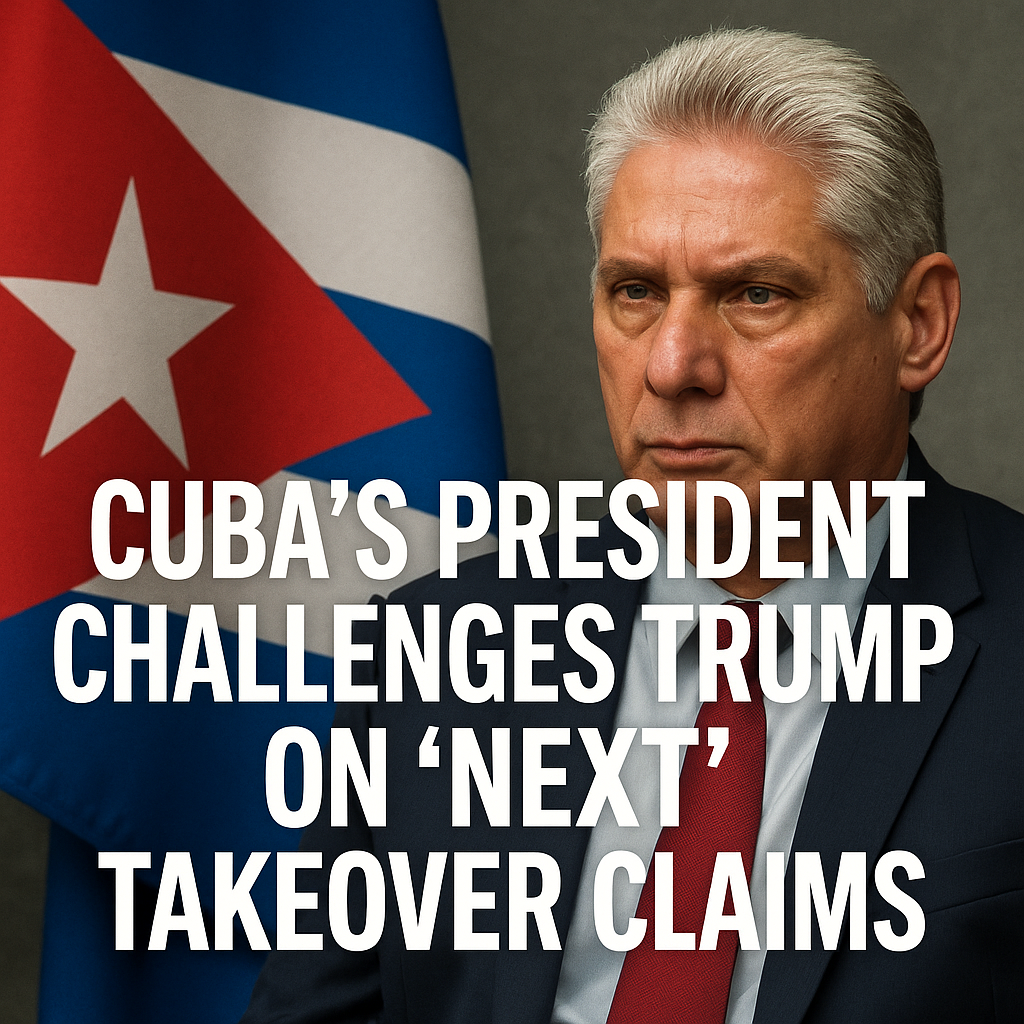
Cuba’s President Challenges Trump on ‘Next’ Takeover Claims
Cuba’s President Challenges Trump on ‘Next’ Takeover Claims
Cuba’s president has responded to Donald Trump’s provocative assertion that the island nation is “next” for a takeover, igniting a spectrum of opinions regarding U.S.-Cuba relations. This dialogue touches on historical grievances, sovereignty issues, and emerging geopolitical dynamics.

Understanding the Context
In a recent statement, Donald Trump suggested that Cuba could be on the cusp of a U.S. takeover if his opponents win the presidency. This remark has not only raised eyebrows but also sparked a robust response from Cuban President Miguel Díaz-Canel. He rejected Trump’s assertions, framing them as yet another attempt to assert U.S. imperialism in Latin America.

Historically, Cuba’s relationship with the U.S. has been fraught with tension—a legacy of decades of embargoes and political maneuvering. Under Trump, the rhetoric regarding Cuba has grown increasingly aggressive, reflecting a broader stance favoring hardline measures against regimes perceived as antagonistic to American interests.

The Cuban Response
Díaz-Canel’s reaction is emblematic of his government’s approach to American rhetoric. He emphasized that Cuba is a sovereign nation and that any threats or claims from the U.S. will be met with a steadfast commitment to independence. In his public address, he stated, “Cuba will never be a conquered country; we will defend our sovereignty at all costs.”
This response highlights a deep-rooted sentiment in Cuba—a historical narrative that has long framed U.S. interventions as acts of colonial encroachment. Analyzing this perspective sheds light on the complexities of Cuban nationalism and the broader implications of U.S. foreign policy in the region.
At the same time, Cuban media have pointed out that although Trump’s comments may resonate with certain factions in the U.S., they do little to foster constructive dialogue between the two nations. For many Cubans, the notion of a “takeover” invokes not only fears of military intervention but also conflicts reminiscent of the Bay of Pigs invasion and decades of sanctions that have crippled the island’s economy.
Diverse Reactions from Analysts
Reactions to Trump’s statements are polarized, with some U.S.-based analysts echoing the Cuban president’s sentiments, while others adopt a more critical viewpoint.
1. Pro-Trump Perspective: Supporters argue that Trump’s comments reflect a necessary toughness in foreign policy, especially against regimes that they view as hostile. They suggest that viewing Cuba as a potential U.S. territory is not entirely outlandish given the island’s complex political history and geographical proximity to the U.S. This viewpoint is often rooted in a belief that strategic interests in the Caribbean could bolster U.S. security.
2. Critics of Intervention: Conversely, critics of Trump’s rhetoric assert that such claims only serve to escalate tensions and hinder potential diplomatic solutions. They cite examples from history showing how military interventions often lead to prolonged conflicts rather than stability. This school of thought promotes engagement over aggression, advocating for normalized relations that could benefit both countries economically and politically.
The Uncertainties Going Forward
The future of U.S.-Cuba relations remains highly uncertain, given the geopolitical shifts in Latin America and the evolving political landscape in the United States. While some analysts predict potential avenues for dialogue, others caution that hardline stances may prevail given the current climate of polarization.
Moreover, there’s a growing worry among Cuban citizens and policymakers alike about the ramifications of U.S. foreign policy choices not just for Cuba, but for the broader region. The question remains: Can dialogue and understanding prevail over the instinct for domination, or will historical patterns continue to dictate relationships?
As both nations grapple with their pasts and the present climate, the dialogue surrounding Cuba’s sovereignty will likely remain a contentious issue that transcends individual administrations. Díaz-Canel’s strong rebuttal serves as a reminder of the sensitive nature of this relationship, one that continues to evolve and provoke discussion on a global scale.
In conclusion, the dynamic between Cuba and the United States is complex, colored by rich historical narratives and present-day geopolitical interests. As discussions unfold, it is crucial for both nations to approach one another with a readiness to understand, rather than dominate.