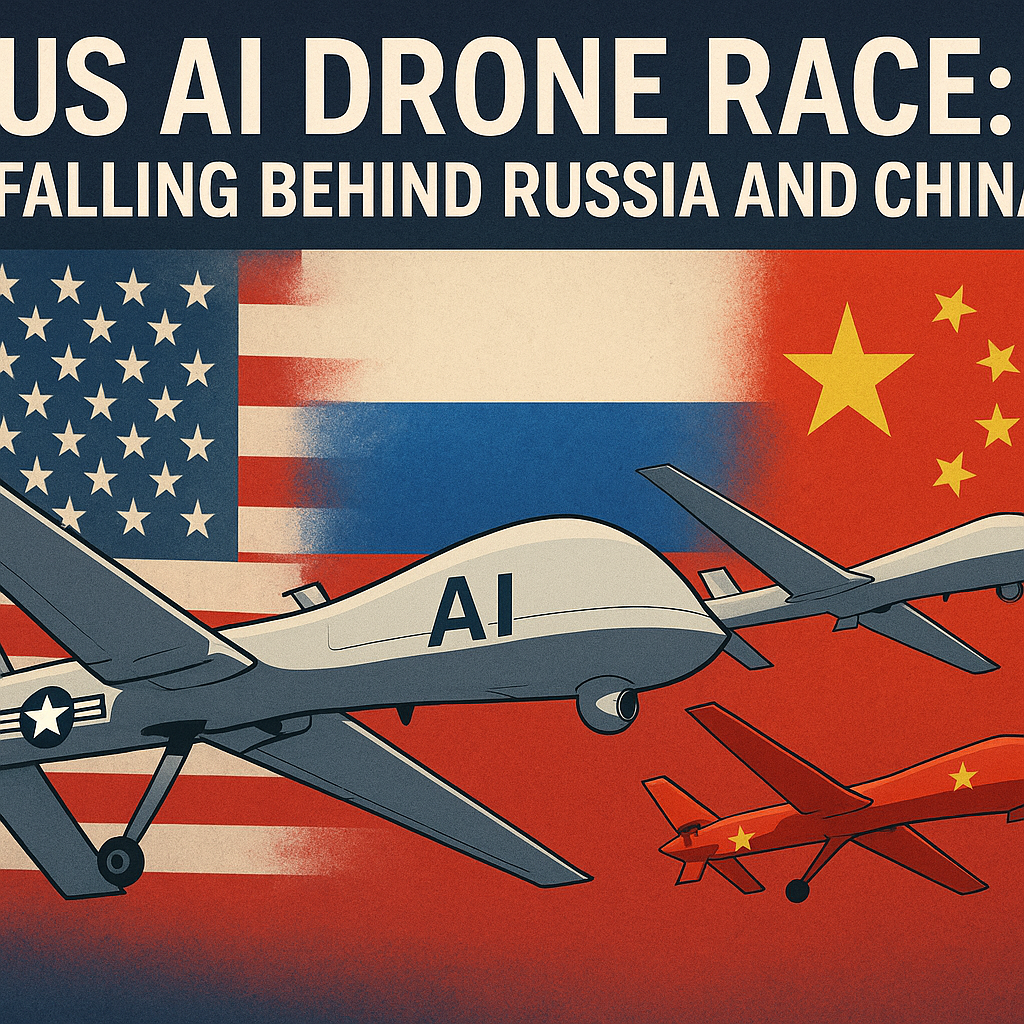
US AI Drone Race: Falling Behind Russia and China
The U.S. AI Drone Race: Falling Behind Russia and China
As the landscape of military technology rapidly evolves, the U.S. finds itself in a precarious position in the AI drone race, increasingly viewed through the lens of its competition with Russia and China. Recent analyses indicate that both nations are making significant strides in artificial intelligence-powered drone technology, prompting concerns regarding U.S. military readiness and technological leadership.

A Shifting Paradigm in Military Tech
The urgency surrounding advancements in AI drone technology is underscored by the growing dependence on unmanned aerial systems in modern warfare. Reports from RT News and various other sources highlight how both Russia and China are accelerating their efforts in this domain. For instance, in recent military exercises, Russia has showcased the deployment of drones that can autonomously identify and engage targets. This contrasts sharply with the current capabilities of U.S. drones, which still require more human intervention for operational effectiveness.

According to a recent piece from Al Jazeera, China’s investment in AI for drone technology is producing systems that are not only advanced but also capable of complex decision-making on the battlefield. The ability to process vast amounts of data in real-time allows these drones to execute missions with greater efficiency and reduced human error. On the other hand, the U.S. has been criticized for being overly reliant on traditional methodologies and bureaucratic processes that slow down innovation.

Comparative Analysis of Military Strategies
When comparing military strategies between the U.S., Russia, and China, it’s clear that both adversaries are leveraging AI as a cornerstone of their defense strategies. China has integrated these technologies into its broader military modernization efforts, emphasizing rapid development and deployment cycles. This stands in stark contrast to the U.S., which appears to be stuck in a regulatory quagmire that often slows progression.
For instance, a report highlighted by RT News suggests that while the Pentagon has initiated various AI projects, the scale and speed of these initiatives do not match those of its adversaries. In stark terms, certain experts argue that the U.S. is not merely lagging but may be falling behind as these competitors embrace a more aggressive approach to integrating drone technology into their military operations.
Moreover, the complexity of AI in combat scenarios raises questions around ethics, accountability, and potential unintended consequences. The absence of a solid regulatory framework in the U.S. for the use of AI in military applications contrasts with the seemingly unabashed approaches taken by China and Russia, raising ethical questions about how these technologies will be used in decision-making processes.
Implications of AI Superiority
The ramifications of losing the AI drone race extend beyond battlefield tactics. As noted in articles from both Sky News and Al Jazeera, dominance in AI drone technology can impact geopolitical dynamics, military spending, and international relations. If Russia or China can establish superiority in this arena, they may exert greater influence over global military strategies and alliances.
Additionally, the U.S. may face escalating pressures to reassess its defense budget allocations and research priorities. A failure to innovate may compel the U.S. to reconsider its reliance on conventional warfare strategies and invest more in R&D for emerging technologies. However, this could also spark an arms race that places ethical AI development at risk.
The Road Ahead: Challenges and Opportunities
While the challenges facing the U.S. in the AI drone race are significant, they also present opportunities for innovation and reflection. Experts suggest that a multi-faceted approach is necessary—one that encourages both public and private sectors to collaborate on technological advancements. This could involve streamlined regulatory frameworks that foster innovation while ensuring ethical standards are upheld.
The defense sector might also benefit from a cultural shift, moving away from a traditional risk-averse mindset. Embracing ‘fail-fast’ methodologies, as tech companies do, could accelerate the development of AI systems, allowing for quicker iteration and refinement based on battlefield feedback.
In summary, the U.S. stands at a crossroads in the evolving AI drone race. The challenges posed by growing capabilities from Russia and China demand urgent responses that blend technology with ethical considerations. As the U.S. reassesses its position, fostering innovation and collaboration may not just bridge the gap but redefine what is possible in the realm of AI applications for defense. Balancing speed with responsibility will be vital for maintaining national security in this new era of warfare.