
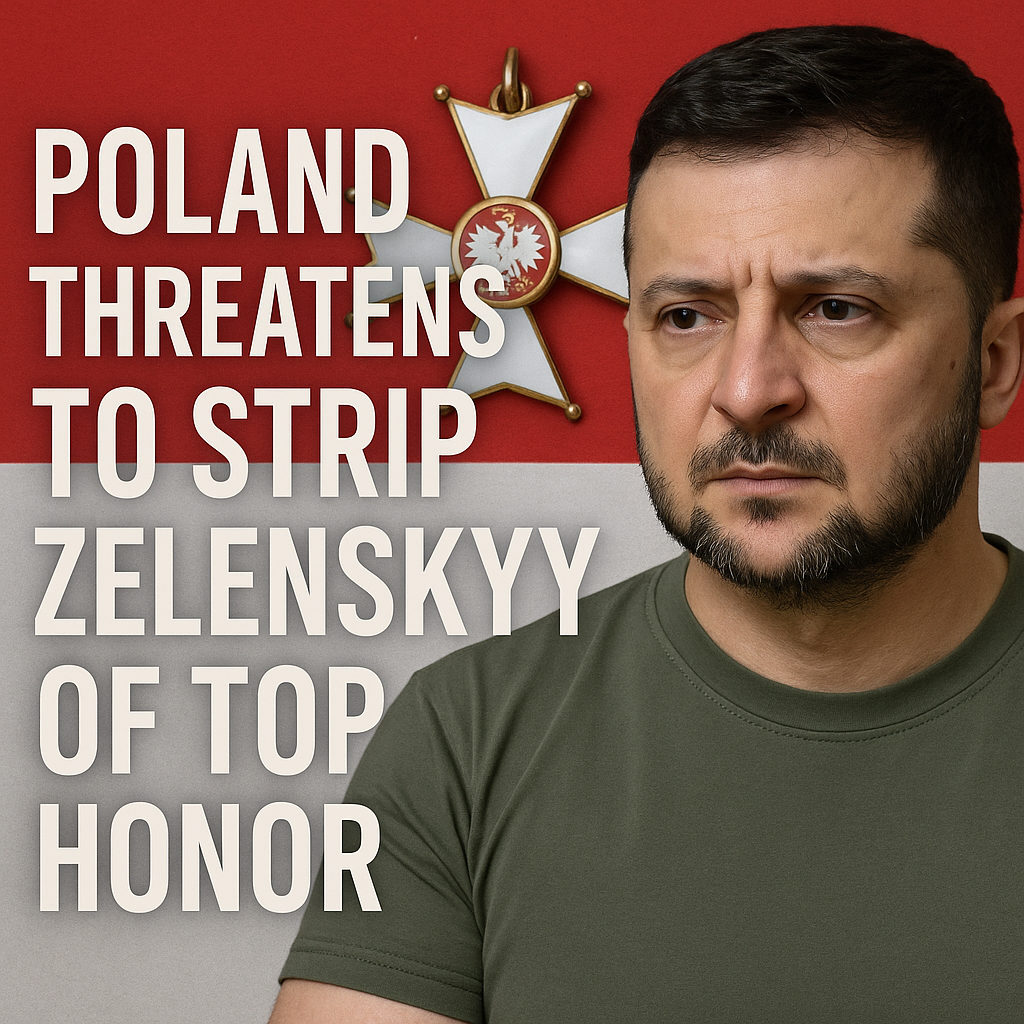
Poland Threatens to Strip Zelenskyy of Top Honor
Poland has threatened to rescind Ukraine’s President Volodymyr Zelenskyy’s top state honor amid rising tensions between the two neighbors. This situation highlights the complex dynamics of Polish-Ukrainian relations and the broader geopolitical landscape in Eastern Europe.

The Honor in Question
The Polish government granted Zelenskyy the Order of the White Eagle, a prestigious state award, in recognition of his leadership during the Russian invasion of Ukraine. However, recent statements from Polish President Andrzej Duda suggest that Zelenskyy’s approach to several key issues could jeopardize that honor. Duda’s comments reflect Poland’s frustration over Ukraine’s perceived shortcomings in addressing historical grievances and bilateral cooperation, particularly concerning Poland’s role in accepting and supporting Ukrainian refugees.

The threat to strip Zelenskyy of this honorary title follows a series of diplomatic spats and growing unease in the region. Polish officials have expressed concern over Ukraine’s handling of its historical narratives, particularly regarding events during World War II that continue to resonate deeply in both nations. This conflict over history, along with disputes relating to agricultural imports, has the potential to fracture the once-solid alliance between Poland and Ukraine.

Diverging Perspectives
The Polish Viewpoint
From Poland’s perspective, the Order of the White Eagle is not just an award; it symbolizes a bond forged in solidarity against a common enemy. President Duda’s announcement has been interpreted as a signal that Poland will not tolerate actions from Ukraine that it deems disrespectful to its historical significance and memory.
Poland has welcomed millions of Ukrainian refugees since the beginning of the Russian invasion, bolstering its image as a staunch ally. Still, as indicated in Duda’s statements, there’s an underlying expectation that Ukraine should reciprocate this support with acknowledgment and sensitivity toward Poland’s historical narrative. Polish officials have repeatedly stated that while they stand firmly behind Ukraine against Russian aggression, they reserve the right to demand respect and understanding in this bilateral relationship.
The Ukrainian Perspective
On the other hand, Ukraine views the threat to strip Zelenskyy of the award as an unnecessary escalation that could undermine the solidarity developed during the war. Ukrainian leaders have articulated that the historical grievances are complex and should be navigated delicately, particularly in times of crisis.
Ukrainian Foreign Minister Dmytro Kuleba has urged Poland to refocus on the larger objective: mutual support in the face of external threats. The sentiment in Ukraine is that while historical matters are significant, they should not overshadow the urgent need for collaboration against Russian aggression. Moreover, stripping Ukraine’s president of a prestigious honor during a critical wartime period could send a chilling message to other nations regarding loyalty and alliances in the face of common threats.
What Lies Ahead?
The current strains in Polish-Ukrainian relations offer a crucial lesson in diplomacy, emphasizing that nations must navigate their historical narratives with care, particularly when there are pressing contemporary issues at stake. As both countries share a common enemy in Russia, it is vital that they find common ground and maintain open dialogue.
Analysts argue that any move to rescind Zelenskyy’s award would have ripple effects not just in Poland and Ukraine, but throughout the region. It could embolden other countries to take hardline stances influenced by historical grievances, further complicating an already intricate geopolitical landscape in Eastern Europe.
As of now, the implication of Poland’s threats remains uncertain. There exists a possibility that both nations could reach a diplomatic resolution through dialogue, addressing contentious historical issues while reinforcing their partnership against external threats. They must also grapple with public sentiment in each country, which increasingly plays a role in shaping foreign policy.
In conclusion, the situation involving Zelenskyy and the Order of the White Eagle encapsulates more than just a bilateral disagreement; it underscores the intricate dance of history, honor, and diplomacy in the face of modern challenges. The path forward will require careful navigation, mutual respect, and a willingness to place pressing contemporary realities above historical animosities.















