
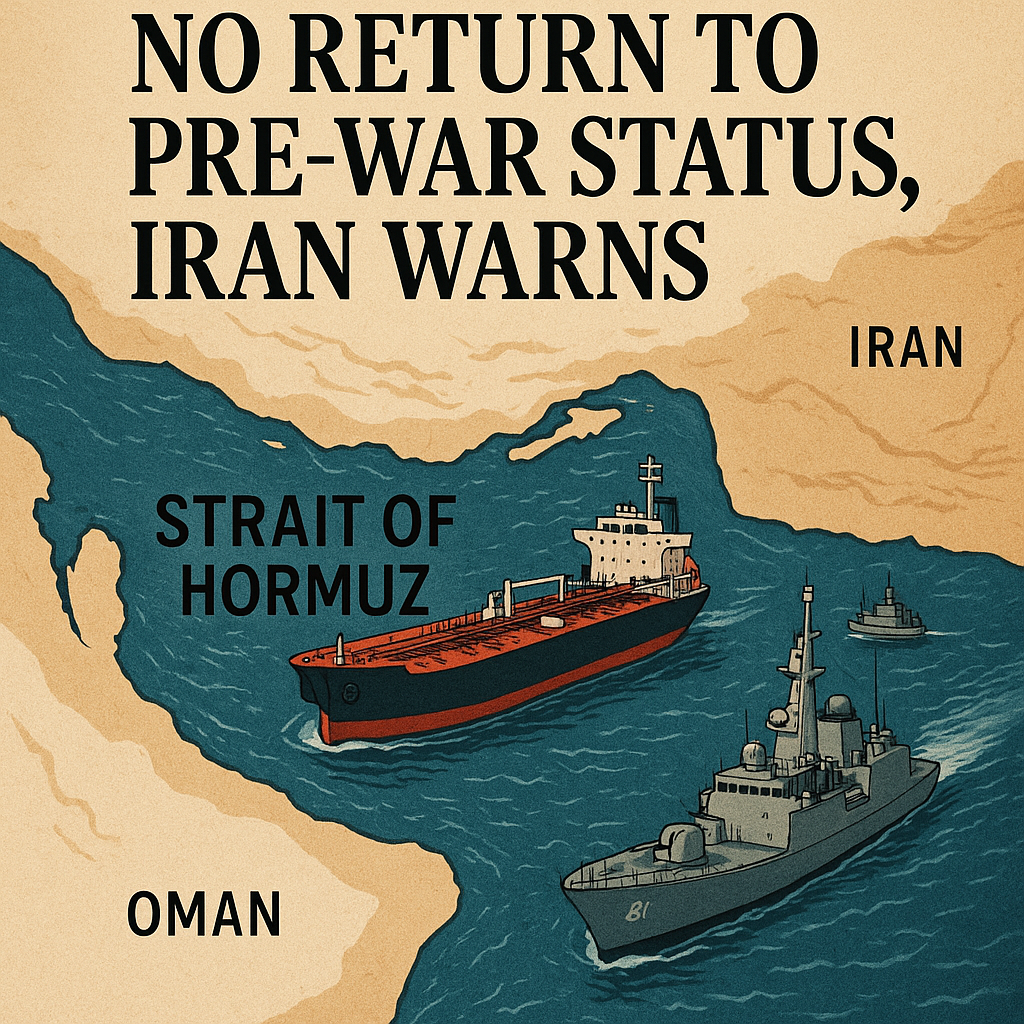
Strait of Hormuz: No Return to Pre-War Status, Iran Warns
Strait of Hormuz: Iran’s Strong Warning on Regional Stability
The Strait of Hormuz has re-emerged as a focal point of geopolitical tensions following Iran’s declaration that the region will not revert to its pre-war status. This strategic waterway, crucial for global oil shipments, has been a flashpoint for conflict and international diplomacy, raising concerns over security and maritime navigation.

Iran’s Firm Stance on Security and Stability
Iran’s Foreign Minister, Hossein Amir-Abdollahian, emphasized the nation’s commitment to safeguarding its interests in the Strait of Hormuz, dismissing any notion of returning to a pre-war equilibrium. He articulated that regional security cannot be guaranteed solely by external powers but must be a collaborative effort among nations bordering the Gulf.

Iran’s warning comes amidst increasing military maneuvers by the United States and its allies, aimed at ensuring freedom of navigation in the Strait, which handles nearly 20% of the world’s oil supply. These activities have been criticized by Tehran, which views them as provocations. Ali Shamkhani, Secretary of Iran’s Supreme National Security Council, warned that the presence of foreign military forces in the region would exacerbate tensions rather than alleviate them.

The Role of International Stakeholders
The Strait of Hormuz remains a vital passage for oil and gas shipments from the Gulf states to international markets, making its security paramount for global energy stability. However, differing international perspectives complicate the situation. The United States insists on maintaining a military presence to deter Iranian aggression and ensure maritime safety, a move that Iran perceives as a threat to its sovereignty.
Meanwhile, other regional players have begun to engage in diplomacy to mitigate tensions. Saudi Arabia and the United Arab Emirates have signaled a willingness to engage with Iran, reflecting a shift towards dialogue rather than confrontation. The recent dialogue between Iran and Saudi Arabia under the auspices of China highlights a pivotal moment in Middle Eastern politics, with both nations recognizing that stability in the Strait of Hormuz is vital for their respective economies.
Despite such diplomatic efforts, skepticism remains among analysts. Some argue that Iran’s military capabilities, including its naval strength and missile systems, have reached a point where it is no longer willing to concede its interests, signaling a transformative shift rather than a return to previous states.
Regional Implications of a Changed Status Quo
The current climate indicates that any stabilization in the region may hinge upon Iran’s willingness to engage with its neighbors while managing the balance of its military posture. However, the Iranian leadership’s recent hardline rhetoric suggests a pivot away from attempts at de-escalation. The lack of consensus on how to navigate this complex landscape raises uncertainty for all stakeholders.
The Gulf nations, particularly those reliant on oil exports, are acutely aware of their vulnerability in this situation. Any disruption in the Strait of Hormuz not only impacts local economies but can also affect global oil prices, leading to broader economic ramifications. Analysts emphasize that finding a pathway towards equitable negotiations is essential for all parties involved.
Additionally, the dynamics within Iran itself are worth noting. Various factions exert influence over its foreign policy, with hardliners advocating for a strong military response to perceived threats. This internal complexity complicates international diplomatic efforts, as external actors must navigate not just the overt actions of the Iranian government but also the underlying power structures within.
Conclusion: A New Era of Tension
As tensions mount in the Strait of Hormuz, Iran’s warnings signify a departure from the previous status quo. The intricacies of regional politics, combined with the vested interests of international players, suggest that the path forward will be fraught with challenges.
For now, it appears that the Strait is set to remain a critical piece on the chessboard of global geopolitics. The strategic implications of Iran’s stance will likely reverberate far beyond the immediate vicinity, necessitating a careful balance of diplomacy and deterrence among nations engaged in the region. While Iran asserts its determination to protect its interests, the stakes for global energy security could not be higher, leading to an unpredictable future in one of the world’s most critical maritime passages.















