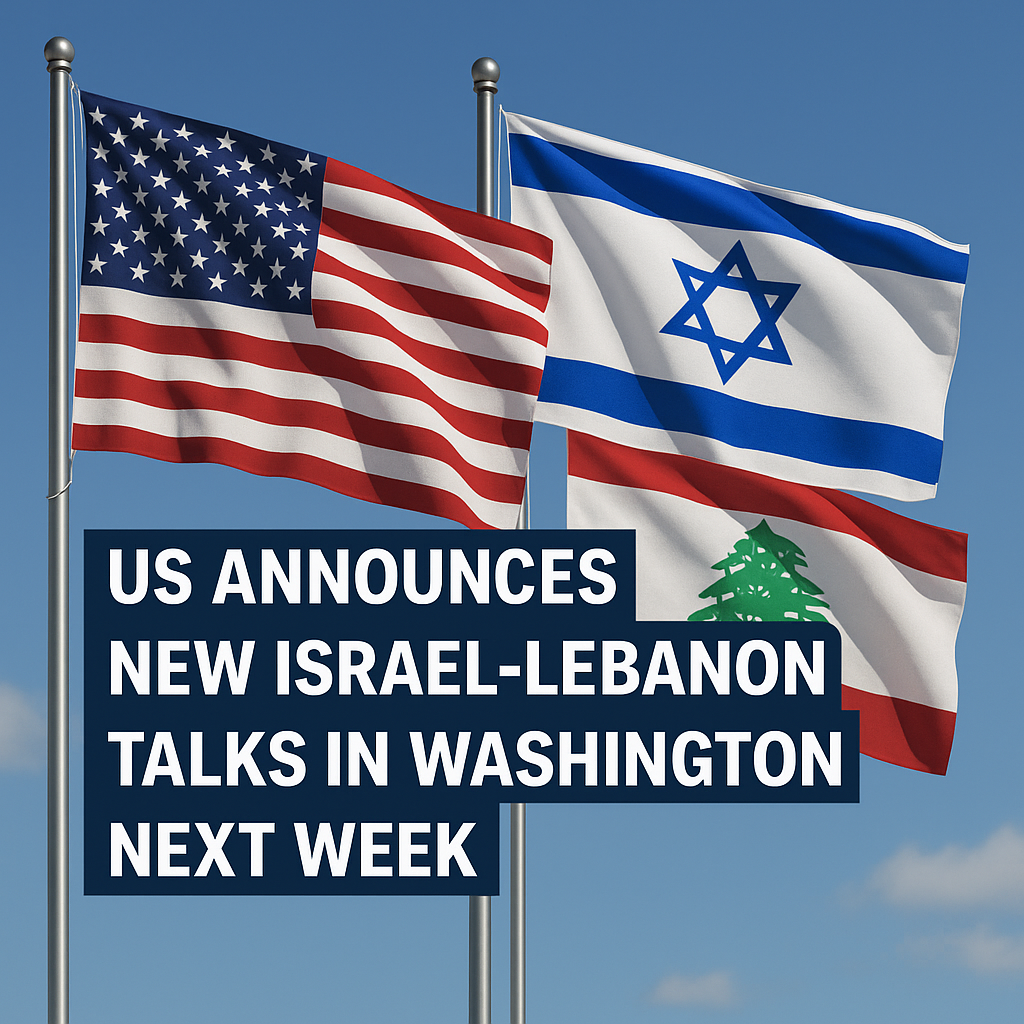
US Announces New Israel-Lebanon Talks in Washington Next Week
The recent announcement regarding the upcoming U.S.-led talks between Israel and Lebanon in Washington seeks to address long-standing tensions between these two neighboring countries. This development signifies a renewed effort towards dialogue, reflecting both nations’ complicated histories and the intricate geopolitical landscape of the region.

Background of the Israel-Lebanon Relationship
The history between Israel and Lebanon is fraught with conflict, beginning notably with the 1948 Arab-Israeli war and escalating during the 1982 Israeli invasion of Lebanon. Since then, multiple conflicts have punctuated their relationship, most recently the 2006 war, which resulted in significant destruction and loss of life. Central to their ongoing discord is the issue of territorial disputes, particularly concerning the border demarcation in the Shebaa Farms area and the maritime boundaries along the Mediterranean coast.

Furthermore, the presence of Hezbollah, a Shiite militant group that Lebanon designates as a resistance organization opposing Israel, adds another layer of complexity. The U.S. designated Hezbollah as a terrorist organization, complicating diplomatic relations and making constructive talks a challenging endeavor.

With the Biden administration signaling an interest in stabilizing the region, the upcoming talks may offer a platform to address not only border disputes but also broader regional security challenges. The informal atmosphere of Washington might facilitate more open discussions compared to previous sessions held in a less neutral environment.
Perspectives on the Talks
Reactions to the announcement of the upcoming talks have varied widely. On one hand, some analysts express cautious optimism. They argue that consistent U.S. engagement could open a channel for more substantive negotiations, potentially facilitating compromises on delicate issues such as the maritime boundaries where gas reserves lie. These analysts posit that the presence of U.S. diplomats might deter aggressive posturing from both sides, thereby creating a more conducive environment for peace.
Conversely, skepticism remains prevalent, particularly among advocates of Lebanese sovereignty. Critics argue that unless the talks address the influence of external actors—namely Hezbollah and Iran—the dialogue may skirt around core issues that impede lasting peace. For many in Lebanon, the prospect of engaging in talks that might overshadow their domestic issues is unsettling. There’s a concern that any agreements reached could prioritize American interests over Lebanon’s own sovereignty and security.
The Israeli stance also reflects a layered perspective. While some officials are hopeful that these discussions could yield security guarantees, others express a reluctance to concede on crucial territorial matters. The Israeli government has emphasized the vital need for ongoing deterrent capabilities, particularly in light of regional upheavals and the evolving threat from groups like Hezbollah.
The Road Ahead
As the scheduled talks draw near, it becomes increasingly evident that the path toward a resolution will not be straightforward. Several variables could influence the outcomes, such as the internal political dynamics within both countries and the role of regional players. There is also the added pressure of international observers, who are keenly monitoring the negotiations and hoping for a breakthrough.
Furthermore, public sentiment in both countries plays a crucial role. In Israel, ongoing conflicts and security concerns have led to a wariness toward negotiations perceived as compromises. In Lebanon, economic pressures and social unrest could either empower or inhibit the government’s ability to negotiate effectively.
Both nations are aware that a failure in these talks might entrench animosities further, risking escalating conflicts that could involve other regional powers. Therefore, while leaders may come to Washington with varied perspectives—some optimistic, others critical—the stakes are inherently high.
In summary, the forthcoming U.S.-Israel-Lebanon talks in Washington provide a hopeful yet uncertain opportunity to address a tangled and historically charged relationship. By fostering open dialogue, the U.S. might contribute to a stabilization of regional tensions, but significant hurdles remain, suggesting that the path to peace will demand patience, compromise, and careful navigation of complex political landscapes. The ability of both Israel and Lebanon to engage meaningfully will ultimately determine whether this dialogue can translate into actionable resolutions or merely serve as another chapter in their protracted narrative of conflict.