
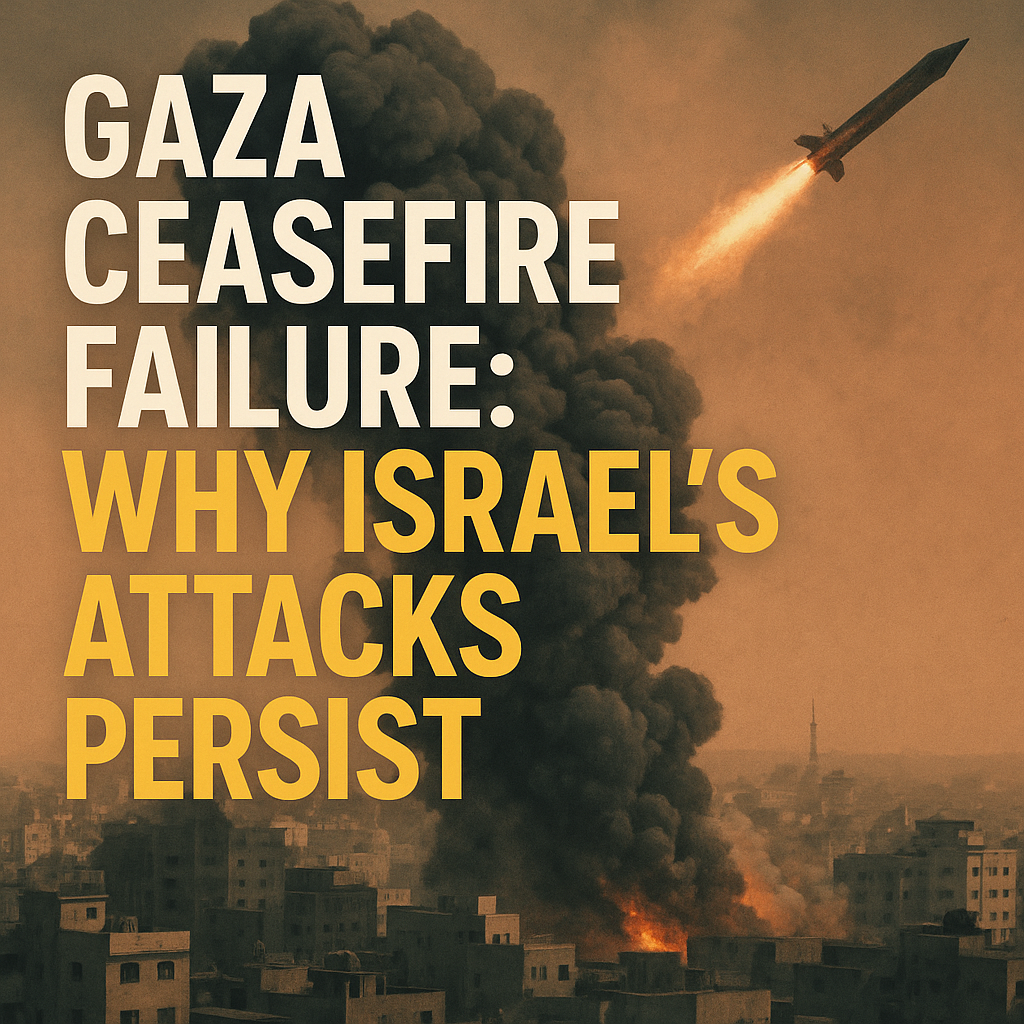
Gaza Ceasefire Failure: Why Israel’s Attacks Persist
Gaza Ceasefire Failure: Why Israel’s Attacks Persist
The ongoing conflict in Gaza has raised significant questions regarding the effectiveness of ceasefire agreements, as recent developments suggest that the respite from violence remains elusive. Despite multiple attempts to broker peace, hostilities between Israel and Hamas continue unabated. Understanding the reasons behind the collapse of these temporary ceasefires sheds light on the broader implications of the conflict.

Factors Contributing to Ceasefire Failures
Historical Context and Entangled Interests
To comprehend why ceasefires in Gaza continually falter, it is essential to consider the historical context. The roots of the Israel-Palestine conflict are deeply entrenched, with decades of territorial disputes, mutual mistrust, and cycles of violence. Attempts at peace are often undermined by political infighting among Palestinian factions and the overarching influence of regional powers.

Recent reporting, including analysis from Al Jazeera, indicates that these political dynamics play a crucial role. Divisions between Hamas, which governs Gaza, and the Palestinian Authority in the West Bank complicate unified negotiations. The lack of cohesion is exacerbated by external influences from countries like Iran and Egypt, which have vested interests that often conflict with the pursuit of peace.

Cycles of Retaliation and Military Strategy
Additionally, the military strategies of both Israel and Hamas contribute to the persistence of hostilities. Israel’s military operations are often framed as defensive measures against rocket fire from Hamas and other militant groups. Conversely, Hamas views its resistance as a legitimate response to occupation and military aggression.
Reports from Sky News highlight a pattern of escalation where both sides perceive the other as untrustworthy. Each ceasefire tends to be marred by skepticism—Israel fears a resurgence of militant capabilities during lulls in fighting, while Hamas often waits for perceived provocations as justification for continued retaliation. This cycle of distrust makes it nearly impossible to establish lasting peace.
The Role of External Influences and International Responses
Global Perceptions and Advocacy Challenges
International reactions to the situation in Gaza have been varied, influenced both by political alliances and humanitarian perspectives. Coverage from RT emphasizes how geopolitical interests often overshadow the dire humanitarian situation on the ground. While many countries advocate for immediate peace, others leverage the conflict for strategic gains, complicating the situation further.
For example, Western nations often express support for Israel’s right to defend itself, while simultaneously acknowledging the need for humanitarian aid in Gaza. This duality creates a perception that solutions are more proscriptive than prescriptive. Efforts from the United Nations and other organizations frequently encounter opposition due to the intricate web of alliances and viewpoints surrounding the conflict.
The Compelling Call for Humanitarian Action
Crucially, the humanitarian aspects cannot be ignored. Civilians bear the brunt of this unending conflict, suffering from displacement, loss of life, and a dire need for basic resources. This has led to increasing calls for a reassessment of military approaches in favor of humanitarian initiatives that prioritize rebuilding trust and addressing the needs of those affected.
While recent discussions suggest a possible shift towards mediating powers advocating for a ceasefire, the path forward is fraught with challenges. These calls often highlight the need for a sustainable solution that addresses root causes rather than merely treating the symptoms of violence.
Conclusion: A Complex Road Ahead
In summary, the failure of ceasefires in Gaza is a multifaceted issue rooted in historical animosities, military strategies, and geopolitical entanglements. The patterns of retaliation and distrust create a cycle that is difficult to break, complicating the prospects for peace. Furthermore, the roles of external influences and humanitarian considerations add layers of complexity to an already turbulent landscape.
While immediate solutions may seem elusive, a deeper understanding of these dynamics is essential for any hopeful negotiation process. Continued advocacy for humanitarian aid, alongside attempts to bridge gaps in political agreements, may foster an environment where lasting peace can be envisioned—not just as an idea but as a true possibility for future generations.















