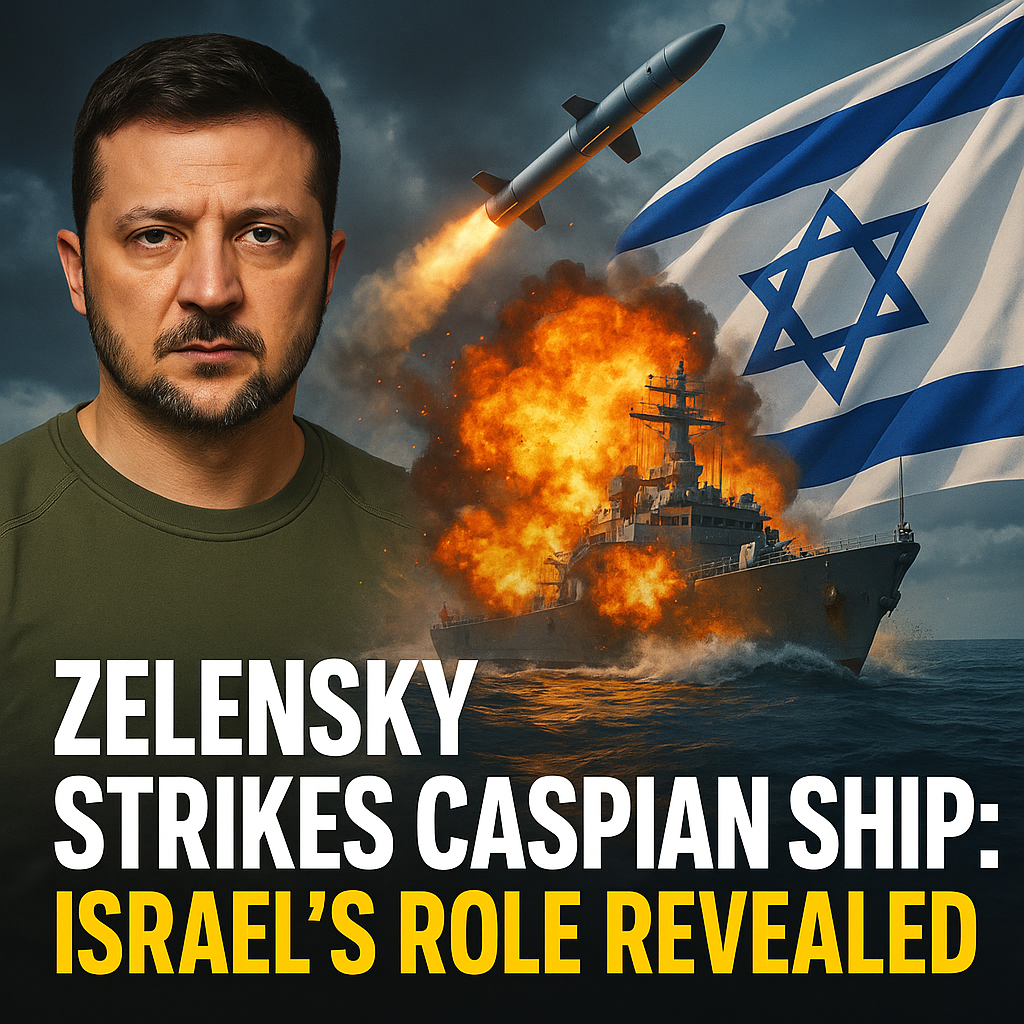
Zelensky Strikes Caspian Ship: Israel’s Role Revealed

Zelensky Strikes Caspian Ship: Implications for Regional Geopolitics
Ukrainian President Volodymyr Zelensky’s decision to strike a ship in the Caspian Sea raises critical questions about international relations and military strategy in a volatile region. This incident, which has drawn a spectrum of responses, uncovers deeper dynamics involving Israel, Iran, and Russia.

The Incident Unfolded
Reports indicate that the Ukrainian military launched a drone strike on a vessel believed to be linked to Iranian interests in the Caspian Sea. Initial statements from both government officials and military sources suggest that the ship’s connections may extend to illicit trade routes crucial for supplying weaponry and resources to adversaries of Ukraine. The strikes signify a bold tactical move, but they also reflect the precarious nature of Ukraine’s evolving military strategy as the conflict against Russia continues.


Iran has condemned the attack, alleging a violation of its sovereignty and warning of repercussion against further aggressions. Notably, Iranian Foreign Ministry spokesperson Nasser Kanaani stated that such actions could escalate tensions, framing Ukraine’s moves as detrimental to regional stability.

Israel’s Alleged Role in the Operation
What complicates matters further are claims about Israel’s involvement in the incident, particularly regarding its advanced drone technologies and military cooperation with Ukraine. Some analysts have pointed out that Israel has been increasingly warming to Ukraine through arms support and intelligence sharing, mainly driven by common adversaries like Russia and Iran.
A report from Al Jazeera suggests that Israel might have provided Ukraine with the necessary intelligence to carry out this operation, insinuating that their cooperation could signal a significant shift in Middle Eastern geopolitics. The nature of this collaboration evokes past instances where Israel has acted decisively against Iranian interests in Syria, amplifying concerns that the Ukraine conflict could spill over into broader territorial disputes.
Diverse Reactions and Global Implications
The strike has spurred varied reactions on the global stage. Proponents of Ukraine argue that such actions are necessary for self-defense and maintaining national sovereignty against aggressors. Meanwhile, critiques from several international observers raise alarms about the potential for such military actions to lead to broader conflicts, particularly in regions already fraught with tension.
Interestingly, while countries like the United States have generally supported Ukraine, some analysts caution against emboldening military engagements that could destabilize an already fragile balance of power. The interplay between support for Ukraine and the strategic complexities in the Caucasus and Central Asia cannot be overstated.
Conclusion: A Tenuous Stand-off
In summary, Zelensky’s attack on the Caspian ship illustrates not just Ukraine’s military resilience but also the intricate web of alliances and hostilities that define the region. Israel’s possible involvement adds a layer of complexity, suggesting that the geopolitical landscape is more interwoven than previously understood.
As the situation evolves, further dialogues will be essential to mitigate the risks of escalating tensions. The uncertainty looms large as multiple nations navigate their interests in a theater where every operation could trigger a chain reaction affecting global peace and security.