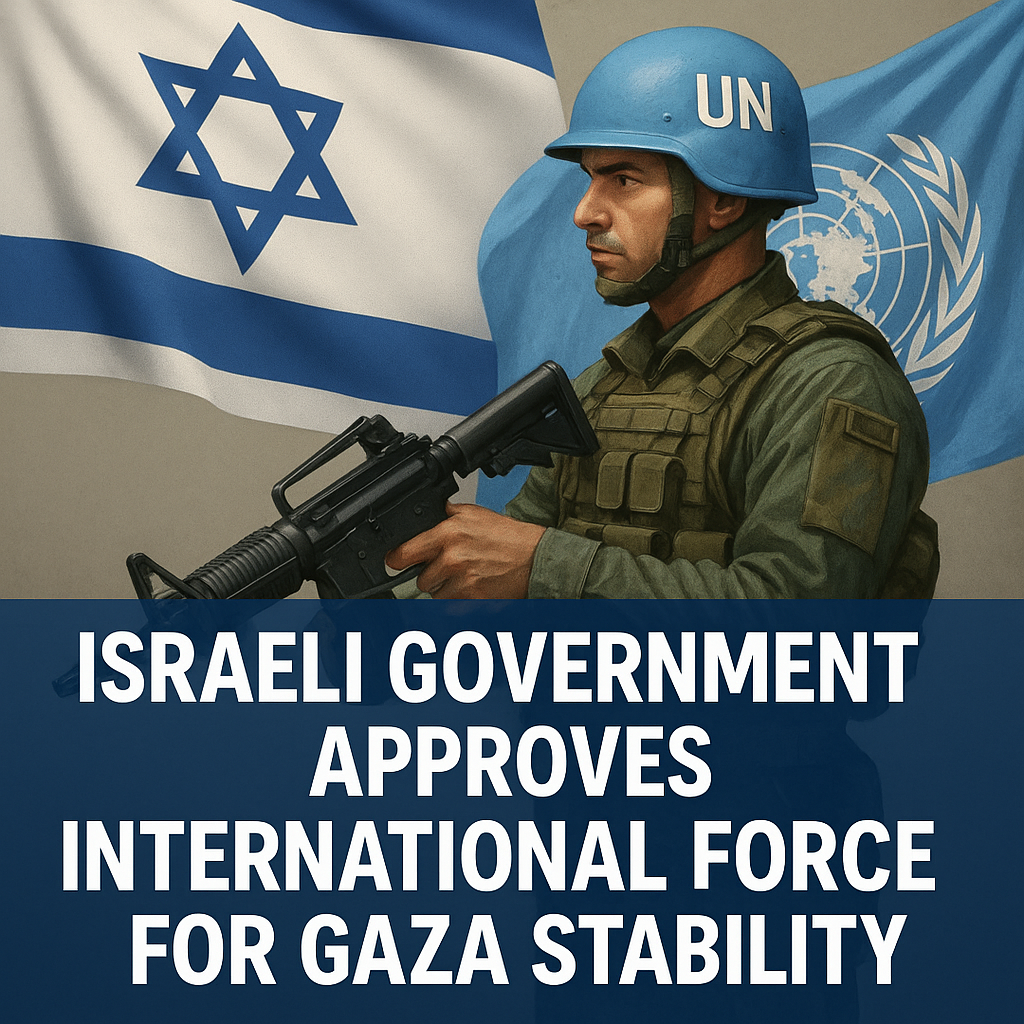
Israeli Government Approves International Force for Gaza Stability
The Israeli government has recently taken a significant step by approving the establishment of an international force aimed at stabilizing Gaza. This decision arrives in the wake of escalating tensions and humanitarian crises in the region, raising questions about the effectiveness, implications, and the much-debated role of foreign intervention.

The Need for Stability in Gaza
The ongoing conflict in Gaza has created a dire humanitarian situation. Reports indicate that this region has been plagued by violence, with civilians often bearing the brunt of military actions and blockades. The approval of an international stabilization force is seen as an attempt by Israel not only to address the immediate need for safety and order but also to restore some level of normalcy for the beleaguered population.

Supporters of the decision argue that foreign boots on the ground could provide much-needed stability, preventing the resurgence of militant groups and ensuring some degree of law and order. For many, the involvement of international forces offers hope that the continuous cycle of violence might finally be interrupted, paving the way for humanitarian aid and rebuilding efforts.

Diverse Perspectives on International Involvement
Despite the potential benefits, the proposal has been met with skepticism from various stakeholders. Critics argue that external forces often complicate local dynamics rather than resolve them. A historical perspective suggests that previous international interventions in the region have yielded mixed results, sometimes exacerbating existing tensions rather than alleviating them.
An article from RT emphasizes this point, suggesting that past efforts to involve international forces in similar conflicts have often led to unintended consequences. Critics also fear that international presence might be perceived as an occupation, further inflaming local sentiments and opposition to foreign influence.
Another perspective comes from Al Jazeera, which highlights the governmental approval as a potential tactical move for Israel. By endorsing an international presence, Israel may aim to demonstrate to the international community its commitment to peace and stability, potentially diverting criticism regarding its military actions in the region. However, there are lingering doubts about whether this action can genuinely lead to peace or if it is merely a short-term solution to a long-standing issue.
The Challenges Ahead
For an international force to operate effectively in Gaza, several challenges must be addressed:
– Coordination with Local Authorities: Effective engagement with local Palestinian leadership is crucial. A lack of cooperation could hinder the implementation of any stabilization mandates.
– Security Dynamics: The security landscape is complex, with various factions operating within Gaza. Ensuring the safety of international personnel will be paramount and remains a significant concern.
– Political Will: The success of any international force heavily depends on the political will of both local stakeholders and the international community. Without a united front and clear objectives, efforts to stabilize Gaza could falter.
A Step Towards Potential Resolutions?
Ultimately, the Israeli government’s approval for an international stabilization force in Gaza encapsulates a complex interplay of geopolitics, humanitarian needs, and historical grievances. The decision reflects a recognition of the urgent need for action, yet it simultaneously highlights deep-seated hesitations regarding the efficacy of foreign intervention.
As discussions unfold, the prospects for peace in the region remain contingent on a myriad of factors. Will this international presence pave the way for meaningful dialogue and enduring stability, or will it merely add another layer of complexity to an already fragmented situation? The answers, much like the situation itself, are fraught with uncertainty.
As the global community watches, the focus now shifts to the implementation process and the commitment of international players to achieve a more stable and peaceful Gaza. The effectiveness of this endeavor will undoubtedly shape the future of not just Gaza, but the broader Israeli-Palestinian relationship moving forward.