
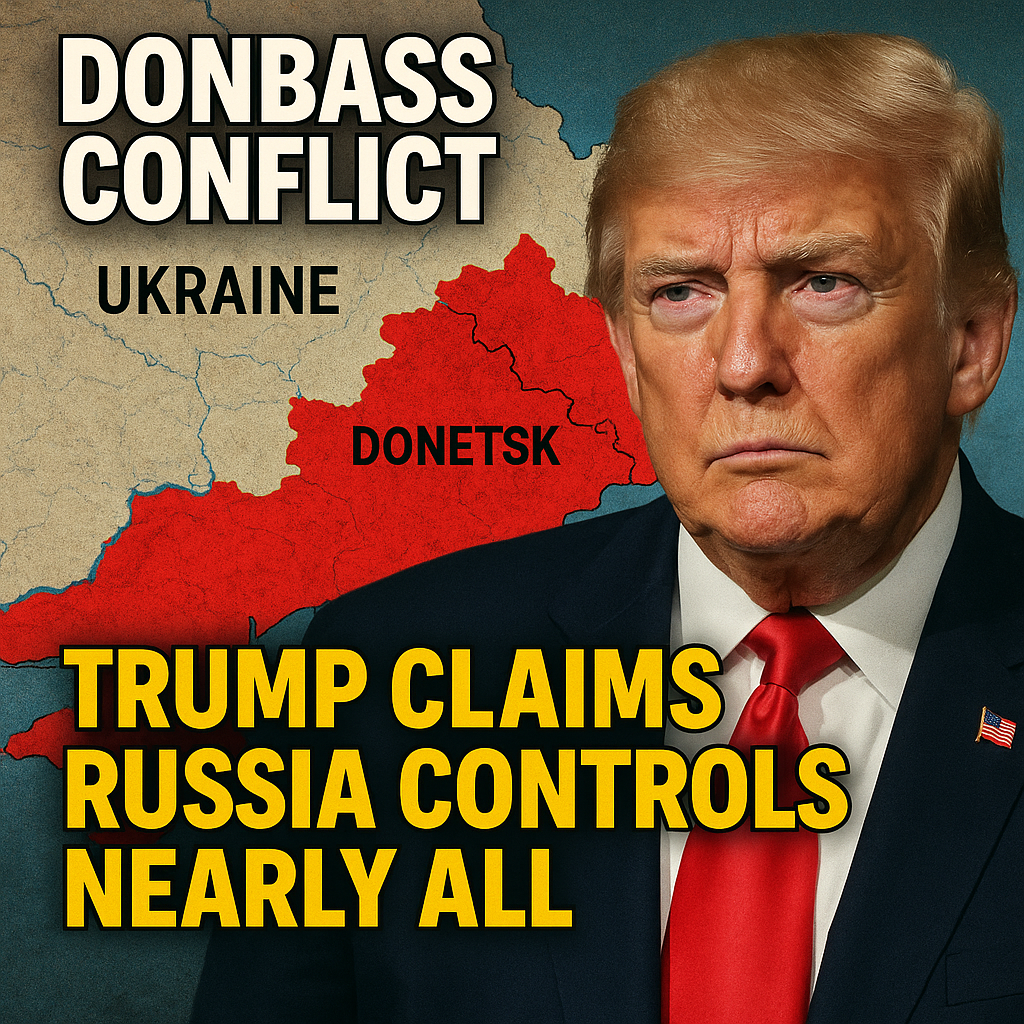
Donbass Conflict: Trump Claims Russia Controls Nearly All

The Donbass Conflict: Trump Claims Russia Controls Nearly All
The ongoing conflict in the Donbass region of Ukraine continues to be a focal point in international discussions, with varying interpretations of the situation. Recently, former President Donald Trump made headlines by asserting that Russia now controls “nearly all” of the Donbass. It’s imperative to unpack this claim and examine the broader context surrounding the conflict, including the perspectives from different news outlets and analysts.

Understanding the Situation in Donbass
The Donbass conflict, which began in 2014, has its roots in Russia’s annexation of Crimea and the subsequent uprising in Eastern Ukraine. The region, comprising the Donetsk and Luhansk oblasts, has been the site of a brutal and protracted conflict between Ukrainian forces and pro-Russian separatists. The ongoing war has led to significant casualties and displacement, complicating the political landscape in Ukraine and its relationships with Western nations.


Trump’s Claims and Their Implications
According to Trump, the assertion that Russia controls “nearly all” of Donbass resonates with the reported territorial advances made by Russian forces in recent months. A report from RT outlines that these claims may stem from substantial gains made by Russia in the area, with analysts suggesting that pro-Russian forces have increasingly consolidated their positions. However, the viewpoint presented may lack nuance, as multiple variables influence territorial control, including ongoing military operations and strategic shifts.


Reactions to Trump’s claims highlight a spectrum of opinions. Some, including conservative commentators, have touted this perspective as evidence that the political and military strategies of the U.S. under President Biden have faltered. On the other hand, critics argue that Trump’s comments oversimplify a highly complex situation, neglecting to acknowledge tenacious Ukrainian resistance and external support from NATO allies.
The Broader Context and Diverse Perspectives
Analyzing statements from various news sources sheds light on the polarized narratives surrounding the Donbass conflict.
Military Dynamics
Recent updates from Al Jazeera highlight that while there have indeed been advances by Russian forces, the Ukrainian military has also demonstrated resilience, particularly in strategic areas like Avdiivka and Bakhmut. These locations have seen fierce fighting, and Ukrainian troops continue to put up a significant defense against Russian advances. This paints a picture that contrasts with Trump’s assertion, suggesting that the situation is far from a clear-cut domination by Russian forces.
A report from Sky News emphasizes the complexity introduced by international aid and sanctions targeted at Russia, providing Ukraine with advanced weaponry and logistical support. Such assistance is designed to bolster Ukrainian defenses and disrupt Russian offensives, thus complicating straightforward narratives about control and dominance.
Opinions on International Response
Furthermore, opinions diverge on how the U.S. and its allies should respond to the evolving dynamics in Donbass. Some experts argue for increased military support to ensure Ukraine can maintain a foothold in the region, while others caution that such a response could escalate tensions between NATO and Russia. The conflict’s implications extend beyond European borders, affecting global energy markets and international relations.
The juxtaposition of Trump’s claims with the varied responses from geopolitical analysts reveals the multifaceted nature of the conflict. While Trump’s perspective resonates with a segment of the population concerned about U.S. foreign policy, it also opens the floor to critique regarding the oversimplification of a complex military landscape.
Conclusion: A Complex Landscape
In summary, the assertion that Russia controls “nearly all” of the Donbass is a reflection of the evolving situation in the region but lacks the granularity needed for a comprehensive understanding. The conflict, far from being a straightforward matter of territorial control, involves intense military operations, strategic resistance from Ukrainian forces, and shifting political tides.
As the global community continues to watch the situation develop, it is essential to remain informed through diverse perspectives and credible analyses. The stakes are high, not just for Ukraine but for regional stability and international relations as a whole. As the conflict persists, the need for a nuanced understanding remains ever more crucial in navigating the complexities of the Donbass.















