
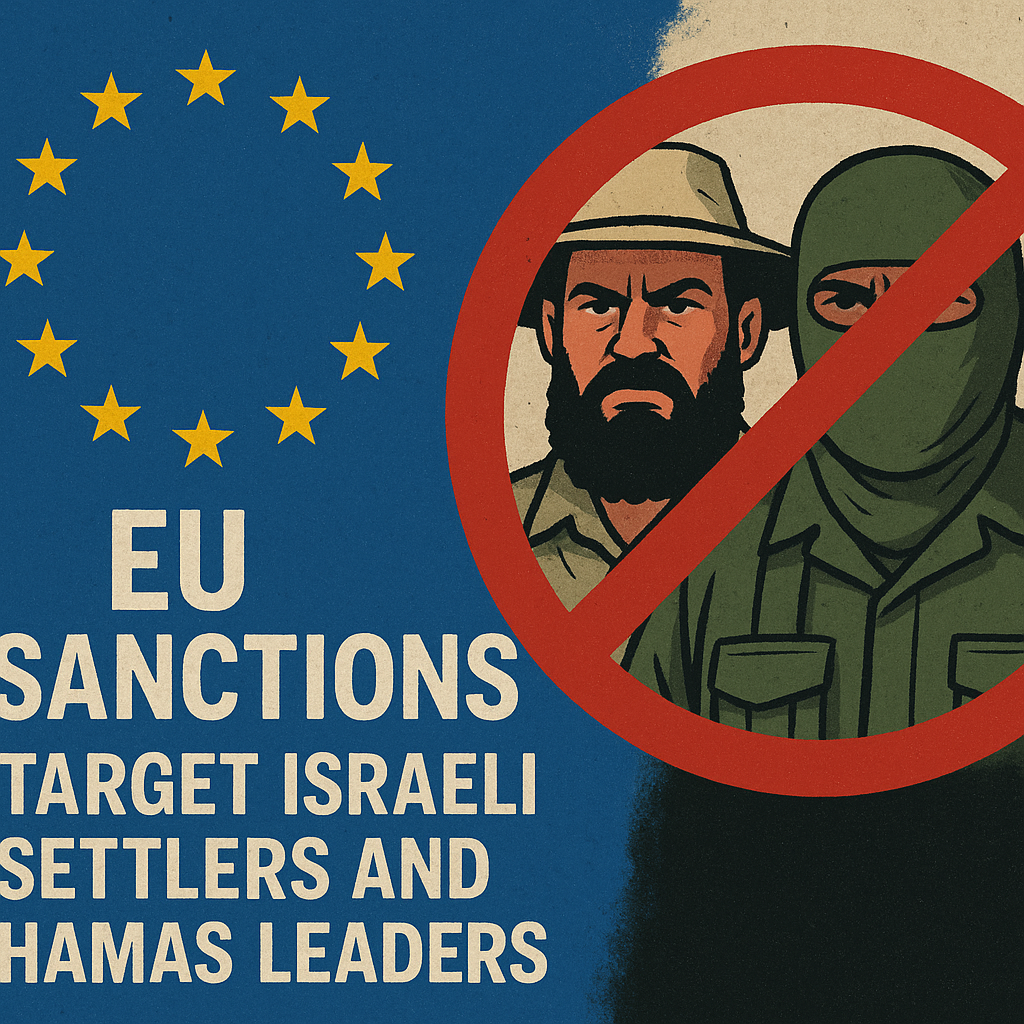
EU Sanctions Target Israeli Settlers and Hamas Leaders

The recent announcement by the European Union (EU) regarding sanctions targeting Israeli settlers and Hamas leaders has sparked a considerable debate within the international community. This move underscores the complexity of the ongoing Israeli-Palestinian conflict and signals a renewed EU commitment to addressing issues of human rights and territorial integrity in a region long plagued by violence and political strife.

Understanding the Sanctions
The sanctions were introduced in response to a series of actions in the West Bank that the EU regards as undermining the peace process. Specifically, the targeted Israeli settlers are accused of exacerbating tensions through illegal land acquisitions, violence against Palestinian residents, and other acts that violate international law. The sanctions are designed to penalize individuals directly linked to these activities rather than impacting broader Israeli society.


According to a report from Al Jazeera, the EU’s move signifies a significant shift in its approach to the Israeli-Palestinian conflict. Historically, the EU has maintained a somewhat neutral stance, often striving to mediate between the two sides. However, this new policy indicates a willingness to impose direct consequences on actions it deems harmful to peace efforts.


Diverse Perspectives on Policy Impact
The response to the EU’s sanctions has not been monolithic. Supporters argue that such measures are essential for holding individuals accountable and deterring further violations against Palestinian rights. Mahmoud Abbas, President of the Palestinian Authority, expressed approval, stating that the sanctions demonstrate a growing recognition of the issues facing Palestinians and the urgent need for accountability in the region.
Conversely, critics of the sanctions, including various Israeli officials, argue that punishing settlers and Hamas leaders may further polarize the situation and complicate diplomatic relations. They emphasize that focusing on individual actors fails to address the fundamental issues at the core of the conflict, such as security, land rights, and mutual recognition. For instance, Israel’s Foreign Ministry condemned the sanctions as counterproductive, claiming that they disregard the complexities of the conflict and undermine any goodwill that could facilitate negotiations.
The Role of Hamas Leadership
The EU’s sanctions also target leaders within Hamas, the militant group controlling Gaza. The bloc has accused these leaders of perpetuating violence against Israeli citizens and undermining peace initiatives. The situation is delicate; any measures taken against Hamas carry the risk of deepening the humanitarian crisis in Gaza, which has been under a blockade for years. Critics argue that sanctions could further harm ordinary Palestinians, who often find themselves caught in the crossfire of larger geopolitical struggles.
Hamas’s leadership has responded by denouncing the sanctions, portraying them as a continuation of a long-standing bias against Palestinian interests. They argue that the EU’s decisions are influenced by external pressures, particularly from the United States and its allies, rather than by an impartial assessment of the conflict on the ground.
The Path Forward
As the EU implements these sanctions, the long-standing question remains: what will be their actual impact on the ground? While the intention behind the sanctions is rooted in a desire to promote peace and uphold human rights, their effectiveness will depend on a multitude of factors. These include the readiness of both Israeli and Palestinian leaders to return to negotiations and the broader geopolitical climate, including the role of the United States and Arab nations in facilitating dialogue.
The EU’s sanctions represent a critical, albeit controversial, step towards addressing the multi-layered facets of the Israeli-Palestinian conflict. They reflect growing frustration with the stagnant peace process and aim to signal a new commitment to human rights and international law. However, the risks associated with such policies cannot be ignored. As history shows, punitive measures can sometimes lead to further entrenchment of positions on both sides, making peace all the more elusive.
Conclusion
In summary, the EU’s decision to impose sanctions on Israeli settlers and Hamas leaders is part of a broader strategy to address long-standing grievances in the Israeli-Palestinian conflict. While it presents potential pathways for change, it also highlights the challenges inherent in navigating such a deeply rooted and complex issue. Stakeholders on both sides will need to adapt to this new landscape, balancing accountability with constructive dialogue to move toward a sustainable resolution. The road ahead remains fraught with uncertainties, and only time will tell whether these measures will pave a path to peace or contribute to further discord.















