
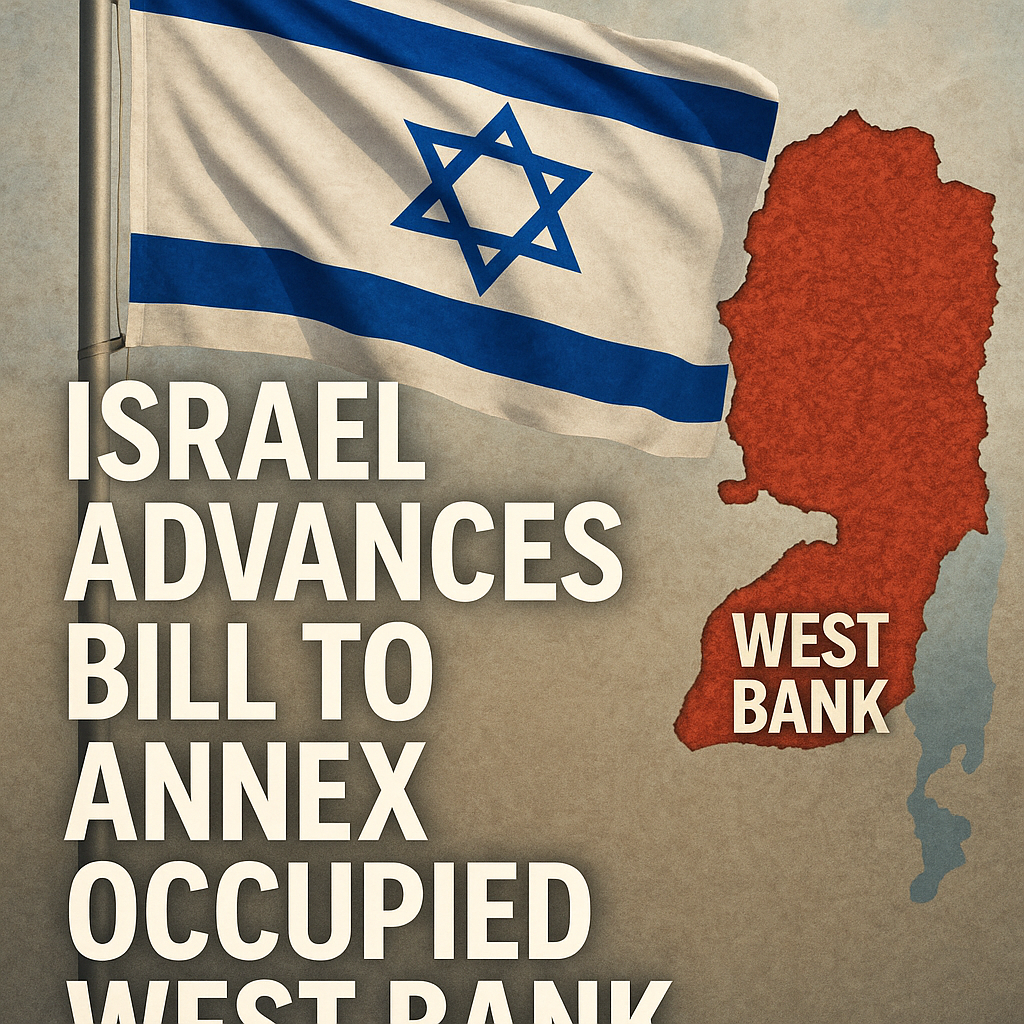
Israel Advances Bill to Annex Occupied West Bank

Israel Advances Bill to Annex Occupied West Bank
In recent developments, Israel’s parliament has taken significant steps towards the annexation of parts of the occupied West Bank, a move that many are concerned could escalate tensions in an already volatile region. This proposal has garnered a variety of reactions, reflecting the complex dynamics at play.

The Legislative Push: What You Need to Know
The Israeli Knesset has advanced a bill that aims to formally incorporate areas of the West Bank into Israel’s sovereign territory. This proposal aligns with long-standing right-wing ambitions within Israeli politics and has been championed by Prime Minister Benjamin Netanyahu’s coalition government. The bill seeks to expedite the legal process for annexation, suggesting that certain zoning laws and regulations would be applied to the territories in question.


Supporters of the bill argue that it represents a necessary step towards consolidating Israel’s security and territorial integrity. They cite historical claims to the land and assert that annexation would affirm Israel’s sovereignty over regions that they believe rightfully belong to them. One politician stated, “Ending the ambiguity over our borders is essential for our national security.”


However, the move has sparked significant backlash not only domestically but internationally as well. Many observers view this as a violation of international law, particularly regarding the Fourth Geneva Convention, which prohibits the annexation of occupied territories. Critics argue that such actions could derail the already fragile peace process with the Palestinians.
The Global Response: Mixed Signals and Concerns
International reactions to Israel’s proposed annexation have been varied. The United Nations has issued statements criticizing the bill, emphasizing that annexation would undermine the two-state solution — a widely supported framework for resolving the Israeli-Palestinian conflict. The UN Secretary-General’s spokesperson remarked, “Any annexation would have serious repercussions on the prospects for peace.”
Conversely, some nations and political factions remain supportive of Israel’s stance, arguing that the move is a legitimate exercise of self-determination. The United States government has adopted a more neutral approach this time, refraining from vocal opposition as seen in previous annexation discussions. This change has been interpreted by some as tacit approval of Israel’s actions, potentially emboldening their resolve to proceed with the annexation.
However, Palestinians and their advocates view the legislation as yet another step in a long history of displacement and disenfranchisement. A spokesperson for the Palestinian Authority condemned the bill, stating it reflects “Israel’s continued efforts to erase Palestinian identity and claims.”
The Implications: Potential Consequences of Annexation
The potential annexation of parts of the West Bank carries significant implications for both Israeli society and Palestinian communities. On one hand, proponents assert that annexation will lead to enhanced security for Israeli citizens and will consolidate political support for the current government’s agenda.
On the flip side, critics warn that it could ignite further violence in the region, exacerbating conflicts that have persisted for decades. The Palestinian response could include increased protests and unrest, as well as a potential collapse of any remaining dialogue for peace. The situation could also provoke a stronger response from neighboring Arab nations, complicating an already sensitive political landscape.
Moreover, annexation could shift international alliances and relationships. Countries that have maintained a level of diplomatic engagement with Israel may reevaluate their positions, particularly those with a vested interest in regional stability.
Conclusion: Navigating a Complex Landscape
As the Israeli government moves forward with its legislative agenda for annexation, the situation remains fluid and multifaceted. While some view this bill as a historical necessity, others see it as a dangerous escalation that could thwart any remaining prospects for peace. The diverse reactions to this development highlight the differing perspectives within Israeli society, among Palestinian communities, and on the international stage.
The future remains uncertain, and as discussions around the bill unfold, it is crucial that all stakeholders engage thoughtfully and responsibly to address the complex realities of the situation. Open dialogue and mutual understanding may serve as the only viable pathways toward lasting peace.















