
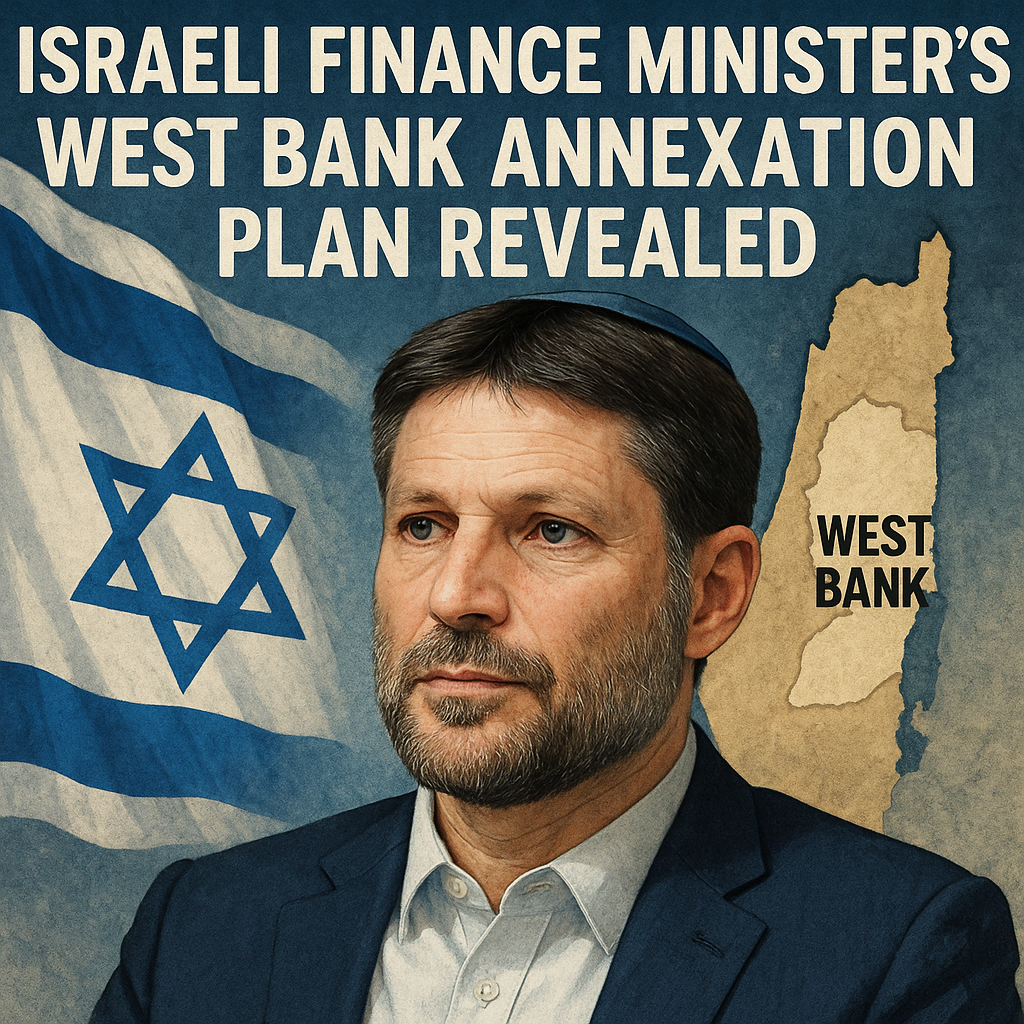
Israeli Finance Minister’s West Bank Annexation Plan Revealed

Israeli Finance Minister’s West Bank Annexation Plan Revealed: Perspectives and Implications
The recent unveiling of the Israeli Finance Minister’s plan to annex parts of the West Bank has ignited a complex dialogue about the future of this contentious region. This development not only highlights the ongoing tensions between Israel and Palestine but also raises significant questions about international law, regional stability, and the prospects for peace negotiations.

Understanding the Annexation Plan
According to reports, the Israeli Finance Minister’s proposal outlines a detailed strategy for annexing substantial portions of the West Bank. This initiative comes at a time when the Israeli government sees a window of opportunity to alter the status quo, viewing the annexation as a way to solidify its territorial claims amid ongoing debates over security and sovereignty.


Key Components of the Plan
The plan, as detailed in various news sources, entails several crucial components:


– Legal Framework: The Minister emphasizes a new legal foundation aimed at integrating the annexed territories into Israel, which would not only redefine borders but also alter the governance structure for Palestinian residents in these areas.
– Economic Integration: The proposal includes measures to foster economic development in the annexed territories, ostensibly to improve the living conditions of residents. However, critics argue that this could further entrench Israeli control rather than promote genuine autonomy.
– Security Justifications: The Finance Minister, along with other proponents, cites security concerns as a primary justification. They argue that annexation is necessary for protecting Israeli citizens and ensuring stability in the face of perceived threats.
Diverging Perspectives on Annexation
While some Israeli officials endorse the plan as a pivotal step toward legitimizing Israel’s claims, there are profound contradictions and critiques emerging from various quarters.
Support from Nationalist Circles
Supporters of the annexation within Israel, particularly those aligned with nationalist sentiments, champion it as a historic opportunity to reclaim land they believe is rightfully theirs. This view is frequently bolstered by interpretations of historical and biblical connections to the land.
– Cultural Resonance: For many, the idea of annexation resonates deeply on a cultural and identity level, reinforcing a narrative of Jewish presence and continuity in the region.
– Frustration with Status Quo: Advocates argue that the current situation, characterized by intermittent violence and stagnation in peace talks, necessitates decisive action to reshape the geopolitical landscape.
Opposition and Criticism
Conversely, a significant faction—both within Israel and internationally—strongly opposes the annexation plan. Critics warn that such actions could exacerbate existing tensions and derail any hopes for a lasting peace settlement.
– International Law Concerns: Opponents cite the Fourth Geneva Convention, which prohibits the transfer of an occupying power’s civilian population into occupied territory. By annexing parts of the West Bank, Israel risks facing international legal repercussions.
– Impact on Palestinian Rights: Human rights organizations have voiced concerns that annexation would undermine the rights and freedoms of Palestinians living in the affected areas, potentially leading to increased violence and unrest.
– Geopolitical Ramifications: Internationally, several nations have condemned the annexation plan, arguing that it jeopardizes stability in the Middle East and fuels anti-Israel sentiment across the region.
The Path Forward: Uncertainty and Complexity
Given the polarized opinions surrounding the Finance Minister’s plan, it is evident that no straightforward conclusion exists. The intersection of nationalistic fervor, security concerns, and international legal standards creates an intricate web of consequences that could impact not only the affected regions but the broader geopolitical landscape.
Questions Without Easy Answers
– How will the international community respond? Regimes that oppose the annexation may impose sanctions or other diplomatic pressures, complicating Israel’s foreign relations.
– What are the potential backlash scenarios? Increased unrest among Palestinians and heightened tensions with neighboring countries could result in significant escalations.
– Is there a pathway to two-state resolution? With annexation advancing, the viability of a two-state solution appears increasingly tenuous, raising doubts about the future of Israeli-Palestinian relations.
In conclusion, the Israeli Finance Minister’s annexation plan underscores the deeply entrenched complexities of the Israel-Palestine conflict. While proponents view it as a necessary step for security and sovereignty, opponents argue that it could ignite further conflict and undermine the prospects for peace. As this situation unfolds, the stakes are undeniably high, emphasizing the ongoing need for dialogue, understanding, and commitment to peace in a highly volatile region.















