
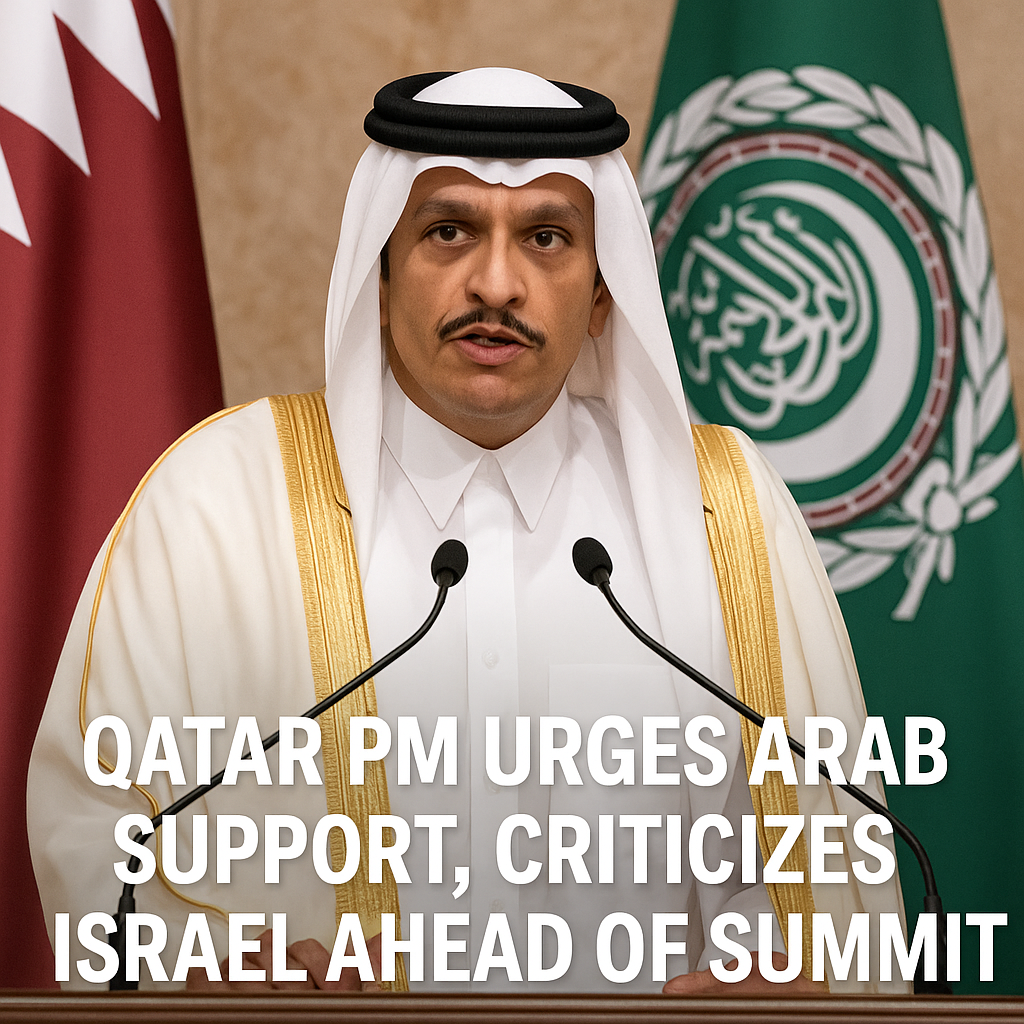
Qatar PM Urges Arab Support, Criticizes Israel Ahead of Summit

Qatar PM Urges Arab Support, Criticizes Israel Ahead of Summit
As tensions rise in the Middle East, Qatar’s Prime Minister has made a powerful appeal for Arab support while firmly criticizing Israel. This call comes just ahead of a pivotal summit, emphasizing regional unity in the face of ongoing conflicts.

Context of the Appeal
In recent weeks, the Israeli-Palestinian conflict has escalated, leading to increased violence and casualties. The Qatar PM’s statements resonate against this backdrop and reflect a broader concern among Arab nations regarding the humanitarian implications of the conflict. During his address, he labeled Israel’s actions as “barbaric,” urging Arab leaders to unite in their stance against what he characterized as aggression. This sentiment is echoed in reports from Al Jazeera, which highlight the need for a collective response to Israel’s policies towards Palestinians.


The urgency of this call to action underscores the fragility of the region’s political landscape. The PM’s remarks come as Arab governments grapple with internal pressures and external influences, necessitating a cohesive strategy moving forward.


Diverse Perspectives on the Crisis
The Qatar PM’s Perspective
Qatar has historically positioned itself as a mediator in the Israeli-Palestinian conflict, providing humanitarian aid while also participating in diplomatic discussions. The PM’s recent statements not only reflect Qatar’s long-standing humanitarian stance but also signal a pivot towards a more vocal opposition against Israel. He emphasized the importance of coordinated Arab engagement, arguing that the region’s stability hinges on solidarity among its nations.
Responses from Regional Leaders
The sentiment expressed by Qatar’s PM is not universally shared among all Arab leaders. Some countries have adopted a more cautious approach, focusing instead on bilateral relations and economic collaborations with Israel. While there is general agreement on the need for supporting the Palestinian cause, opinions diverge on how to approach Israel directly. For instance, some leaders view economic ties as essential for long-term regional stability, as evidenced by recent peace agreements between Israel and several Arab states.
International Reactions
International responses to the escalating conflict have also varied. Countries outside the Arab world have called for de-escalation and dialogue, with some openly criticizing Israel’s military actions while others stress the importance of security for all nations involved. Such contrasting views reflect the complex geopolitical dynamics at play, where actions taken by one party can evoke a wide range of reactions from the global community.
The Path Forward: Challenges and Opportunities
As the summit approaches, Qatar’s push for solidarity poses both challenges and opportunities for Arab nations. The call for unity is crucial; however, historical disputes and competing interests often hinder collective action. The PM’s assertion that the Arab world must rally around Palestinian rights aligns with a growing sentiment among the populace across many Arab nations, advocating for a stronger stance against perceived injustices.
Yet, the challenge remains: Will leaders prioritize solidarity over national interests? The divergent pathways taken by some Arab states suggest that while the rhetoric may lean towards support for Palestinian rights, practical steps often correlate with a country’s geopolitical aspirations.
Conclusion
The situation surrounding the Qatar PM’s appeal for Arab support against Israel illustrates the complexity of the Israeli-Palestinian conflict and regional politics. With strong sentiments on both sides, the upcoming summit will serve as a critical platform for Arab leaders to navigate their collective response. The outcome remains uncertain, as balancing national interests with regional solidarity presents a formidable challenge. As discussions unfold, one can only hope for steps that prioritize peace, humanity, and mutual understanding in this deeply affected region.















