
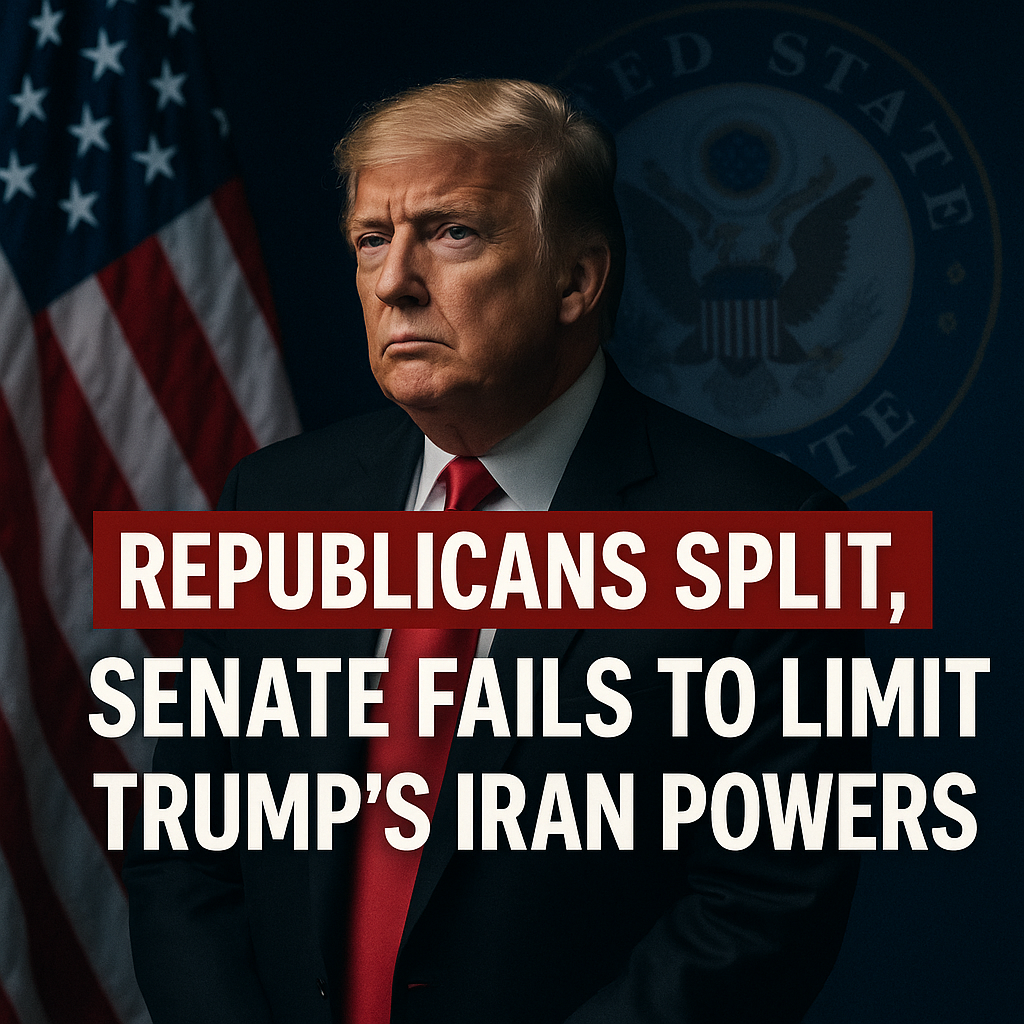
Republicans Split, Senate Fails to Limit Trump’s Iran Powers

In a significant political moment, the Senate has failed to impose restrictions on President Trump’s war powers concerning Iran, following a rare display of bipartisanship that saw three Republican senators break ranks with their party. This decision has sparked discussions regarding the balance of power between Congress and the Executive, illustrating the deep divisions within the Republican Party on matters of foreign policy and military intervention.

The Political Landscape
The move to limit Trump’s powers emerged in the context of rising tensions with Iran, as many lawmakers expressed concern about the potential for escalating conflict. Republican Senators Rand Paul, Mike Lee, and Susan Collins voted in favor of the resolution aimed at restricting Trumps’s use of military force without Congressional approval. Each senator provided differing rationales for their decisions, but a common theme was the belief in the Constitution’s provisions regarding war powers.


– Rand Paul emphasized a more restrained foreign policy, arguing that endless military engagements are detrimental to American interests and lead to unnecessary risks for U.S. service members.
– Susan Collins voiced her concern that the president’s current posture could lead to unintended escalations, echoing sentiments from constituents worried about the ramifications of military action.
– Mike Lee questioned the administration’s transparency and the intelligence surrounding Iran, suggesting a need for broader discussions on the matter before proceeding.


Despite this rare bipartisan support, the resolution faced significant opposition within the Senate, ultimately leading to its failure. Many Republican senators rallied around the President, arguing that curtailing his powers would undermine national security strategies at a time when U.S. interests were particularly threatened.
Divisions Within the Republican Party
This schism within the Republican Party brings to light the ongoing tension between Trump’s administration and traditional Republican values. While Trump’s supporters continue to advocate for a robust and aggressive foreign policy, a growing contingent of Republicans is calling for restraint and reevaluation of America’s role in global conflicts. The divide can be illustrated through the following perspectives:
– Pro-Trump Republicans: This faction argues for a strong, unwavering military presence that they believe is essential for deterrence against adversaries like Iran. They maintain that the executive branch must have the flexibility to respond quickly to threats.
– Cautious Republicans: In contrast, these members are prioritizing careful deliberation and accountability. They assert that Congress should play a significant role in matters of military engagement to ensure that military actions align with a broader strategic vision and do not spiral out of control.
The contrasting views have further strained party unity and raised concerns among political analysts about the future coherence of the GOP. As elections approach, this divide could resonate with voters who are increasingly attuned to how military engagement impacts both international stability and domestic priorities.
The Broader Implications
The Senate’s failure to pass the resolution not only reflects the internal conflicts within the Republican Party but also underscores broader issues at play regarding military authority and oversight. With the rise of populism and the instinct to favor presidential power in matters of national security, the legislative body finds itself grappling with how to reassert its role under the Constitution.
Moreover, public opinion is reacting to these developments, especially after the high-stakes backdrop of the Iran situation. Polls indicate that a significant portion of the American public desires more legislative oversight of military actions, especially following experiences in Iraq and Afghanistan that have led to prolonged engagements without clear objectives.
As foreign tensions continue to simmer, this legislative clash may set the stage for future debates over U.S. military policy, governance, and the delicate balance of power between Congress and the Executive. The future trajectory appears uncertain; as factions within the Republican Party grapple with their collective identity, the implications for U.S. foreign policy remain fluid and complex.
In conclusion, the Senate’s inability to limit Trump’s war powers signals a critical juncture in U.S. politics, marked by deepening divisions within the Republican Party and a growing call for accountability in matters of military force. As the landscape unfolds, stakeholders must remain vigilant and engaged in discussions to clarify the nation’s direction in an increasingly volatile global arena.















