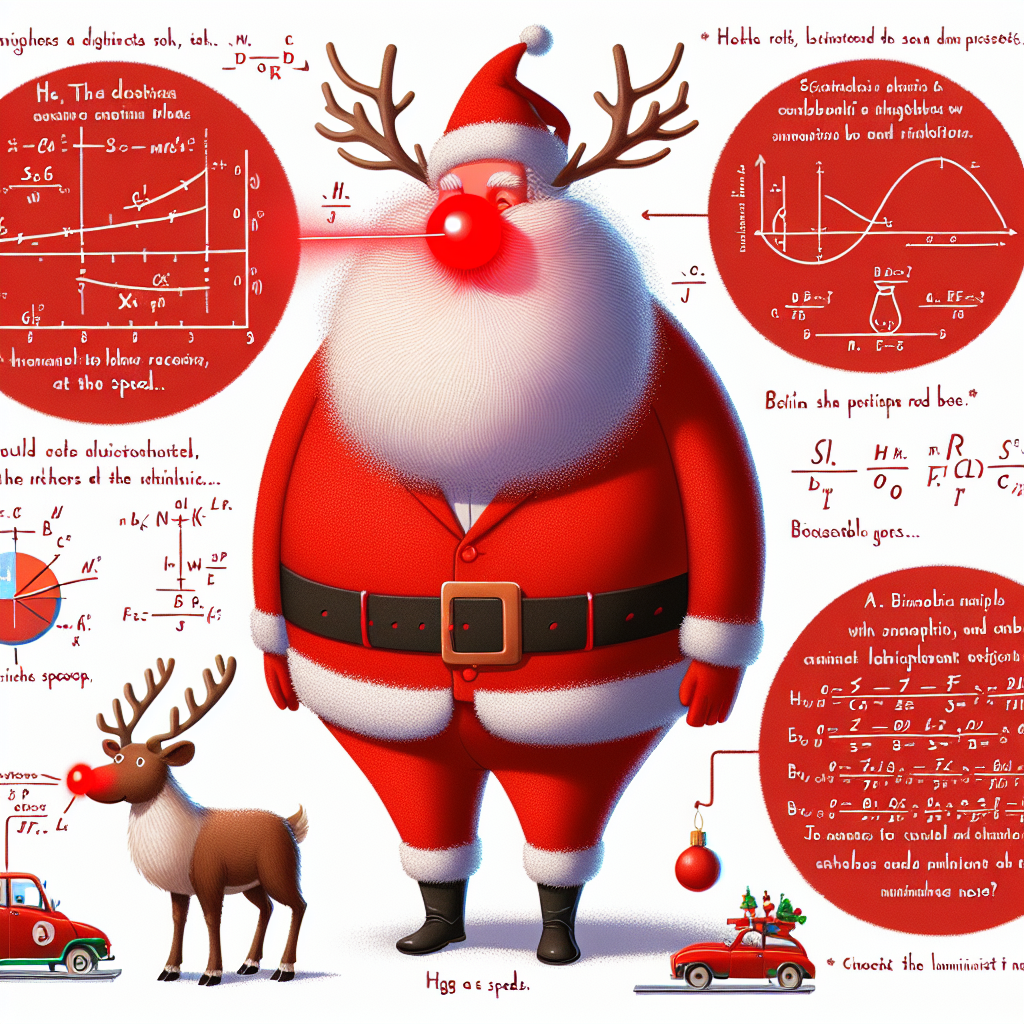
The Science Behind Santa’s Speed and Rudolph’s Glowing Nose

The Science Behind Santa’s Speed and Rudolph’s Glowing Nose
Introduction
Every Christmas, the magical journey of Santa Claus captivates the imagination of children and adults alike. But how does Santa manage to deliver gifts to millions of homes in just one night? And what is the secret behind Rudolph’s glowing nose? Let’s delve into the science that explains these festive phenomena.

Santa’s Super Speed
Time Dilation and Relativity
Santa’s ability to travel the world in a single night can be explained through the principles of time dilation, a concept from Einstein’s theory of relativity. By traveling at near-light speeds, time for Santa would slow down relative to those on Earth, allowing him more time to complete his deliveries.


Advanced Technology
- Quantum Tunneling: Santa could use quantum tunneling to bypass physical barriers, allowing for instantaneous travel between locations.
- Wormholes: Theoretical physics suggests that wormholes could provide shortcuts through space-time, enabling Santa to cover vast distances quickly.
Rudolph’s Glowing Nose
Bioluminescence
Rudolph’s nose could be an example of bioluminescence, a natural phenomenon where living organisms produce light. This is seen in creatures like fireflies and certain deep-sea fish.


Genetic Mutation
A unique genetic mutation might cause Rudolph’s nose to emit a red glow, similar to how some animals have evolved to have distinctive features for survival or attraction.
Conclusion
The enchanting tales of Santa’s speed and Rudolph’s glowing nose can be explored through the lens of science, offering fascinating explanations rooted in advanced physics and biology. While these theories add a layer of scientific intrigue, the magic of Christmas remains a cherished tradition that continues to inspire wonder and joy across the globe.