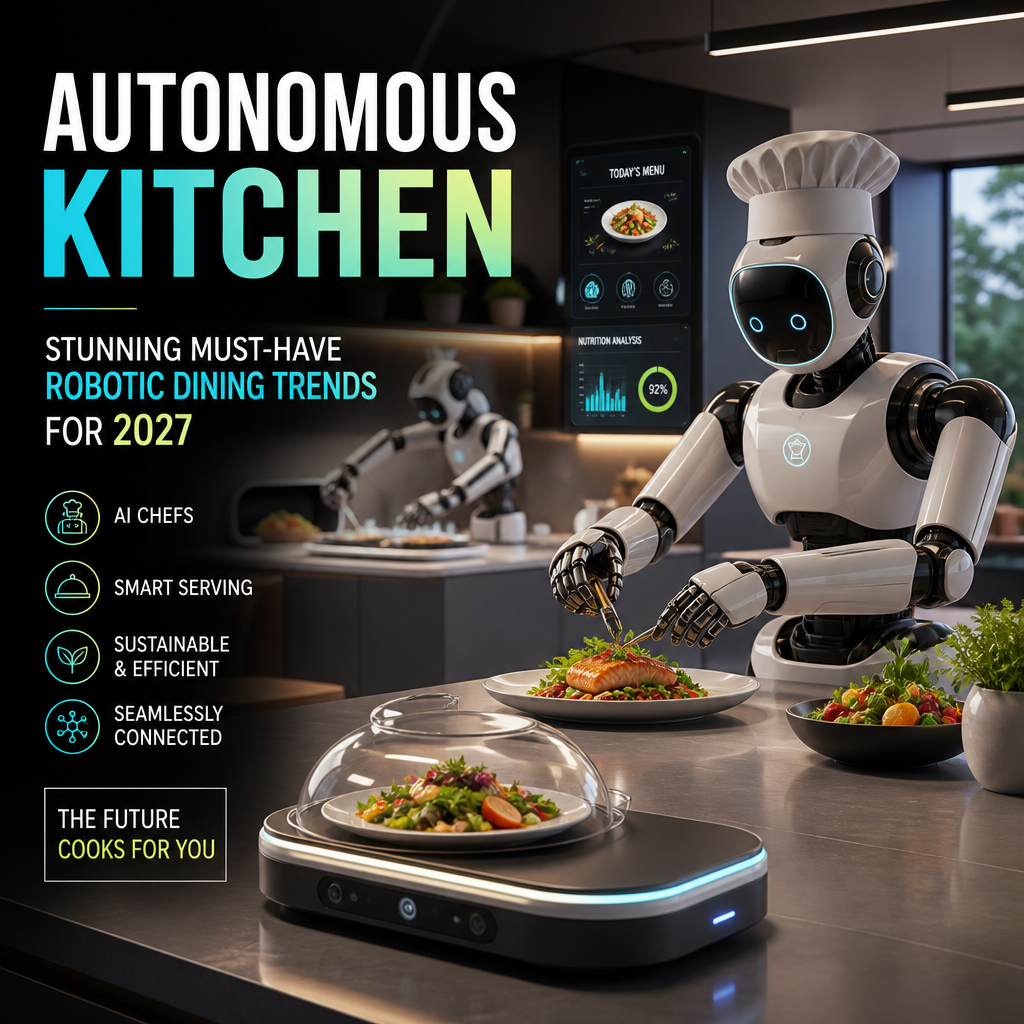
Autonomous Kitchen: Stunning Must-Have Robotic Dining Trends for 2027
The autonomous kitchen is quickly moving from science fiction to a practical dining model, and by 2027 it may become one of the most important forces reshaping how food is prepared, served, and scaled. As labor shortages, rising costs, and customer demand for speed continue to pressure the foodservice industry, robotic culinary systems are emerging as a powerful answer. These systems are no longer limited to novelty burger machines or single-task fry robots. They are evolving into coordinated, intelligent kitchen environments capable of managing multiple steps of food production with remarkable consistency.

What makes this shift so significant is not simply automation for its own sake. The autonomous kitchen represents a broader change in how restaurants, hotels, ghost kitchens, corporate cafeterias, and quick-service chains think about operations. Instead of relying entirely on human labor for repetitive cooking tasks, operators can use robotics, sensors, software, and machine learning to streamline production while improving accuracy, safety, and speed. By 2027, the best kitchens may be those that blend human creativity with machine precision.

What defines an autonomous kitchen?
An autonomous kitchen is a food preparation environment where robots and intelligent systems handle many of the repetitive or highly controlled tasks involved in cooking. This can include ingredient dispensing, chopping, mixing, grilling, frying, plating, cleaning, temperature monitoring, and inventory tracking. In a more advanced setup, the entire workflow can be coordinated by software that monitors demand, adjusts recipes, and keeps equipment operating efficiently.

The idea is not necessarily to replace chefs. Instead, it is to automate the tasks that are repetitive, time-sensitive, or difficult to staff consistently. In many cases, the human role shifts toward supervision, quality control, menu design, and customer experience. That balance is what makes autonomous kitchens appealing: machines bring consistency and scale, while people bring judgment, creativity, and hospitality.
Why 2027 matters for robotic culinary systems
The dining landscape of 2027 is likely to be shaped by several converging trends. First, the restaurant industry continues to face staffing challenges, especially for back-of-house roles that are physically demanding and often high turnover. Second, consumers increasingly expect fast service without sacrificing quality. Third, operators are under pressure to reduce waste, improve margins, and meet stricter food safety expectations.
Robotic culinary systems address all of these needs. A robot does not call in sick, forget a step in a recipe, or vary portions based on mood or fatigue. It can repeat the same process hundreds of times with precision, which improves consistency across locations. As the technology becomes more affordable and reliable, 2027 may be the point where adoption moves beyond pilot projects and into mainstream deployment across multiple food segments.
Core technologies powering the autonomous kitchen
Several technologies are coming together to make autonomous kitchens viable.
Robotics and motion systems
Robotic arms, conveyor systems, and specialized cooking devices can now perform tasks that once required manual dexterity. These systems can chop ingredients, flip burgers, dispense sauces, and plate food with increasing accuracy. Their value lies in repeatability and speed, especially in high-volume environments.
Computer vision and sensing
Cameras, heat sensors, weight sensors, and depth perception tools help kitchens understand what is happening in real time. A robot can identify whether a steak has reached the proper sear, whether a pan is overheating, or whether a plate has been filled correctly. This sensor-based feedback reduces mistakes and helps systems self-correct.
Artificial intelligence and predictive software
AI makes autonomous kitchens adaptive rather than merely mechanical. Software can forecast demand based on time of day, historical sales, weather patterns, or local events. It can also optimize cooking order to reduce bottlenecks and energy use. In some cases, AI can even adjust ingredient quantities or recommend menu tweaks based on performance data.
Cloud connectivity and kitchen management platforms
Modern robotic kitchens often depend on networked systems that connect equipment, recipes, ordering, and inventory in one place. These platforms help managers monitor operations remotely, track machine health, and plan maintenance before breakdowns occur. That level of visibility is crucial for scaling.
How dining operations will change by 2027
The biggest impact of autonomous kitchens will be operational. Restaurants will be able to produce food more predictably, with fewer staffing gaps and less waste. A robotic system can portion ingredients precisely, which reduces overuse and improves cost control. It can also help standardize quality across multiple sites, which is especially valuable for chains and franchise models.
Speed will improve as well. In a traditional kitchen, one delayed station can slow the whole line. In an autonomous setup, tasks can be synchronized to reduce wait times and keep orders moving. That can translate into faster drive-thru service, better lunch rush performance, and more efficient delivery preparation.
Another major shift is location flexibility. Autonomous kitchens are well suited to compact or nontraditional spaces, which means operators can open in places where labor availability is limited. This could support more ghost kitchens, micro-restaurants, airport concessions, campus dining programs, and urban fulfillment kitchens.
Benefits for operators and consumers
For operators, the benefits are straightforward: lower labor dependency, improved consistency, tighter inventory control, and better throughput. Food businesses can also use robotics to expand hours of operation, since machines can work during late-night or off-peak periods with fewer staffing concerns. In some settings, autonomous systems may reduce workplace injuries by handling repetitive lifting, cutting, or high-heat tasks.
For consumers, the upside includes faster service, more uniform quality, and potentially more customization. Automated systems can be programmed to prepare specific dietary variations without slowing down the line too much. That could make it easier to serve gluten-free, low-sodium, vegetarian, or allergen-aware meals at scale.
There is also a trust factor. When robots prepare food in a tightly monitored environment, customers may feel more confident about cleanliness and process control. While not every diner will prefer a fully automated experience, many will appreciate reliable execution, especially in fast-casual and convenience-driven contexts.
Challenges that still need solving
Despite the promise, autonomous kitchens are not without hurdles. The biggest challenge is cost. Advanced robotic systems require significant upfront investment, and operators need clear return-on-investment models before committing. Maintenance, software updates, and integration with existing kitchen layouts can also be complex.
Menu design is another limitation. Robots are best at standardized, repeatable tasks, which means highly intricate or constantly changing menus can be difficult to automate. Many successful deployments will likely focus on items that can be prepared in controlled steps rather than highly improvisational cuisine.
There are also human concerns. Employees may worry about job displacement, and customers may resist a dining experience that feels too impersonal. Successful adoption will depend on clear communication and thoughtful redesign of roles, so that automation supports the workforce instead of simply replacing it.
The new role of chefs and kitchen staff
By 2027, chefs may spend less time on repetitive prep and more time on development, oversight, and innovation. In an autonomous kitchen, the most valuable human contributions may include menu engineering, quality auditing, guest interaction, and troubleshooting exceptions that machines cannot handle well. Staff may also become system supervisors, ensuring that robotic equipment is calibrated correctly and that food standards remain high.
This creates a different career path in foodservice. Workers may need skills in digital monitoring, equipment management, and systems thinking. The kitchen of the future will likely reward technical fluency as much as traditional culinary training.
What to expect in the dining experience of 2027
Consumers in 2027 may not always see the robots working behind the scenes, but they will feel the effects. Orders will likely arrive faster and more consistently. Menus may become more modular, built around machine-friendly workflows. Kitchens may communicate wait times more accurately because the production process is data-driven. In some venues, diners may even watch the cooking process as part of the experience, turning automation into a brand differentiator.
The most successful dining concepts will probably be hybrid. Human staff will handle hospitality, creativity, and problem-solving, while robotic culinary systems manage precision tasks and heavy production loads. That blend could define a new standard for efficient, scalable, and resilient foodservice.
The autonomous kitchen is not just about replacing labor with machines. It is about designing a smarter kitchen ecosystem that can respond to real-world pressures while delivering better outcomes for operators and guests alike. By 2027, the restaurants that embrace this shift may have a strong advantage in speed, consistency, and resilience, setting the stage for a new era in dining.