
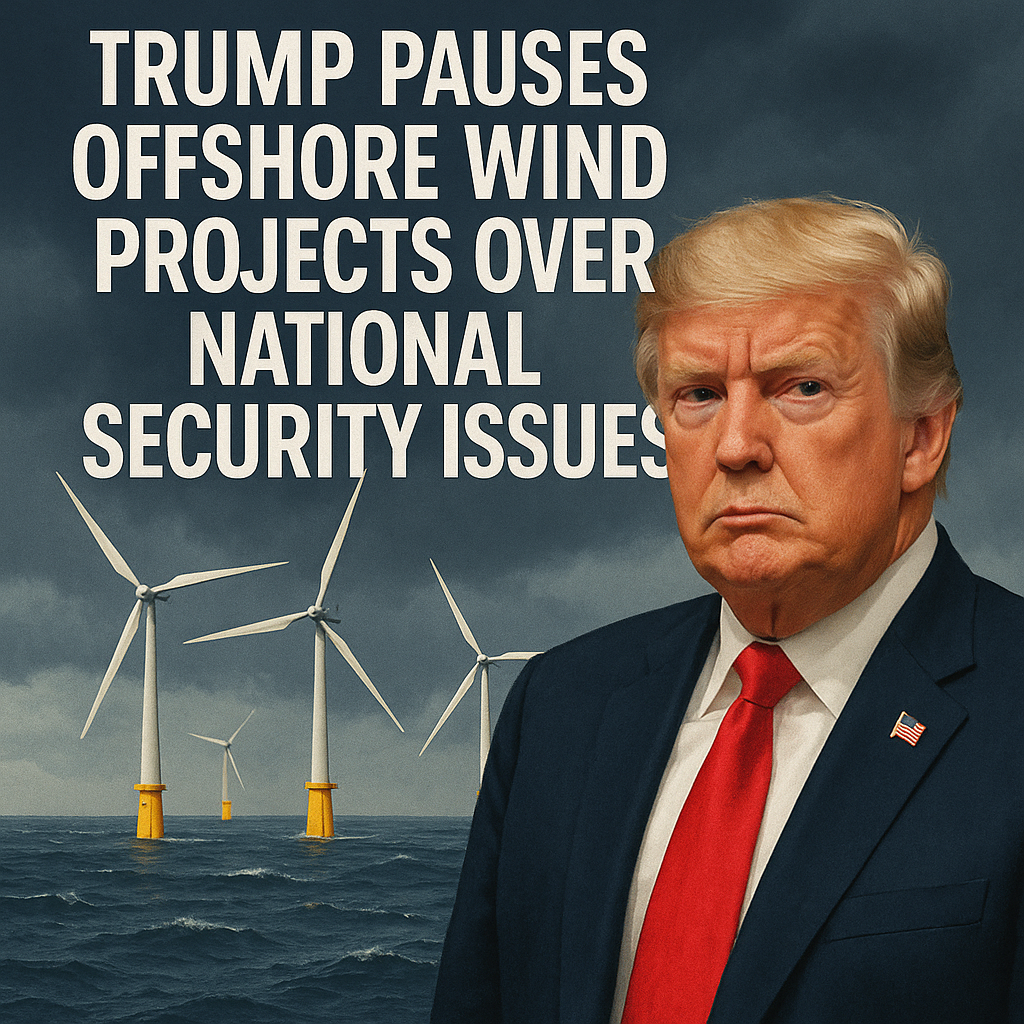
Trump Pauses Offshore Wind Projects Over National Security Issues

Trump Pauses Offshore Wind Projects Over National Security Issues
In a surprising move, former President Donald Trump announced a pause on several offshore wind projects, citing national security concerns. This development has stirred a complex debate about the intersection of renewable energy and national security, as various stakeholders assess the implications of such a decision.

The Controversial Decision
The decision to halt these offshore wind initiatives has sparked a flurry of responses from environmental advocates, industry experts, and political commentators. Touted as a significant step towards renewable energy, the paused projects included developments off the coast of New Jersey and other Eastern states. Trump’s administration claims that foreign entities, particularly those from China, could exploit these projects to gather intelligence or damage national infrastructure.


Divergent Perspectives in the Debate
While national security remains a legitimate concern for any administration, the abrupt pause on these projects has not been without criticisms. For instance, environmental groups argue that this decision undermines efforts to combat climate change and transition to renewable energy sources. An Al Jazeera report highlighted that while national security must be taken into consideration, the long-term benefits of offshore wind energy—reduction in carbon emissions and energy independence—should not be sacrificed.


Conversely, some industry insiders express understanding towards Trump’s position, noting that foreign investments in critical infrastructure can pose risks. As reported by RT, there is a growing sentiment among certain lawmakers and stakeholders that enhanced scrutiny of overseas investments is vital, especially in sectors crucial for national security.
Notably, this decision reflects a broader trend in U.S. politics where energy policy is increasingly entwined with national security considerations. Some sources suggest that this could lead to regulatory changes that make it more difficult for foreign entities to invest in renewable projects, impacting innovation and competition in the sector.
The Practical Implications for Offshore Wind
The practical implications of pausing these projects are manifold. Initially, there may be delays in transitioning to renewable energy which could affect job creation in the growing green technology sector. A Sky News article pointed out that the offshore wind industry is seen as a critical component in meeting the U.S. economy’s clean energy targets by 2030, potentially stalling progress in a rapidly evolving sector.
Furthermore, this decision could signal a shift in how future energy projects are approached vis-à-vis foreign investments. If the regulatory landscape becomes more stringent, developers might face longer timelines and increased costs—potentially deterring investments. This could be detrimental in a marketplace that is increasingly competitive on a global scale, as countries around the world race to establish their own renewable energy capacities.
Weighing National Security Against Renewable Energy Goals
This pause raises significant questions: Is the potential risk to national security substantial enough to justify the slowdown in offshore wind projects? Are there more balanced approaches that can mitigate risks without completely halting progress in renewable energy? Such considerations are necessary for crafting policies that prioritize both energy independence and national security.
The ongoing discourse reflects a broader challenge faced by policymakers: balancing environmental sustainability with the protection of national interests. Opinions vary among experts, with some arguing for a comprehensive review process that considers both viewpoints, while others advocate for an outright freeze on foreign involvement in renewable energy projects until a clear framework is established.
In the debate surrounding Trump’s decision, there is an underlying challenge: how to encourage innovation in renewable energy while also safeguarding national interests. This challenging balancing act will likely influence future energy strategies in the U.S. and beyond.
Conclusion
As the conversation around President Trump’s pause on offshore wind projects evolves, it is clear that both national security and renewable energy are pressing issues that require careful scrutiny. While halting projects may address immediate concerns, the long-term implications for the environment and the economy must not be overlooked. The need for a balanced approach that safeguards national security while progressing towards greener energy solutions remains paramount.
Ultimately, the dialogue surrounding this issue must continue as stakeholders from various ends of the spectrum come together to forge a path forward that prioritizes both national safety and sustainability. Whether a compromise can be reached is yet to be seen, but it’s vital for the future of energy and national security.















