
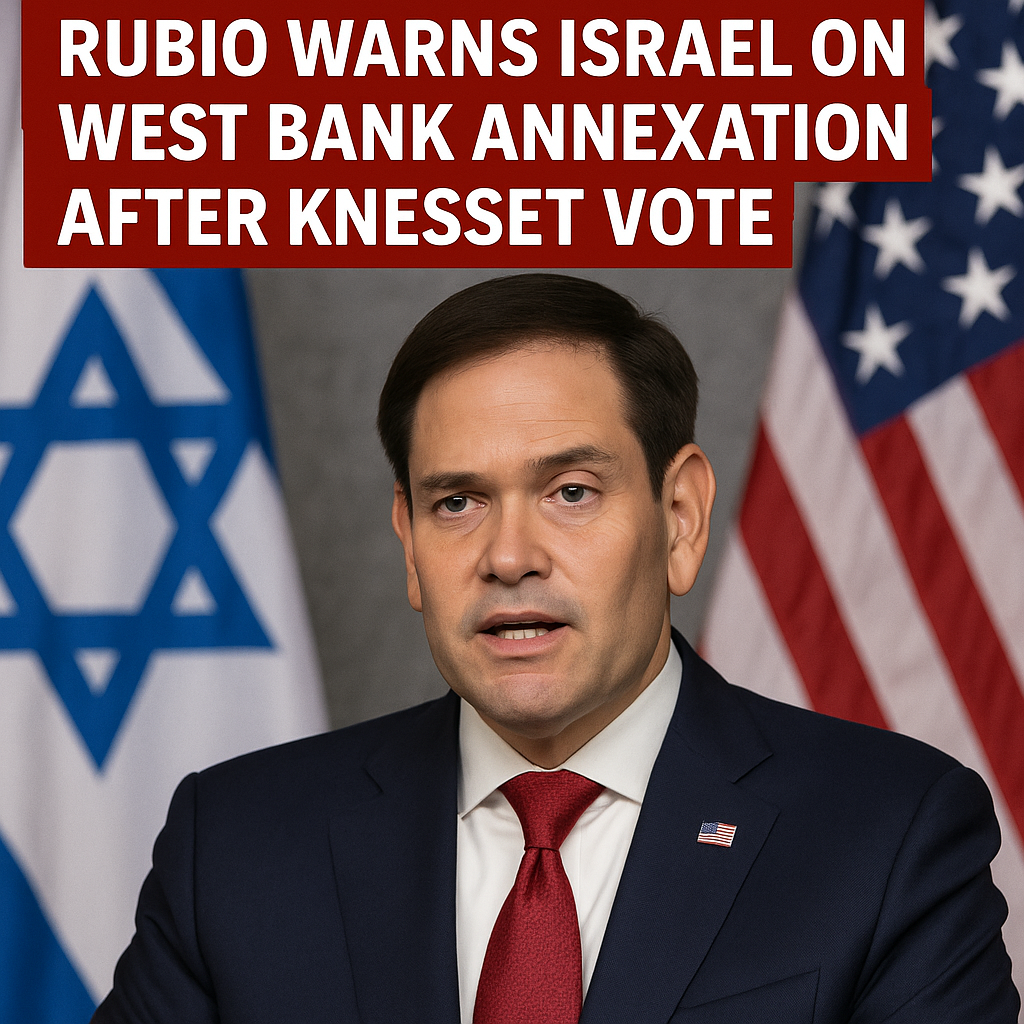
Rubio Warns Israel on West Bank Annexation After Knesset Vote
Rubio’s Cautionary Stance on Israeli Annexation Following Knesset Vote
Senator Marco Rubio recently expressed significant concerns regarding Israel’s potential annexation of parts of the West Bank, following a pivotal vote by the Israeli Knesset. This warning speaks volumes about the evolving dynamics in the region and the complexities that underpin U.S.-Israeli relations.

The Knesset Vote: A Controversial Turning Point
The Knesset’s recent vote has reignited debates surrounding the annexation of certain West Bank territories, an issue that has long since polarized both Israeli and Palestinian communities. While some Israeli lawmakers view annexation as a crucial step toward further solidifying Israel’s claim over the West Bank, others—including international observers—caution against it, warning that such a move could exacerbate tensions between Israelis and Palestinians.

Rubio’s comments underscore a broader apprehension held by various observers of the Middle Eastern landscape. In a statement, he emphasized that annexation would complicate relations not only with Palestinians but also with neighboring Arab nations. This sentiment resonates with those who see Israel’s expanded territorial claims as a potential source of destabilization in an already volatile region. Moreover, Rubio pointed out that any unilateral actions taken by Israel could have implications for U.S. support and influence in the Middle East.

Diverse Perspectives on Annexation
Reactions to the Knesset vote and ensuing discussions on annexation exhibit a wide array of viewpoints, both supportive and critical. Proponents of annexation argue that Israel has a historical and theological claim to the land, asserting it as an integral part of its national identity. They contend that Israeli sovereignty over the West Bank is necessary for national security and would deter future aggression from neighboring Arab states.
Conversely, critics of the proposed annexation articulate concerns regarding its impact on the long-stalled peace process. Palestinian leadership has stated that annexation would effectively end any hope for a two-state solution, which many believe is essential for achieving lasting peace. Additionally, international observers and human rights organizations maintain that annexation could increase illegal settlements, further complicating negotiations over territory.
Interestingly, recent surveys indicate that many Israelis remain divided on the issue. While a portion of the population supports annexation, there are equally significant voices advocating for diplomatic solutions. This nuanced public opinion illustrates the complexities involved, as support or opposition can be deeply influenced by evolving political contexts.
Implications for U.S. Foreign Policy
Rubio’s remarks draw attention to the delicate balance the U.S. must maintain regarding Israel and Palestine. Historically, the U.S. has been one of Israel’s staunchest allies, often providing political and military support. However, unilateral moves like annexation raise questions about the future of U.S. involvement in peace negotiations—a central pillar of American foreign policy in the region.
Moreover, Rubio’s warning highlights potential ramifications for U.S.-Arab relations. Should Israel proceed with the annexation, it could sour relations with key Arab nations that have engaged in recent normalization agreements with Israel, such as the UAE and Bahrain. There are indications that these countries would consider their ties to Israel contingent upon its adherence to the principles of a two-state solution.
Some analysts argue that the U.S. cannot simply endorse all Israeli policies, especially those perceived as exacerbating tensions. They suggest that nuanced diplomatic efforts should aim to facilitate dialogue between Israelis and Palestinians, rather than supporting unilateral actions that could lead to broader conflict.
A Complicated Future
While Rubio’s warning encapsulates significant concerns, it also reflects the broader complexities surrounding the Israel-Palestine issue. The Knesset’s vote and the potential for annexation continue to invoke a spectrum of opinions that are often deeply influenced by historical narratives, human rights discussions, and geopolitical calculations.
The path ahead remains uncertain. Both internal Israeli politics and the dynamics of Palestinian governance, including divisions between the Palestinian Authority and Hamas, complicate matters further. As the world watches closely, the hope remains that thoughtful dialogue and considerations of mutual respect will prevail over unilateral actions that threaten to exacerbate conflict.
In conclusion, the unfolding situation in Israel and the West Bank remains intricate and fraught with challenges. Rubio’s cautionary stance is just one perspective in a broader, ongoing conversation about how to navigate the tensions and aspirations of all involved. As events continue to evolve, it is vital that voices from both sides are included in the dialogue, ensuring that pathways to peace are prioritized over division.















