
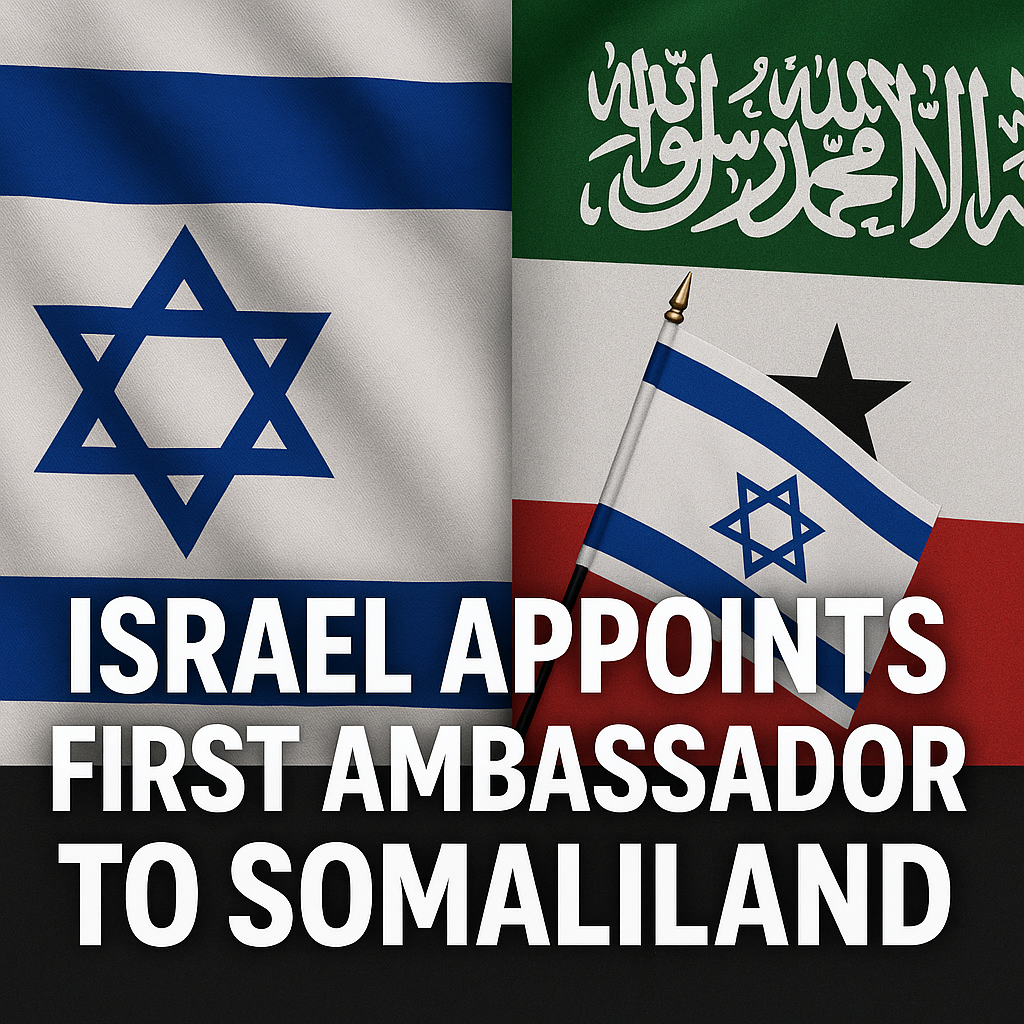
Israel Appoints First Ambassador to Somaliland
Israel Appoints First Ambassador to Somaliland
In a landmark diplomatic move, Israel has appointed its first ambassador to Somaliland, marking a significant step in international relations within the Horn of Africa. This development highlights not only Israel’s interest in Somaliland but also the shifting geopolitical dynamics in the region.

The Significance of the Appointment
Somaliland, a self-declared independent region of Somalia, has been seeking international recognition for years. Despite declaring independence in 1991, Somaliland has not received formal recognition from the United Nations or most countries, making Israel’s decision particularly noteworthy. By appointing an ambassador, Israel signals its willingness to engage with Somaliland and potentially support its aspirations for greater autonomy on the global stage.

Diverse Viewpoints on the Appointment
This development has elicited a spectrum of responses from various geopolitical analysts and media outlets. Some commentators hail the move as a pragmatic recognition of Somaliland’s stability and its strategic position in a historically tumultuous region. For instance, analysts from Al Jazeera have pointed out that Israel can benefit from Somaliland’s relatively stable governance, especially in a region rife with conflict. This new diplomatic relations may also lead to increased investments and trade opportunities for both parties.

On the other hand, critics argue that this could complicate Somalia’s fragile political landscape. The Somali central government has consistently opposed Somaliland’s push for recognition and has termed Israel’s move as an affront to its sovereignty. RT has reported concerns that strengthening ties with Somaliland could embolden separatist movements in Africa, potentially leading to further regional instability.
Economic and Strategic Implications
Israel’s appointment of an ambassador to Somaliland also holds significant economic implications. The Horn of Africa has been gaining importance due to its strategic maritime routes and natural resources. Israel could leverage its relationship with Somaliland to establish trade partnerships, access resources, and enhance its standing in Africa.
Moreover, the diplomatic engagement may pave the way for technological collaboration. Israel has a robust tech sector and expertise in various development areas, from agriculture to cybersecurity. For Somaliland, which is exploring avenues to bolster its economy, these partnerships could prove instrumental in fostering growth and improving service delivery.
A Broader Context of Middle Eastern Relations
This move is not happening in isolation; it forms part of a broader trend of Middle Eastern nations seeking to extend their influence in Africa. Countries such as the United Arab Emirates and Saudi Arabia have also been strengthening ties with various African nations. Israel’s recent normalization of relations with several Arab countries, under the Abraham Accords, has reset its diplomatic approach. By establishing a presence in Somaliland, Israel is not only diversifying its diplomatic portfolio but also potentially countering Iranian influence in the region.
However, there is a looming uncertainty regarding the long-term implications of these shifting alliances. While some see the potential for a more cooperative Middle East and African relationship, critics caution against the pitfalls of treating diplomatic appointments solely as geopolitical chess moves.
Closing Thoughts: A Carefully Navigated Diplomatic Path
Israel’s decision to appoint its first ambassador to Somaliland reflects both an acknowledgment of Somaliland’s unique status and a deeper strategy to bolster its global influence. While there are promising opportunities for economic cooperation and strategic partnerships, the complex realities of regional politics reveal that this relationship must be carefully navigated.
As these diplomatic ties develop, it remains to be seen how they will play out among Somaliland’s desire for recognition, Somalia’s assertions of sovereignty, and broader geopolitical interests in the region. The appointment is a significant development that could reshape interactions in the Horn of Africa, underscoring the intricate tapestry of international relations that continues to evolve.















