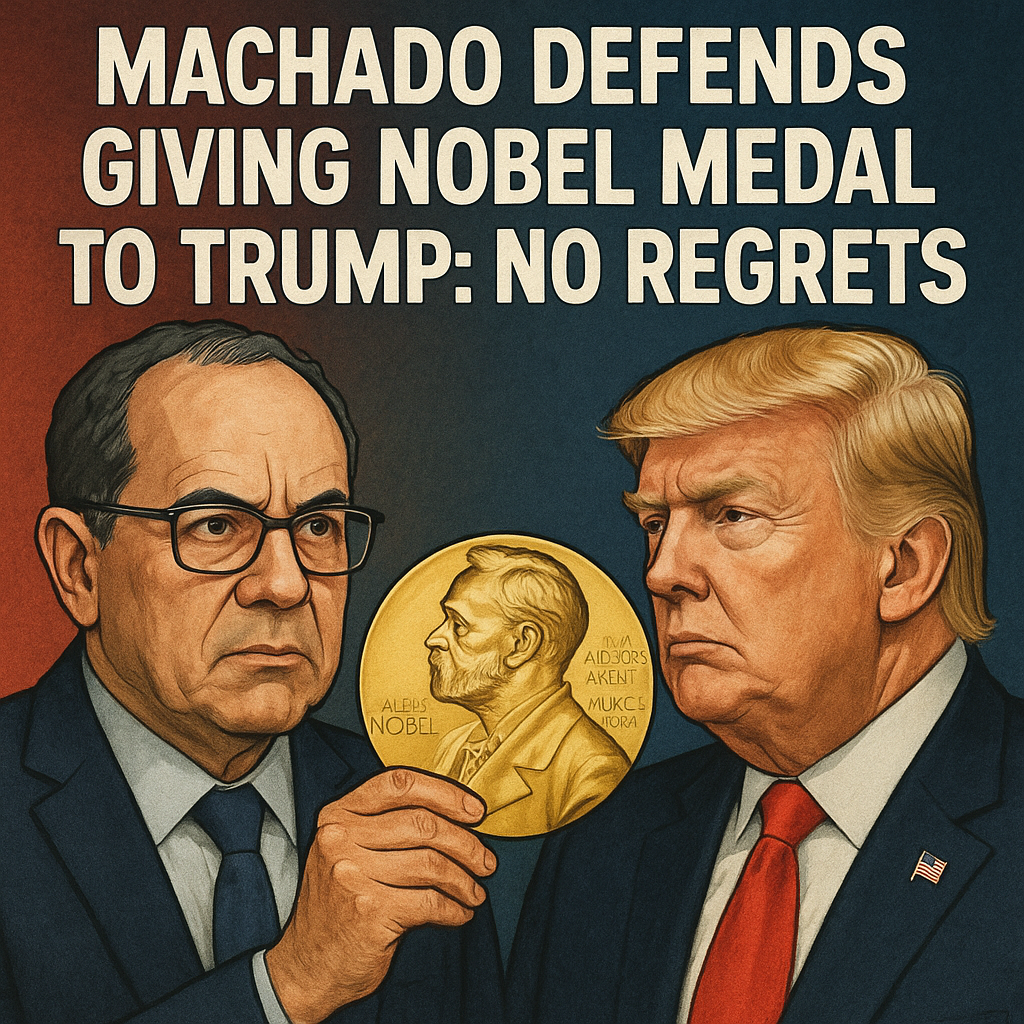
Machado Defends Giving Nobel Medal to Trump: No Regrets
Machado Defends Giving Nobel Medal to Trump: No Regrets
In a surprising turn of events, Venezuelan politician María Corina Machado stands firm in her decision to award her personal Nobel Prize to former U.S. President Donald Trump. This controversial choice has sparked wide debate, illustrating the complexities of international politics and the intersection of personal ideologies with broader geopolitical realities.

The Context of Machado’s Decision
María Corina Machado, a prominent figure in Venezuela’s opposition movement, presented Trump with the Nobel medal during an event aimed at recognizing leaders who advocate for democracy and freedom. This decision has been met with both support and criticism across the political spectrum. Advocates view her action as a bold statement that highlights Trump’s contentious but pivotal role in supporting Venezuelan democracy through sanctions and diplomatic pressure against the Maduro regime.

Machado argues that embracing Trump reflects a pragmatic approach to securing freedom for Venezuela. “Sometimes, you must shake the tree to get the fruit,” she stated during her announcement. She emphasizes the need for anti-Maduro allies to unite, regardless of their political backgrounds, highlighting that facing a common enemy often requires unconventional alliances.

However, this decision has led to a cacophony of responses. Critics, particularly within Venezuela, argue that honoring Trump undermines the complexities of Venezuelan politics and caters to populist narratives. They assert that while international support is crucial, it should not be tied to controversial figures whose policies may not align with democratic values as perceived by many Venezuelans.
Diverse Reactions from the Global Community
The global response to Machado’s act has been mixed. Supporters argue that Trump’s tenure, marked by a vocal anti-Maduro stance, warrants recognition, especially for those suffering under the current regime. Prominent commentators have suggested that the gesture symbolizes a broader call for solidarity among those fighting against tyranny, drawing parallels between Machado’s decision and other historical instances of unconventional diplomacy.
Conversely, critics from various sectors point to Trump’s polarizing legacy as a reason to reject any form of validation through awards. In their view, honoring Trump sends a troubling message about the nature of democracy and what leaders might be deemed worthy of recognition. The argument follows that alternative diplomatic channels exist which focus on fostering democratic ideals without endorsing controversial figures.
The debate extends beyond national borders, reflecting varying perspectives on democracy, leadership, and human rights. In Latin America, the sentiment towards Trump is particularly nuanced; different countries and political movements harbor distinct opinions on U.S. involvement in regional affairs. While some welcome U.S. cooperation, others are wary of foreign intervention based on previous historical traumas.
The Consequences of Machado’s Actions
Machado’s firm stance not only affects her political image but also the landscape of Venezuelan politics and its relationship with the United States. By aligning herself openly with Trump, she has positioned herself in a manner that could polarize her support base. This could either empower her with new allies or alienate those who are resistant to associating with figures seen as divisive.
Furthermore, this move reflects broader implications in international diplomacy, particularly regarding the integration of leaders with significantly varying global views and policies. Critics warn that such decisions might complicate diplomatic relations, as Trump’s past administration is often seen as erratic and self-serving. Therefore, the implications of Machado’s decision may reach far beyond the personal or even national levels, affecting how leaders interact on the global stage.
In this evolving scenario, it remains to be seen whether Machado’s unyielding support for Trump will bolster her political aspirations or bring about unforeseen challenges. As the dialogue around leadership and democracy continues, her actions will likely influence future strategies for Venezuelan advocacy and opposition movements.
Conclusion: Uncertainty and Debate
Machado’s determination to celebrate Trump’s role in the fight against Maduro provokes critical discussions on the nature of democracy and international alliances. While her motives are clear in seeking greater support for Venezuelan freedom, the choice to honor a divisive figure like Trump leaves much to debate. This complexity reflects ongoing conversations surrounding leadership, international relations, and the varied perceptions of democracy itself.
Ultimately, the political landscape remains fluid, and Machado’s approach may either serve as a catalyst for change or highlight the broader ideological rifts that persist within and beyond Venezuela. The only certainty lies in recognizing that diverse opinions will continue to shape the narrative surrounding this contentious issue. As the community navigates through this provocative moment, it is vital to remain open to the complexities inherent in such geopolitical discussions.