
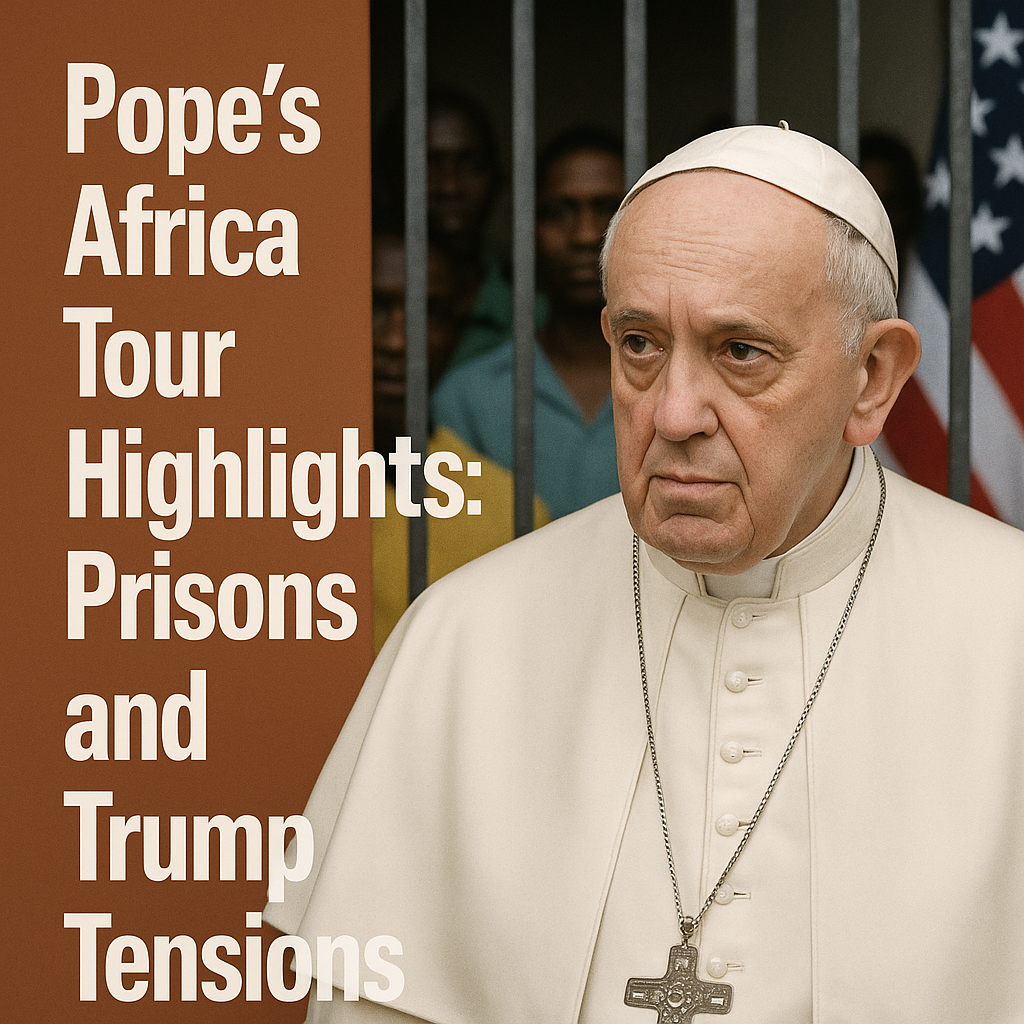
Pope’s Africa Tour Highlights: Prisons and Trump Tensions
Pope’s Africa Tour Highlights: Prisons and Trump Tensions
The Pope’s recent Africa tour brought together significant themes of spirituality, social justice, and unexpected political tensions, particularly concerning former President Donald Trump. This article delves into the nuanced moments of the Vatican’s outreach in Africa, from poignant prison visits to confrontations in the political arena.

A Celebration of Compassion and Justice
Pope Francis concluded his Africa tour with a visit to a local prison, a poignant reminder of the Church’s mission to advocate for social justice and compassion. This visit resonates deeply in a continent where many face systemic injustices and human rights abuses. The Pope emphasized the importance of rehabilitation over punishment, urging prison reform to align with restorative justice principles.

The Power of Redemption
During his address at the prison, Francis stated, “No one is beyond hope.” This message is particularly important in regions like Africa, where overcrowded and underfunded prisons are common. Advocates for human rights believe that the Pope’s focus on such issues can create awareness and possibly inspire reforms in systemic practices across the continent.

Several reports highlight local reactions, with many African leaders praising the Pope’s willingness to engage with marginalized communities. As noted by Al Jazeera, these visits symbolize a broader commitment to social issues that persist in several African nations, where economic stability does not always equate to social justice.
Political Tensions: The Trump Factor
While the Pope’s focus on human rights resonates, his recent remarks concerning the political climate in the United States, particularly in relation to Donald Trump, sparked significant discourse. The Vatican has been at odds with some aspects of Trump’s policies, especially those seen as exclusionary towards immigrants and refugees.
In a noteworthy exchange, Trump responded to the Pope’s allusion to populist leaders capitalizing on fear and division, stating, “If these leaders really care, why don’t they help?” This tension draws a spotlight on how religious leaders are navigating an increasingly polarized political environment.
Divergent Perspectives
Various news sources presented contrasting interpretations of this interaction. Sky News emphasized the Pope’s call for compassion and solidarity, casting him as a moral leader standing against divisive rhetoric. On the other hand, Russian news outlet RT suggested that Trump’s response signifies a broader narrative of tensionsbetween religious interpretations and political realities in the West.
This dialogue illustrates how a global religious figure can inadvertently emerge as a political symbol, sometimes overshadowing the original intent of spiritual messages. Moreover, it raises questions about how religious leadership should engage with contemporary political challenges without compromising their moral authority.
Bridging Cultures through Dialogue
The Pope’s Africa tour was more than just a series of events; it was an attempt to bridge cultural divides and advocate for a more united future. By participating in dialogues that include homeless individuals and incarcerated populations while also addressing the political climate in the United States, Francis is attempting to engage a wide array of audiences.
The Aftermath: Potential Impact
The implications of the Pope’s visit may resonate for years. It is anticipated that his messages will influence local and international conversations about human rights, offering hope to those whose voices have been historically marginalized. The conversations around prison reform highlighted during his visit could spur local initiatives and inspire biblical principles of compassion within governmental policies.
Moreover, the political dialogue surrounding Trump emphasizes the need for global leaders to engage with complex international issues. The Pope’s example shows that spiritual authority can intersect with political discourse, driving conversations that may lead to transformative outcomes.
Conclusion
The Pope’s recent tour highlights the intricate web of spirituality, social justice, and political engagement. His focus on marginalized communities underscores a universal call for compassion, while his public disagreements with political figures like Trump illuminate the challenges of navigating these intertwined spheres. In a world increasingly defined by division, the Pope’s outreach serves as a powerful reminder of the enduring need for empathy and dialogue across cultural and political boundaries.
Through these experiences in Africa, Pope Francis continues to champion a vision of hope, emphasizing that real change begins with understanding and compassion—principles that resonate far beyond the confines of any single nation or political ideology.















