
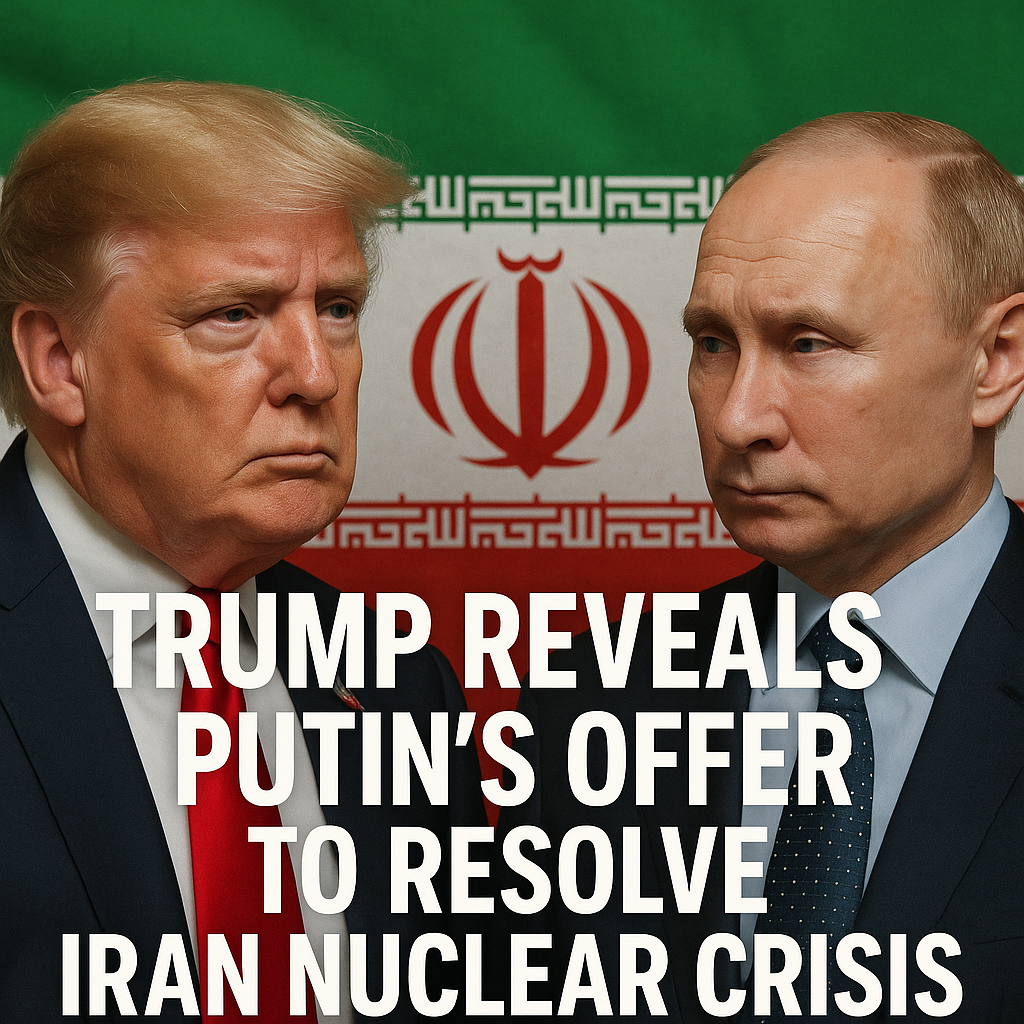
Trump Reveals Putin’s Offer to Resolve Iran Nuclear Crisis
Trump Reveals Putin’s Proposal for Iran Nuclear Resolution: A Complex Diplomatic Landscape
Former President Donald Trump’s recent revelation regarding an offer from Russian President Vladimir Putin to help navigate the Iranian nuclear crisis has stirred considerable attention and debate. The geopolitical implications of this overture resonate deeply within the ongoing discussions surrounding Iran’s nuclear ambitions and international diplomacy.

Context of the Iranian Nuclear Crisis
For years, the Iranian nuclear program has been a contentious issue, involving various international stakeholders. Following the U.S. withdrawal from the Joint Comprehensive Plan of Action (JCPOA) in 2018, tensions escalated as Iran resumed nuclear activities that had previously been curtailed. The situation has led to conflicting opinions on how best to address the potential nuclear threat posed by Iran.

The offer disclosed by Trump raises critical questions about Russia’s role in this geopolitical stalemate. Both Iran and Russia have fostered ties while simultaneously confronting U.S. interests in the region. Hence, Putin’s willingness to broker a deal could signal a shift in alliances or strategies on the part of Russia.

Diverse Perspectives on Putin’s Involvement
The divergence in viewpoints surrounding Putin’s offer highlights the complexity of international diplomacy. For some analysts, Putin’s interest could be viewed as an opportunistic maneuver to expand Russian influence in a pivotal region. According to a source from Sky News, Putin’s readiness to meddle in such negotiations could demonstrate Russia’s expanding role as a counterweight to U.S. power, especially in the Middle East.
Conversely, proponents of engaging with Russia argue that incorporating Moscow into these dialogues could yield substantial benefits. Al Jazeera has reported that a collaborative approach, where significant powers work together, may lead to more durable diplomatic solutions, allowing for better control over Iran’s nuclear trajectory.
The Fine Line of International Diplomacy
While Trump’s comments shed light on an intriguing development, opinions diverge regarding the efficacy of involving Russia in the Iran nuclear discussion. On one hand, some observers argue that Putin’s track record in foreign affairs might cast doubt on his motives. The Kremlin’s actions in Ukraine and its long-standing partnerships with regimes like that of Iran raise skepticism about Russia acting as a neutral mediator.
On the other hand, others posit that a multifaceted approach that includes a major power like Russia could be necessary for any sustainable resolution. Diplomatic success would likely depend on the nuanced interplay of various interests, emphasizing the importance of collaboration over isolationist strategies.
Uncertainty and Future Trajectories
The reception of Trump’s statement has not been uniform. Some commentators express optimism that engaging Russia could lead to breakthrough negotiations, while others caution against placing too much faith in a power perceived as increasingly antagonistic towards the West. In balancing these viewpoints, it becomes evident that while the intention appears to be constructive, the potential pitfalls are equally significant.
Furthermore, the Iranian leadership has often demonstrated unpredictable behaviors in response to international overtures. The upcoming political climate in Iran, particularly with potential leadership changes, adds another layer of uncertainty. Recent reports suggest that Iran remains adamant about pursuing its nuclear program, irrespective of external pressures, which could limit the effectiveness of any proposed framework by Moscow.
Conclusion: Navigating a Complex Path Forward
Trump’s revelation around Putin’s proposal introduces a new dynamic in discussions surrounding the Iranian nuclear crisis. While the opportunity for Russia to mediate presents both challenges and prospects, stakeholders must navigate a web of alliances and historical tensions.
Going forward, the challenge lies in formulating a cohesive strategy that incorporates various international perspectives, balancing skepticism with the need for engagement in kind. The ongoing dialogues will inevitably shape the future landscape of international relations in the region, making the case for a diplomatic approach more pressing than ever. As the global community watches closely, the potential paths could lead to significant shifts in not only the Iranian nuclear issue but also the broader dynamics of diplomacy.















