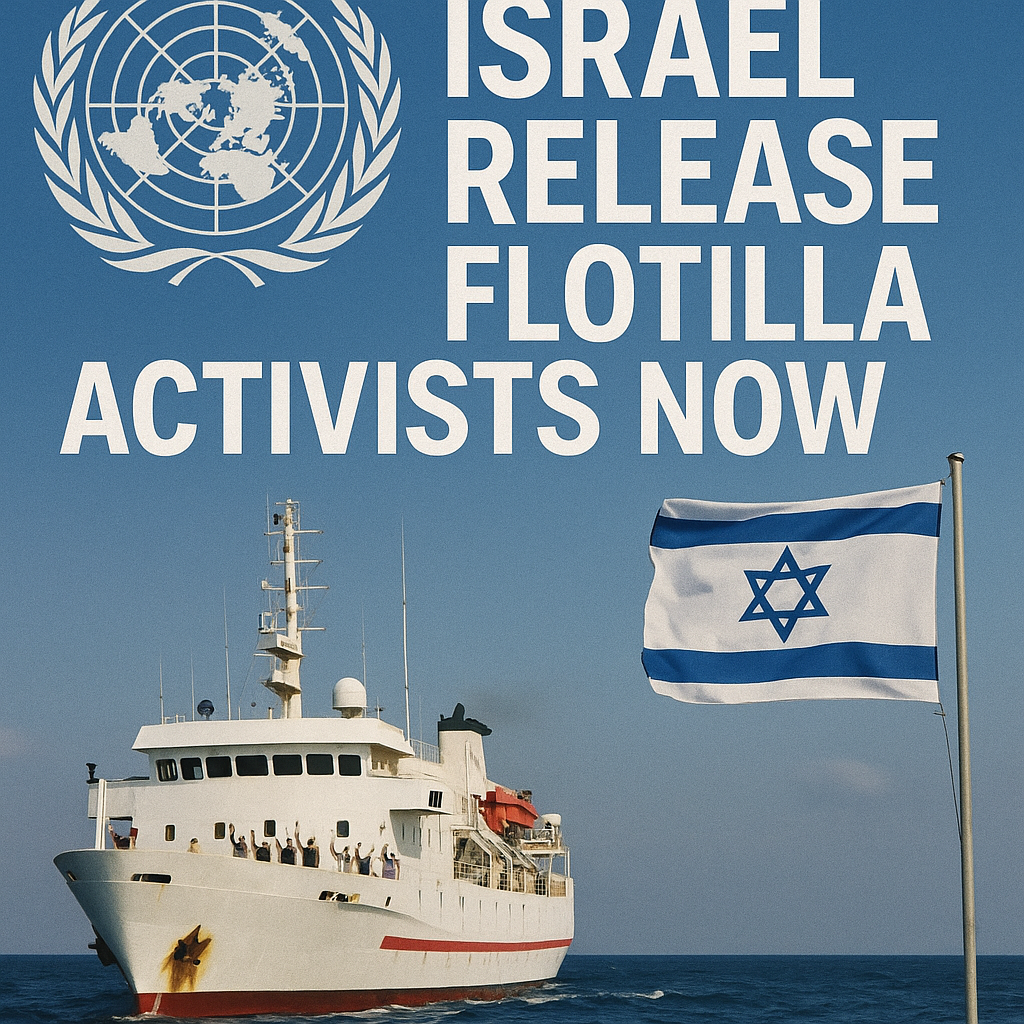
UN Demands Israel Release Flotilla Activists Now
UN Demands Israel Release Flotilla Activists
The recent call from the United Nations for Israel to immediately release the activists detained during a humanitarian flotilla has ignited passionate discussions worldwide. This demand underscores ongoing tensions in the region and highlights broader issues regarding human rights and international maritime law.

Background on the Flotilla Incident
The flotilla, comprising various ships aiming to deliver humanitarian aid to Gaza, was intercepted by the Israeli Navy. Israel contends that the flotilla attempted to breach its naval blockade, which it enforces for security reasons. The incident, which unfolded in international waters, has raised significant legal and ethical debates regarding freedom of navigation and the right to assist those in humanitarian crises.

The UN’s position, underscored by statements from Secretary-General António Guterres, calls for a review of the circumstances surrounding the detention. Guterres emphasized the necessity for Israel to respect international law, stating, “The unjust detention of activists undermines efforts for peace and dialogue in the region.” This assertion aligns with earlier UN resolutions calling for Israel to lift restrictions on Gaza, reinforcing the idea that humanitarian assistance must not be obstructed.

Diverse Perspectives on the Situation
While the UN advocates for the release of the activists, Israeli officials argue that the flotilla posed a significant threat. The Israeli government maintains that the blockade is a legitimate security measure aimed at preventing weapons smuggling to Hamas. “Our actions were necessary to protect our citizens and maintain security in the region,” stated an Israeli Defense Forces spokesperson.
Conversely, human rights organizations argue that detaining activists limits freedom of expression and violates international maritime law. Amnesty International called the blockade a form of collective punishment against Gazans, asserting that “this approach only perpetuates the cycle of violence and despair.”
This divergence in perspectives highlights the complexities involved in discussions surrounding Israel and Gaza. When analyzing the facts, it becomes clear that each side has deeply rooted beliefs regarding security, sovereignty, and humanitarian aid.
The Bigger Picture: Human Rights and International Norms
The UN’s demand is not merely about the immediate release of the activists but rather reflects broader concerns regarding Israel’s treatment of dissent and its adherence to international conventions. The situation brings to the forefront critical issues related to human rights, governance, and global accountability.
Many international actors, including the European Union and various human rights groups, have echoed similar sentiments, emphasizing that waterway rights and humanitarian aid should be safeguarded regardless of political disputes. The ongoing blockade, which has been criticized for contributing to severe humanitarian conditions in Gaza, fuels this debate.
However, many Israeli supporters argue that the blockade is vital for national security and that concessions could lead to increased hostility. They cite prior instances of violence linked to material reportedly smuggled via aid channels. This aspect complicates the conversation, as it juxtaposes security concerns against humanitarian imperatives.
Uncertain Outcomes and Future Implications
As the international community continues to pressure Israel for the release of the detained flotilla activists, the ultimate resolution remains unclear. Will Israel comply with the UN’s demands, or will it maintain its stance on the blockade and national security? Such questions linger, leaving room for significant uncertainty regarding whether this demand might catalyze broader conversations about peace in the region or deepen existing divides.
The tension surrounding this issue demonstrates the delicate balancing act that countries and organizations navigate when addressing human rights and security. The nuanced perspective of international law, diverging national interests, and humanitarian needs must converge for sustainable solutions to emerge.
In conclusion, the UN’s call for Israel to release the flotilla activists is not only a demand for the immediate liberation of specific individuals but also serves as a critical litmus test for international norms and practices regarding humanitarian aid and human rights. As discussions continue, it remains imperative for all stakeholders to engage in dialogue that respects both security and humanity.