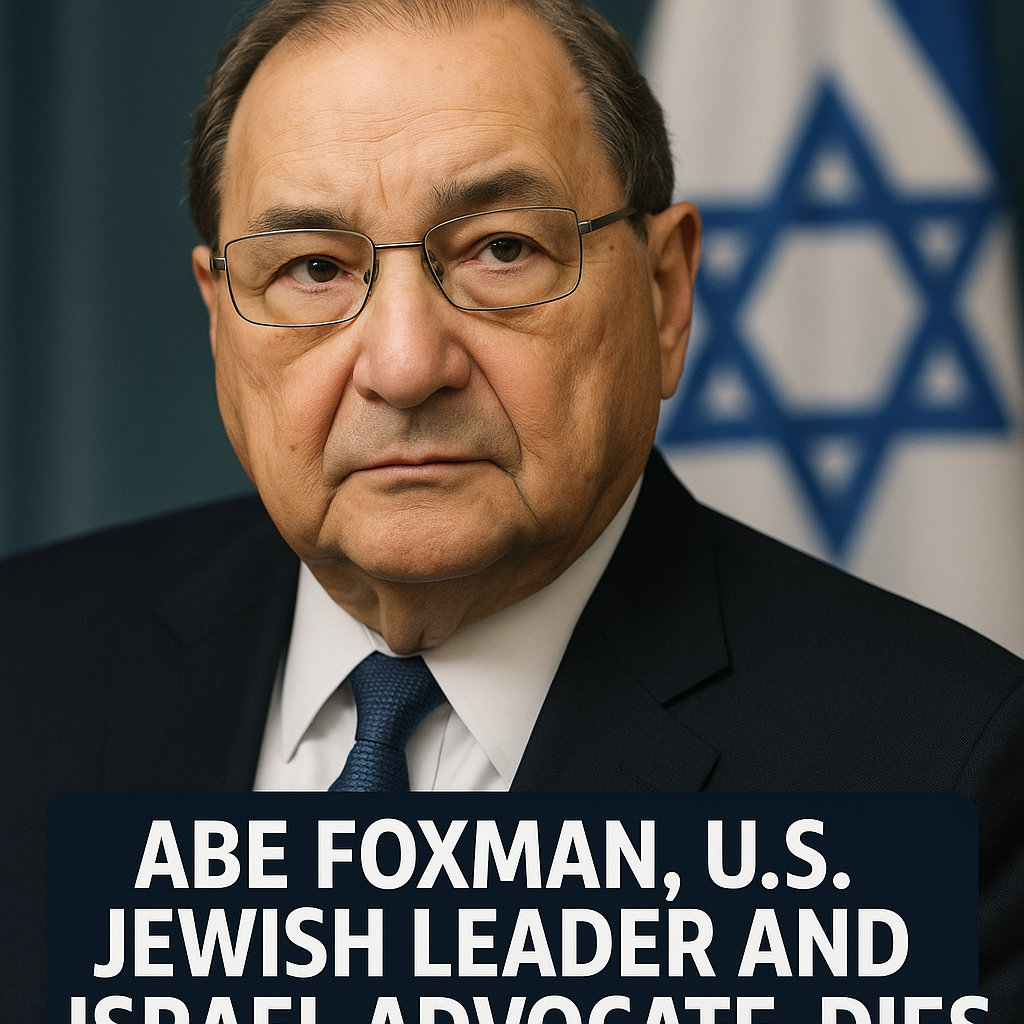
Abe Foxman, US Jewish Leader and Israel Advocate, Dies at 86
Abe Foxman, a prominent U.S. Jewish leader and advocate for Israel, passed away at the age of 86, leaving behind a complex legacy that has sparked discussions across various platforms. Known for his outspoken defense of Jewish interests and his unwavering support for Israel, Foxman was a significant figure in American-Jewish relations, shaping discourse for decades.

A Legacy of Advocacy
Foxman served as the national director of the Anti-Defamation League (ADL) from 1987 until his retirement in 2015. Under his leadership, the organization expanded its mission to not just combat anti-Semitism but also champion civil rights and social justice issues and advocated for Israel’s right to exist as a secure state. His approach often put him at the intersection of American politics and international Jewish concerns.

Supporters describe Foxman as a stalwart advocate who fought tirelessly against prejudice and discrimination. His role in mobilizing support for Israel during tense geopolitical periods underscored a commitment that many admired. “Foxman was crucial in shaping a dialogue about the importance of standing up against anti-Semitism not only in the U.S. but globally,” stated one commentator reflecting his influence in a recent tribute.

However, his legacy is not seen uniformly. Critics have pointed to moments where they felt he prioritized Israel’s interests at the expense of broader humanitarian concerns, particularly regarding Palestinian issues. This dichotomy is indicative of the complex pressures faced by Jewish leaders in advocating for a nation often at the forefront of geopolitical conflict.
The Dual Perspectives on His Impact
Advocacy for Israel
From one viewpoint, many underscore Foxman’s unwavering support for Israel, praising his efforts to foster a robust connection between American Jews and the Israeli government. His tenure at the ADL saw the organization actively lobby against Boycott, Divestment, and Sanctions (BDS) movements and push for strong U.S.-Israel relations. In this frame, he is celebrated as a guardian of Jewish identity, ensuring that issues concerning Israel would remain in the public discourse.
The ADL, under Foxman, managed to play a decisive role in countering anti-Israel sentiment in international forums. His frequent public appearances and statements rallied the Jewish community and its allies to defend Israel amid global criticism. “Abe Foxman was a figure who galvanized support and brought unity on pressing issues concerning Israel,” noted an analyst from a prominent Jewish publication.
Contentions Over His Methods
Conversely, dissenters within both the Jewish community and the Palestinian rights circle contend that Foxman’s approach often bordered on exclusionary. They argue that his tactics sometimes ignored the nuanced realities faced by Palestinians, fostering an environment that stifled critical conversations about peace in the region. Some have characterized his leadership as overly hawkish, suggesting it may have contributed to polarization rather than understanding.
A prominent advocate for Palestinian rights remarked, “Foxman’s legacy reminds us of the importance of inclusive dialogue, which sometimes went missing in the pro-Israel narrative he so passionately advanced. For a lasting peace to truly emerge, both sides must feel heard and valued.”
This pushback is essential in understanding Foxman’s place in history. The dialogue surrounding his life and work invites reflection on how advocacy shapes perceptions in a multifaceted conflict, urging contemporary leaders to navigate these waters with greater sensitivity.
Conclusion: A Life That Divided Yet United
Abe Foxman’s life was a testament to the intricate nature of Jewish advocacy, reflecting the dualities and complexities of identity, advocacy, and geopolitics. As he moves into memory, debates about his legacy will likely linger—whether one sees him as a defender of Jewish rights, a staunch supporter of Israel, or a figure whose methods deserve scrutiny. Ultimately, his impact will resonate through the conversations he sparked, underscoring the necessity of navigating these discussions with an understanding of the diverse perspectives that shape them. With Foxman’s passing, his narrative serves as a reminder of the ongoing struggle for identity, justice, and peace in a divided world.