
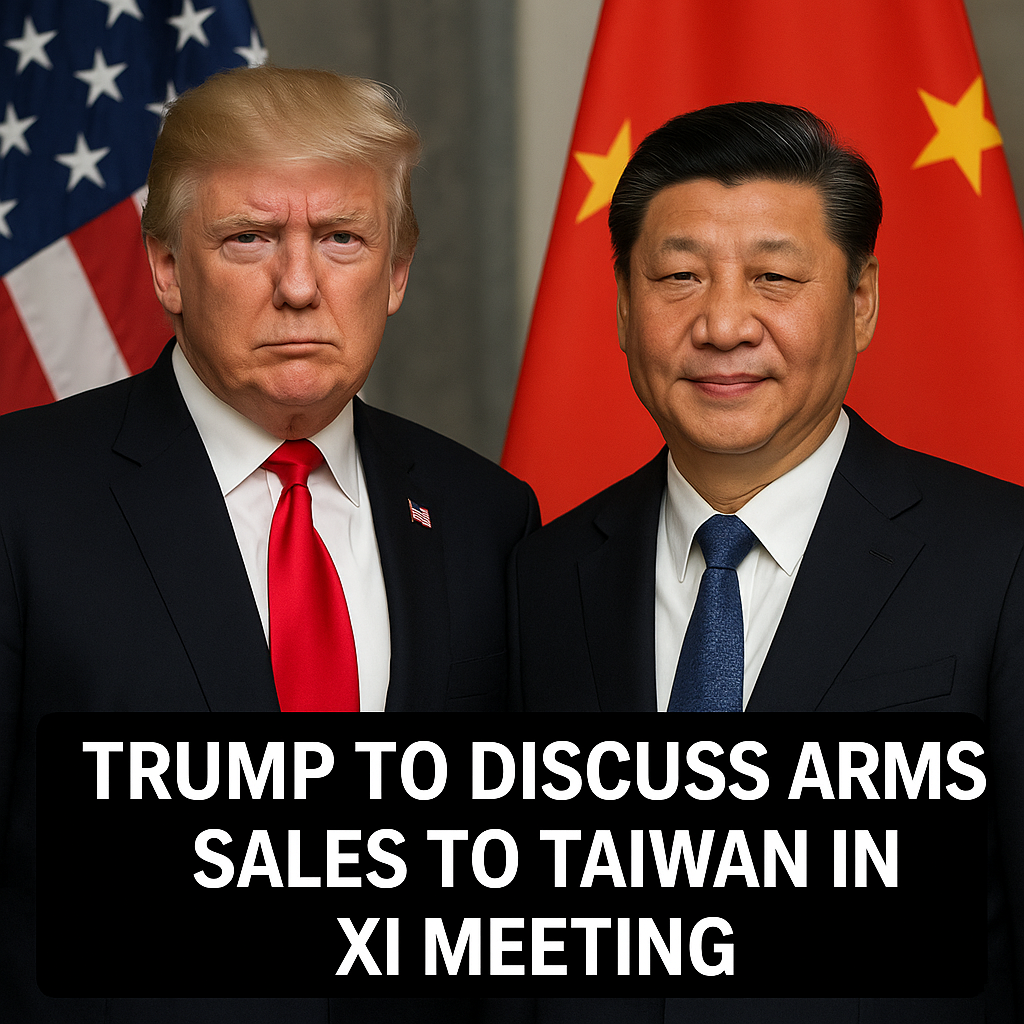
Trump to Discuss Arms Sales to Taiwan in Xi Meeting
The Implications of Trump’s Upcoming Meeting with Xi on Arms Sales to Taiwan
In a notable turn of diplomatic events, former President Donald Trump has announced plans to discuss arms sales to Taiwan during his forthcoming meeting with Chinese President Xi Jinping. This discussion comes amid growing tensions in the Indo-Pacific region, making it a subject of significant geopolitical interest.

Background on Arms Sales to Taiwan
Arms sales to Taiwan have long been a contentious issue between the United States and China. Taiwan, which Beijing considers a breakaway province, has sought to bolster its defense capabilities amid increasing military pressure from China. The U.S. has historically supported Taiwan by supplying military equipment and facilitating defense initiatives, emphasizing a commitment to Taiwan’s self-defense under the Taiwan Relations Act of 1979.

The current dynamics have intensified following China’s assertive military maneuvers near Taiwan, which have raised alarms both in Taipei and Washington. The island’s leadership has called for advanced weaponry to deter potential aggression. Thus, Trump’s indication to discuss arms sales could signify a robust U.S. stance on Taiwan, potentially irking Beijing further.

The Responses from Experts and Officials
Insights from various political analysts underline the complexity of this upcoming meeting. Some experts assert that Trump, by advocating for arms sales, is reaffirming the U.S. position on Taiwan, regardless of the shifting political landscape under President Biden. As per a recent article from Al Jazeera, Trump’s plans to bring up arms sales may enhance Taiwan’s deterrence capabilities but could also provoke a stronger reaction from China, who views such discussions as provocative.
On the other hand, there are voices concerned about the implications of this approach. Analysts from RT have pointed out that discussions surrounding arms sales could escalate tensions in the region. They warn that a firm U.S. stance may be interpreted by China as a challenge to its sovereignty, leading to a cycle of escalation that could have broader repercussions not only for U.S.-China relations but also for regional stability.
Potential Outcomes from the Meeting
The anticipated dialogue between Trump and Xi presents multiple potential outcomes. Here are a few scenarios based on the current geopolitical landscape:
– Strengthening U.S.-Taiwan Relations: A favorable discussion could lead to increased military support for Taiwan, potentially incentivizing further defense cooperation. This may embolden Taiwan’s efforts in self-defense but could also rekindle friction with China.
– Reaction from Beijing: The Chinese government may respond with increased military activity or diplomatic protests, arguing that U.S. arms sales undermine peace in the Taiwan Strait. China has previously reacted strongly to arms deals with Taiwan, and it is likely that Trump’s actions will be met with disapproval.
– Bipartisan Implications: Both Republican and Democratic lawmakers in the U.S. have affirmed their support for Taiwan, which could lead to a consensus in favor of military sales regardless of the administration. However, how this fits into broader U.S.-China relations remains uncertain. The implications of Trump’s presidency reflect a continuation of a strategic rivalry that transcends partisan lines—a critical point to consider when evaluating policy decisions.
An Uncertain Future
While the meeting’s agenda is set, the exact outcomes remain unpredictable. The interplay of these discussions can significantly influence not only U.S.-China relations but also the ongoing geopolitical stability in the region. Observers will likely note the significance of tone and content during the talks, as they can signal broader intentions beyond mere defense agreements.
Moreover, as the meeting approaches, responses from both sides will be instrumental in shaping public understanding. Should there be public concessions or threats, the international community will be watching closely. Key questions remain: Will the U.S. reiterate its commitment to Taiwan, and how will China counter this narrative?
Conclusion
As Trump prepares to engage Xi regarding arms sales to Taiwan, the global context of this discussion is fraught with complexity. While the potential for strengthening Taiwan’s defenses is evident, the ramifications of such discussions cannot be underestimated. Balancing support for Taiwan against the desire to maintain stable U.S.-China relations will be an intricate task. As tensions fluctuate, only time will reveal the true impact of this pivotal meeting.















