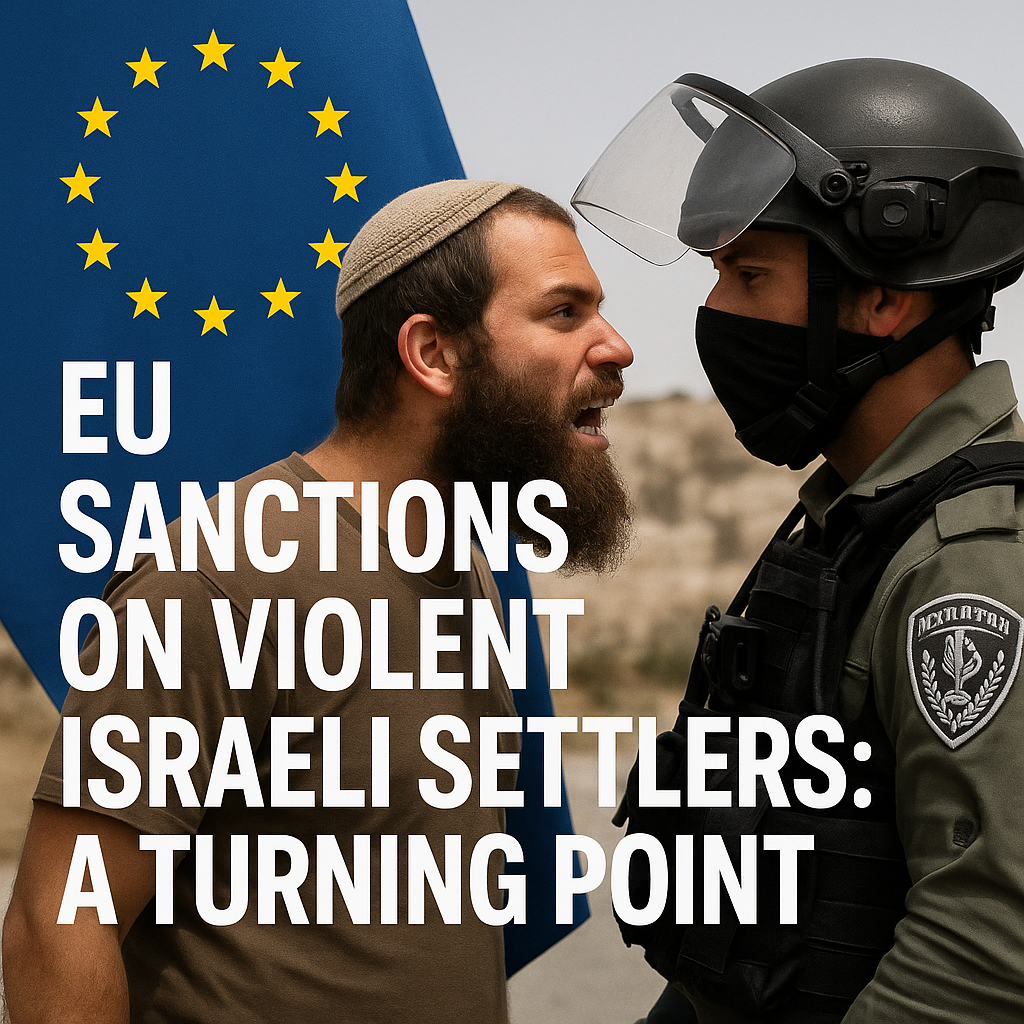
EU Sanctions on Violent Israeli Settlers: A Turning Point
The recent European Union sanctions targeting violent Israeli settlers mark a significant shift in international attitudes toward the long-standing Israeli-Palestinian conflict. After prolonged inaction, the EU’s decision to impose these measures raises important questions about the future of this contentious issue.

New EU Sanctions: Escalation or Justified Response?
The EU’s actions, described in reports from Al Jazeera and RT, reflect mounting frustration over escalating violence in the occupied territories. The sanctions specifically target individuals recognized for their violent actions and association with settlement activities that contradict international law. This move has drawn mixed reactions globally—while some view it as a courageous step towards accountability, others express skepticism regarding its efficacy and potential for further conflict escalation.

Support for the Sanctions: A Closer Look at International Law
Proponents of the sanctions argue that they are necessary for upholding international law and protecting Palestinian rights. Al Jazeera reported on the EU’s stance, emphasizing that continued support for settler violence undermines the peace process and the possibility of a two-state solution. By holding individuals accountable, the EU aims to signal to Israel and the international community that such actions will not go unchecked.

Furthermore, supporters see these sanctions as a moral obligation to oppose state-sanctioned violence and discrimination. The legal interpretation of the EU’s moves rests heavily on UN resolutions that deem the settlement of Israeli citizens in occupied territories as illegal. For many observers, this decision represents a long-overdue application of international standards that have often been overlooked.
Criticism of EU Sanctions: Questions of Effectiveness and Consequence
In contrast, critics argue that such sanctions could exacerbate tensions rather than alleviate them. Voices from RT and various opinion pieces highlight concerns regarding the feasibility and potential backlash from the Israeli government and settlers. These critics contend that sanctions might only strengthen hardline attitudes within Israel and provoke retaliation against Palestinian communities.
Additionally, there is apprehension that the sanctions could isolate Israel further on the international stage without fostering meaningful dialogue. Some experts warn that facilitating communication and cooperation might be more effective in reducing violence than punitive measures.
Another point of contention is whether these sanctions will have any tangible impact on the ground. Previous sanctions and resolutions have often led to token compliance rather than genuine change, leading skeptics to wonder whether the recent actions will differ in outcome.
Complexities in the Israeli-Palestinian Conflict
The situation is anything but straightforward. The Israeli-Palestinian conflict has deep historical roots and continues to be shaped by a complex interplay of local and international factors. The EU’s latest sanctions are set against a backdrop of heightened tensions, including increased violence between settlers and Palestinian residents. As these elements converge, the question remains whether sanctions can play a meaningful role in shifting the conflict’s trajectory.
While the EU’s decision is clearly a calculated political response, the likely outcomes remain uncertain. The sanctions may serve as a wake-up call to Israel regarding the repercussions of unchecked violence by settlers. However, they could also lead to unintended consequences that complicate already fractious relationships.
Balancing Act: Path Forward in the Conflict
Looking forward, the EU’s sanctions must be viewed as part of a broader strategy to address the Israeli-Palestinian conflict, which has remained unresolved for decades. Achieving peace will require not only punitive measures but also diplomatic efforts aimed at fostering dialogue between both parties.
The imposition of sanctions reveals a clear intention on the part of the EU to re-engage in the discourse surrounding the conflict. However, their effectiveness will largely depend on how they are received by both Israeli leaders and the Palestinian community. The dual goals of holding violators accountable while facilitating a pathway to peace represent a challenging balancing act that the EU must navigate carefully.
In conclusion, the EU sanctions on violent Israeli settlers represent a critical moment within the broader context of the Israeli-Palestinian conflict. While they can signal a commitment to accountability, the effectiveness and consequences of these actions remain to be seen. As the world watches closely, the focus now shifts to the next steps in this complex and ongoing narrative.