
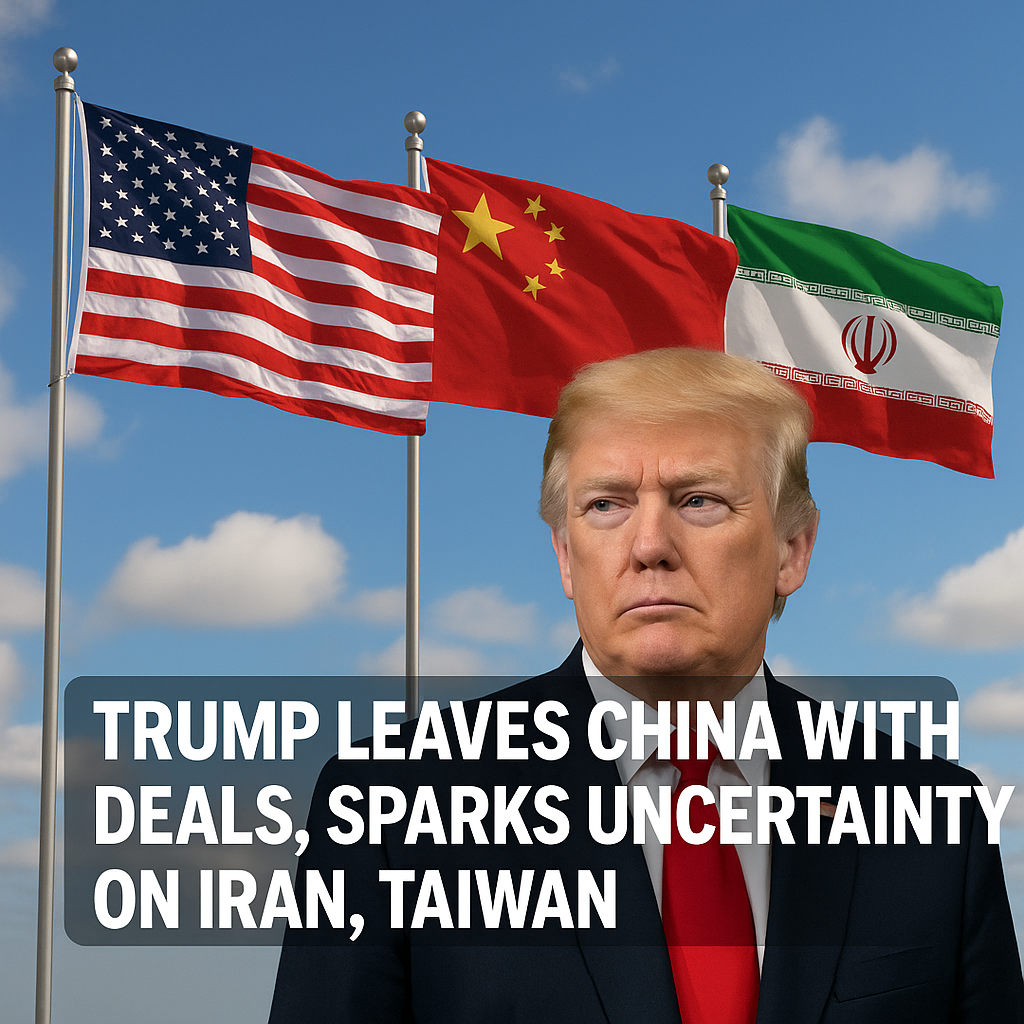
Trump Leaves China with Deals, Sparks Uncertainty on Iran, Taiwan
In an unexpected turn of events, former President Donald Trump concluded his visit to China, leaving behind a series of claimed trade deals that amplify uncertainty regarding key geopolitical relationships, particularly with Iran and Taiwan.

Trade Outcomes: Deals or Illusions?
During his visit, Trump touted various agreements purportedly struck with Chinese officials aimed at easing trade tensions between the two nations. According to reports from Al Jazeera, these deals included commitments on agriculture and technology sharing, framed as a significant step towards rebuilding ties that have been strained over the past few years. However, scrutiny from analysts suggests that the actual impact of these deals may be less substantial than portrayed.

Critics argue that many of these so-called agreements lack specificity and concrete timelines for implementation. The essence of the deals remains vague, prompting questions about their longevity and effectiveness. Sky News echoed similar sentiments, noting that while the announcements made headlines, the actual mechanisms for these agreements were not clearly defined, leading to skepticism among economic experts.

Conversely, Trump asserted that this visit had laid the groundwork for improved relations, insisting that such engagements are vital for future stability. He emphasized the mutual benefits derived from cooperation, which he claimed would bolster both the U.S. and Chinese economies.
Geopolitical Uncertainties: Iran and Taiwan
While the economic implications of Trump’s visit captured the spotlight, his trip also reignited concerns about U.S. foreign policy, particularly regarding Iran and Taiwan. The relationship with Iran is notably complex, especially amidst ongoing tensions related to nuclear negotiations. Trump’s dealings appear to sidestep any definitive stance on Tehran, leaving analysts puzzled about the Administration’s strategy moving forward.
As reported by RT, the former president’s approach suggests a possible shift towards a more isolationist policy regarding Iran, despite prior rhetoric focused on a robust stance against perceived aggressions from the nation. There is growing conjecture that the U.S. might be willing to adopt a more conciliatory tone, particularly if it facilitates trade negotiations with China.
Meanwhile, Taiwan remains a flashpoint in U.S.-China relations. Trump’s visit, intentionally or not, seems to have brought Taiwan into sharper focus. With increasing Chinese military activities near the island, any perceived weakening of U.S. support for Taiwan could embolden Beijing’s stance, leading to dire consequences. Observers fear that without a definitive U.S. commitment to Taiwan, the island could face unprecedented pressure from China, making it a critical issue that needs immediate attention.
Navigating Future Implications
As Trump returns to the U.S., the implications of his visit extend far beyond the trade deals at hand. Analysts are weighing the possible outcomes of the diplomatic moves made, leading to an atmosphere of uncertainty. The lack of clear policy directions on Iran and Taiwan, contrasted with Trump’s ambitious claims regarding China, showcases the inherent complexities of U.S. foreign relations.
The intersection of these issues raises a critical question: Can a series of trade agreements with China truly stabilize or impact broader geopolitical tensions? The consensus among experts seems divided. Some believe that economic ties can foster more amicable relations, ultimately leading to stable peace efforts. Others argue that without addressing core issues, such as military tensions and ideological conflicts, any economic agreements may merely serve as temporary band-aids.
As time progresses, we may witness how Trump’s claimed achievements in China play out against the backdrop of these escalating tensions. The potential for miscalculations looms large, underlining the necessity for stringent diplomatic strategies that can adapt to an ever-evolving global landscape. How the U.S. defines its approach to Iran and Taiwan in light of these new developments could very well influence not only regional stability but also the broader international order.
In summary, while Trump’s visit to China may have presented opportunities for economic advancement, the lingering uncertainties regarding Iran and Taiwan pose significant challenges. As stakeholders assess the ramifications, the world watches closely to see how the geopolitical chessboard will evolve in the coming months.















