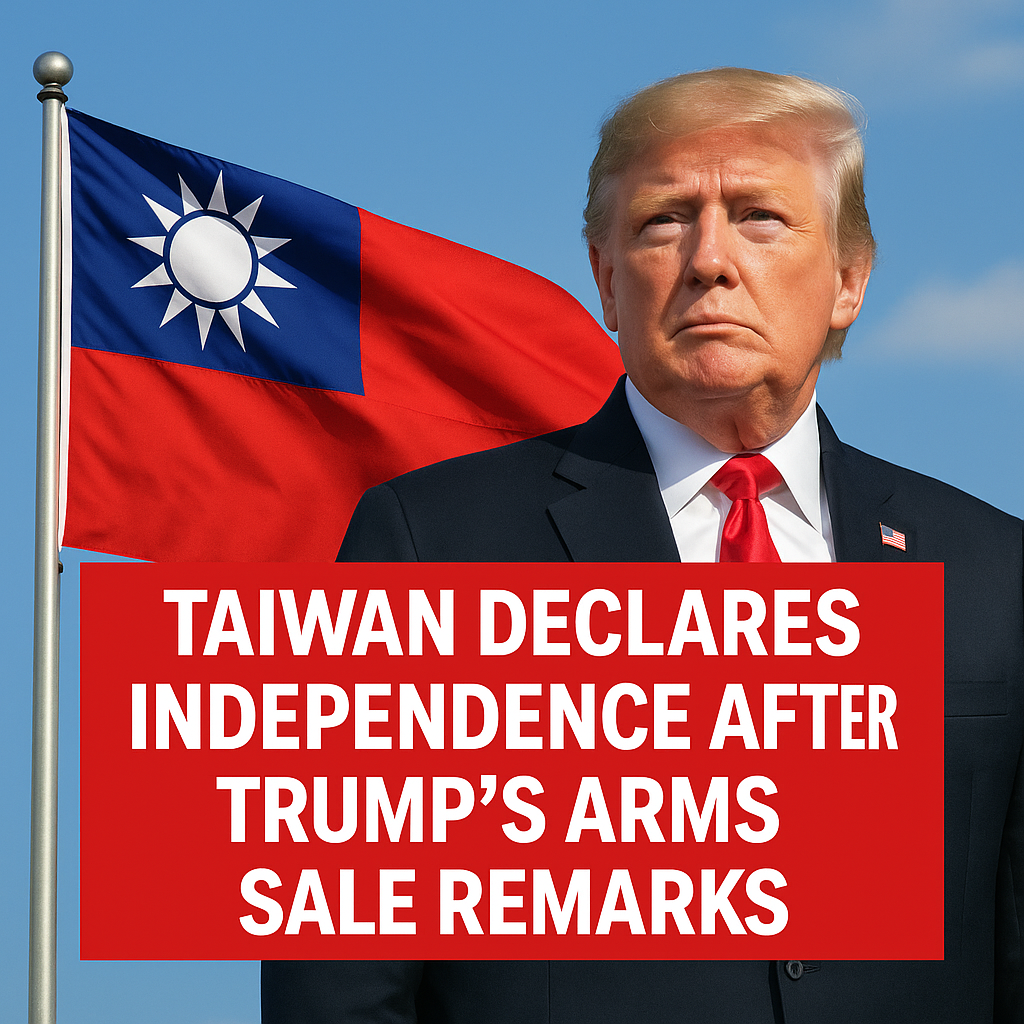
Taiwan Declares Independence After Trump’s Arms Sale Remarks
Taiwan’s Declaration of Independence: A Response to Trump’s Arms Sale Remarks
Taiwan has announced its firm stance on independence, particularly in the wake of recent remarks by former U.S. President Donald Trump regarding arms sales. Trump’s comments, framed as supportive of Taiwan’s military strength in the face of increasing tensions with China, have sparked a complex dialogue about sovereignty, international support, and the delicate balance of power in East Asia.

The Context of Trump’s Remarks
During a speech, Trump suggested that supporting Taiwan through arms sales was essential for maintaining a balance against Chinese aggression. This assertion has brought renewed focus to Taiwan’s quest for recognition as an independent nation amidst rising tensions with Beijing. Taiwan’s leaders heralded Trump’s stance as a validation of their sovereignty, asserting that “Taiwan is an independent nation,” a point reinforced in various coverage following Trump’s speech.

Many analysts view Trump’s comments as a reflection of his administration’s shift towards more active support for Taiwan, diverging from traditional U.S. diplomatic posture which embraced a “strategic ambiguity” approach. This approach is designed to discourage both Taiwanese independence efforts and aggressive Chinese posturing.

While some political factions in Taiwan see potential in strengthening ties with the U.S. as a counterweight to China, others express concerns that such reliance could provoke further escalation in already strained cross-strait relations.
Diverse Perspectives on Independence
The implications of Trump’s remarks have elicited varied reactions. On one side, pro-independence advocates in Taiwan express optimism that U.S. backing could enable Taiwan to assert itself more firmly on the global stage. A spokesperson from the Taiwanese government emphasized the importance of military readiness and international support, suggesting that “greater arms sales can bolster our defense capabilities against potential threats.”
Conversely, there are voices within Taiwan who caution against relying too heavily on external entities for security. Critics argue that unbridled declarations of independence might antagonize China, which views Taiwan as a breakaway province. An editorial from a Taiwanese newspaper offered a warning: “While we celebrate our right to self-determination, we must also tread carefully to avoid triggering a military response from Beijing.”
Chinese responses have been predictably critical, reiterating their stance on reunification. Various sources report that Beijing condemned both Trump’s comments and Taiwan’s newfound assertiveness, hinting at potential retaliatory measures, including increased military maneuvers in the Taiwan Strait.
Balancing Sovereignty and Stability
The tension generated by these developments raises critical questions about Taiwan’s future course. Advocates for independence believe that a definitive stance could catalyze international recognition and support. However, as Taiwan navigates this treacherous landscape, it must weigh the risks of provoking China against the necessity of affirming its identity and agency.
Furthermore, the international community’s response is critical in shaping the dynamics. The U.S. has historically been a key ally for Taiwan, but with shifting geopolitical interests, it remains to be seen how steadfast this support will be moving forward. Some analysts argue that while the U.S. might provide military aid, it stops short of tacit endorsement of independence, leaving Taiwan in a precarious position.
In the broader geopolitical context, Taiwan’s situation serves as a microcosm of U.S.-China relations. The balance of power in the Indo-Pacific is rapidly evolving, and Taiwan stands at the center of this changing landscape—a symbolic flashpoint for wider tensions as both superpowers compete for influence.
Conclusion: A Cautious Path Forward
Taiwan’s declaration of independence in light of Trump’s arms sale remarks encapsulates the intricate dance of sovereignty and security in contemporary international relations. As Taiwan proclaims its self-identity while reaffirming its military readiness, it must remain astute to the complexities of its situation. Navigating these waters requires a careful approach, balancing its desire for independence against the backdrop of regional stability.
The unfolding narrative surrounding Taiwan serves as a reminder of the interconnectedness of global politics, where one nation’s declaration can ripple through continents, influencing dynamics far beyond its borders. For Taiwan, the path forward will require not only resolve but also an acute awareness of the external forces at play, all while safeguarding its right to self-definition in a world marked by uncertainty.