
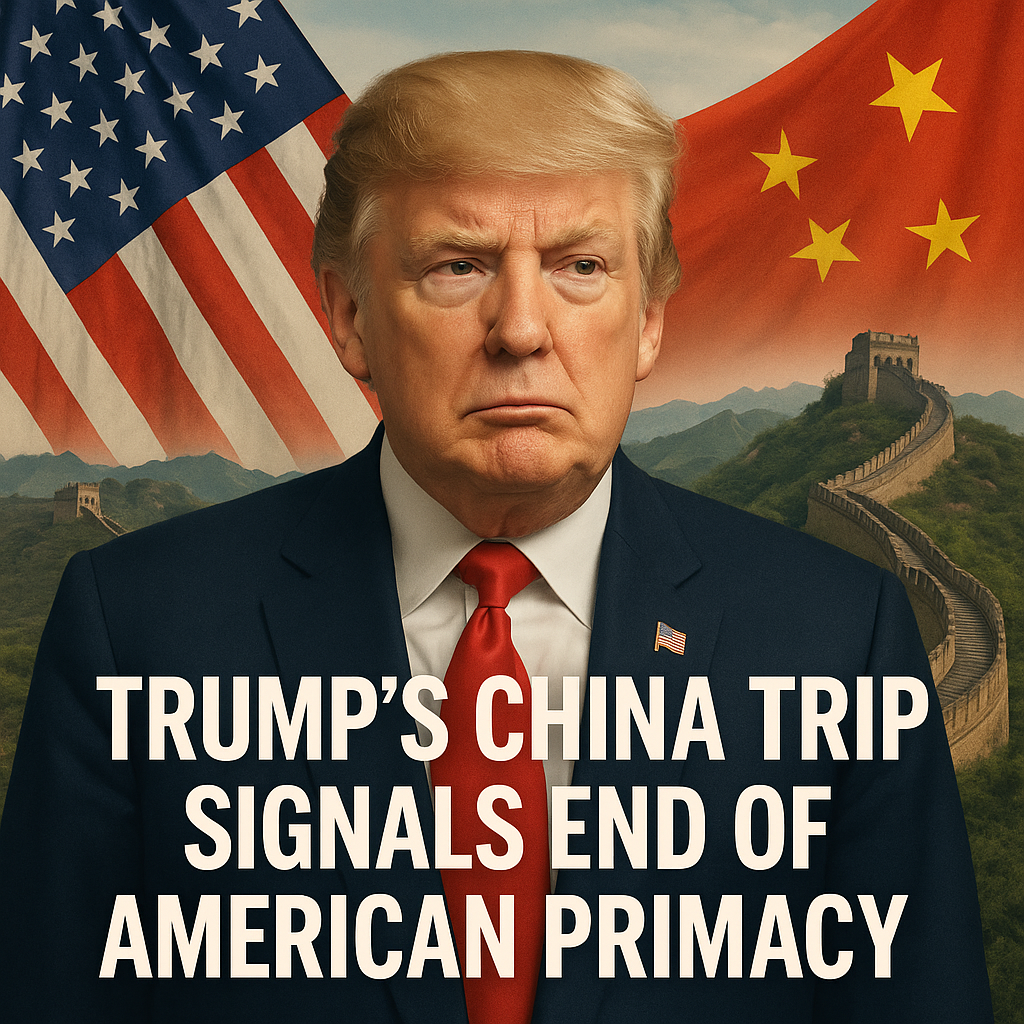
Trump’s China Trip Signals End of American Primacy
Trump’s China Trip: A Turning Point for American Global Influence
The recent trip by former President Donald Trump to China has sparked intense debate among analysts and commentators regarding its implications for American influence on the global stage. Many argue that this visit signals a potential decline in American primacy as geopolitical dynamics shift and countries re-evaluate their alliances and strategies.

A Changing Global Landscape
As the U.S. faces rising tensions with China, Trump’s visit can be seen as a notable attempt to reposition himself within this complex landscape. Reports indicate that he aimed to strengthen ties with Chinese leadership, emphasizing the need for cooperation on various global issues, including trade and climate change. However, this move has been met with mixed reactions, particularly from those concerned about China’s growing assertiveness in the Indo-Pacific region.

According to Al Jazeera, Trump’s engagement with China might be a strategic play to re-establish his influence after his presidency, hinting at a desire to redefine U.S.-China relations. On the other hand, critics argue that such visits could undermine the United States’ position on human rights and democratic values. The nuanced debate underscores how critical decisions made in the context of foreign relations can have cascading effects not only on national policies but also on global stability.

Analysis of American Primacy
The prevalence of dissenting views about Trump’s visit reflects broader anxieties regarding America’s status as a superpower. Sky News reports that many analysts believe the dominance of the U.S. is increasingly being challenged by other nations, particularly China and Russia. They assert that behaviors and policies exhibited by these nations, including military posturing and economic partnerships, are indicative of a multipolar world emerging where American leadership might no longer be the gold standard.
Furthermore, the notion of American exceptionalism is increasingly scrutinized. As highlighted by RT, Trump’s visit could signal a willingness to engage with adversaries, a move that some interpret as a reduction of the U.S.’s traditionally strong stance on international issues. This potentially represents a rethinking of what it means to wield influence—perhaps suggesting that collaboration, even with rival nations, may be more beneficial than confrontation.
Diverging Perspectives
Supporters of Trump view his China trip as a pragmatic approach to diplomacy that could lead to economic benefits and cooperative trade relations. Successful negotiations or partnerships formed during this visit could bolster both nations’ economies, potentially dispelling fears of an outright hostility that has characterized recent relations. They argue that any step toward dialogue is better than a policy of isolation or hostility.
Conversely, critics are quick to point out the dangers of engaging with a nation frequently accused of human rights violations and aggressive expansionism. They argue that Trump’s visit could be perceived as legitimizing China’s authoritarian governance, which undermines both the American brand and the global narrative centered around democracy and human rights.
Conclusion: Uncertainty in American Global Influence
As Trump’s China trip continues to unfold in public discourse, the ramifications for American primacy remain complex and unclear. While there are valid concerns regarding the potential erosion of U.S. influence, there is also an argument to be made for adaptive foreign policies that engage with rivals in constructive ways. Ultimately, the outcome of such diplomatic endeavors will hinge on long-term strategies and the responses from both American leadership and China’s government.
With the geopolitical landscape constantly evolving, it remains to be seen whether this trip will mark a new chapter in U.S.-China relations—or signify a step towards a larger decline in American primacy on the world stage. The multifaceted and contradictory nature of international relations underscores the uncertainty that lies ahead, calling for a cautious yet open-minded approach as nations navigate through these changing tides.















