
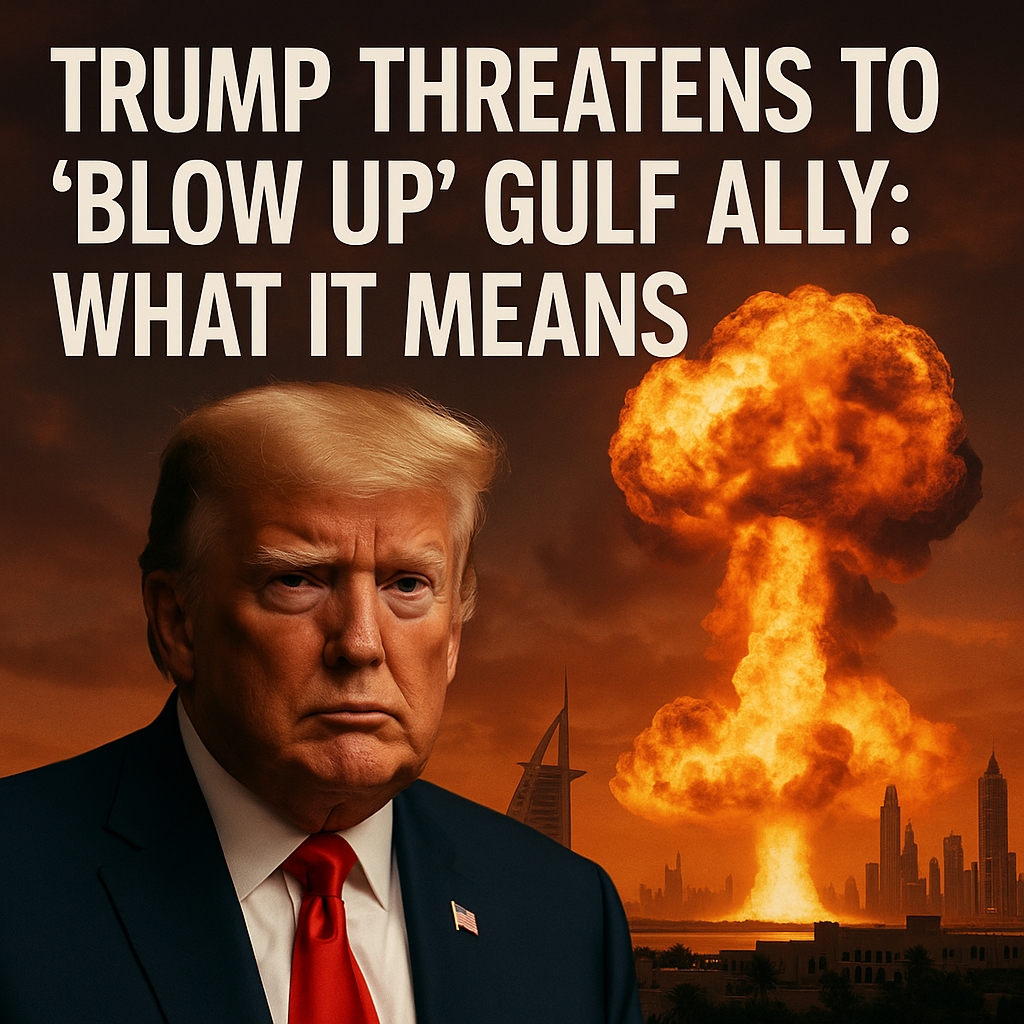
Trump Threatens to ‘Blow Up’ Gulf Ally: What It Means
Understanding Trump’s Stark Warning to Gulf Allies
Former President Donald Trump is once again making headlines with his dramatic pronouncement that he could “blow up” U.S. relations with Oman unless certain political debts are settled. This statement, made during a recent rally, has sent ripples across diplomatic circles, raising questions about what it signifies for U.S. foreign policy in the Gulf region.

Context: Trump’s Recent Comments
Trump’s threats are rooted in longstanding grievances he has articulated regarding financial obligations and support from allies in the Gulf. Specifically, he called out Oman, suggesting that unless the country fulfills its commitments, the U.S. might reconsider its diplomatic stances. This rhetoric is consistent with Trump’s transactional view of international relations, where alliances are forged based on mutual benefits rather than shared values or ideological goals.

Analyzing his remarks in the context of ongoing geopolitical dynamics, one can see that Trump’s approach diverges from traditional U.S. foreign policy, which has often prioritized stability and mutual support. By asserting such threats, Trump appears to be advocating for a more confrontational stance, raising concerns about potential ramifications for diplomatic relations in a region already fraught with tensions.

The Reactions
Mixed Responses from Analysts
Responses to Trump’s comments have been varied. Some analysts argue that his statements could be seen as a continuation of his “America First” agenda, which often prioritizes national interests over international alliances. This perspective holds that such rhetoric may resonate with a segment of voters who see it as standing up to perceived complacency from allies.
Conversely, other experts warn that such bombastic pronouncements could destabilize already tense relations between the U.S. and Gulf states. They emphasize that Oman has generally played a mediating role in regional conflicts, particularly between Saudi Arabia and Iran, and upsetting this balance may have unintended consequences.
Furthermore, a report from Al Jazeera highlights Oman’s unique position as a non-aligned nation striving for neutrality in regional disputes. Trump’s threats could alienate Oman and deter its willingness to mediate future conflicts, thus diminishing U.S. influence in the region.
The Broader Implications
A Shift in Diplomatic Dynamics
Trump’s rhetoric invites a questioning of what loyalty and alliances mean in the current geopolitical climate. If the U.S. continues down this road of direct financial accountability for alliances, it sets a precedence that could redefine diplomatic relations worldwide. Moreover, this kind of transactional diplomacy may compel other nations to reconsider their alliances, possibly shifting towards more robust partnerships based on immediate interests.
On the other hand, analysts caution that similarly aggressive rhetoric from the U.S. might embolden adversaries. An environment where allies feel threatened could destabilize existing agreements, leading to increased tensions not only in the Gulf but with nations like Iran, which is closely monitoring these developments.
Navigating Uncertainties
While there is an evident disconnect between Trump’s views and traditional U.S. diplomatic policies, the long-term implications of his threats remain uncertain. Will the next administration adopt a similar stance, or will there be a return to more conventional diplomatic strategies focusing on multilateralism and collective security?
In this context, Trump’s comments could be interpreted in many ways. Some argue they reflect a growing dissatisfaction with traditional alliances; others see them as mere campaign rhetoric, absent of meaningful foreign policy direction.
Conclusion
Donald Trump’s warning to Oman encapsulates the complexities of modern diplomacy in a multifaceted global landscape. As relationships among Gulf states and the U.S. continue evolving, Trump’s approach raises critical questions about the nature of partnerships and the future of American influence in the region. Without clear consensus on the effects of such rhetoric, the situation remains fluid, leaving analysts, diplomats, and policymakers grappling with the potential consequences of these provocative assertions. As events unfold, the international community will be closely watching for signs of how these tensions might reshape diplomatic relations in the Gulf.















