
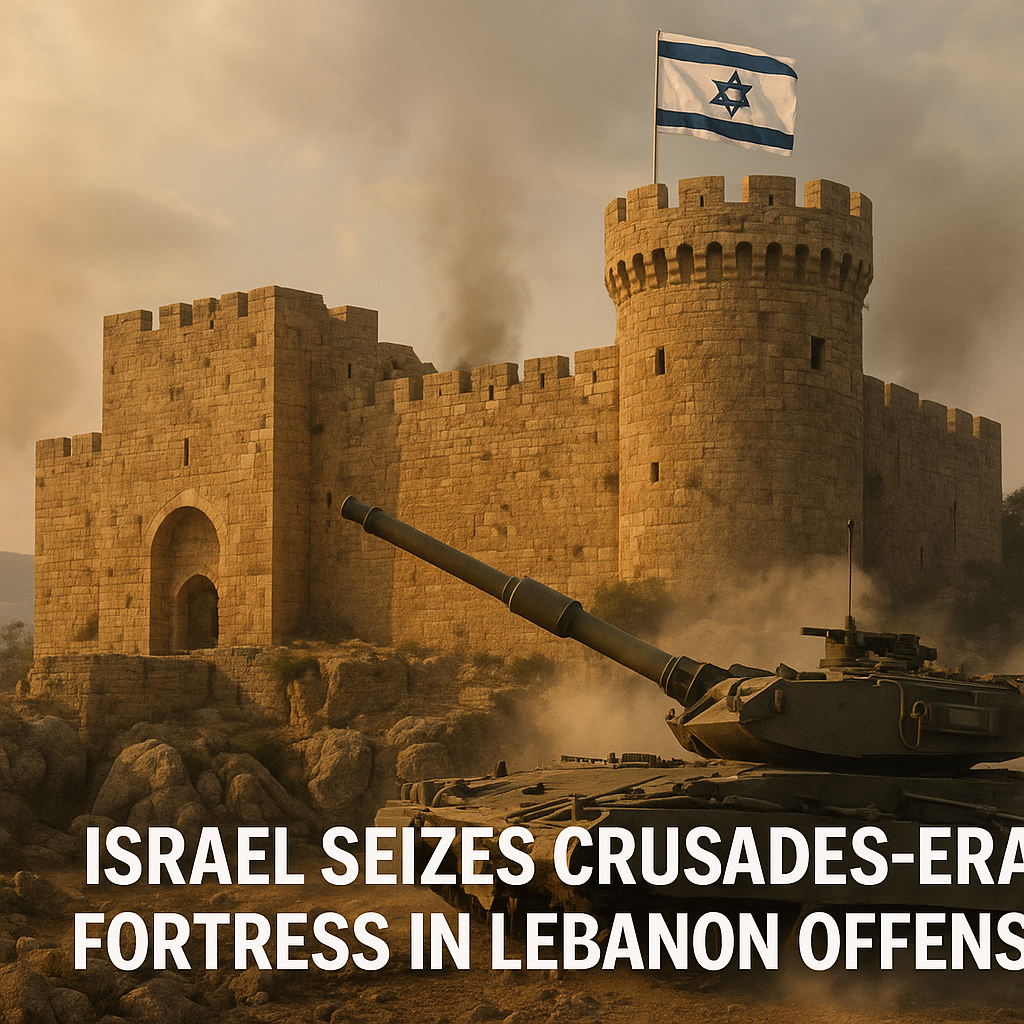
Israel Seizes Crusades-Era Fortress in Lebanon Offensive
Israel Seizes Crusades-Era Fortress in Lebanon Offensive
The recent seizure of a Crusades-era fortress in Lebanon by Israeli forces marks a significant escalation in regional tensions, reflecting a complex interplay of historical grievances and contemporary conflict dynamics.

Historical Context and Significance
The fortress, known as the Château de Saint-Louis, served as a critical military stronghold during the Crusades and has remained a symbol of the region’s tumultuous history. Israeli forces captured it during a series of operations aimed at dismantling perceived threats from Hezbollah, a militant group based in Lebanon. This operation not only underscores Israel’s military objectives but also highlights the historical resonance of such sites in the ongoing conflict.

While Israeli officials describe the capture as a “strategically crucial victory,” proponents of Palestinian rights criticize the military’s actions as a continuation of what they view as unwarranted aggression against historical and cultural monuments. As tensions rise, the implications of such military actions raise questions about the potential for long-term stability in the region.

The Military and Political Landscape
The backdrop of this operation encompasses both military and political dimensions. Israeli Prime Minister Benjamin Netanyahu has framed the offensive as necessary for national security, positing that the fortress could serve as a base for attacks against Israel. Conversely, Hezbollah has condemned the seizure, vowing to retaliate and protect Lebanese sovereignty. This sentiment resonates deeply with many in Lebanon, where historical grievances regarding foreign occupation play a pivotal role in national identity.
Reports indicate that while the Israeli military may gain short-term advantages through such offensives, the long-term consequences could be severe. Scholars and analysts suggest that increased military presence and occupation could further alienate local populations and recruit new members to militant organizations like Hezbollah. The fiery rhetoric from both sides often complicates diplomatic efforts, making peaceful resolutions seem more elusive.
Diverging Perspectives
Analyzing media coverage from various sources reveals contrasting interpretations of the events surrounding the fortress’s capture. According to Sky News, the Israeli forces executed the operation with precision and efficiency, highlighting the military’s capabilities and readiness. On the other hand, Al Jazeera critiques the narrative, arguing that such military moves perpetuate cycles of violence and overlook the humanitarian impact on local populations.
The diverging views illuminate a deeper conflict: while one narrative emphasizes immediate military success, another warns of the dangers of neglecting social and cultural reverence for historical sites. This contrast raises crucial questions about the ethics of military engagements in regions rich with history and cultural significance.
Uncertain Future
As the situation continues to evolve, uncertainties linger regarding the path forward. Military successes may bolster the current Israeli government’s position domestically, yet they may also catalyze international scrutiny and backlash. It is essential to weigh these outcomes against the backdrop of a long-standing conflict characterized by retaliation and a deeply rooted cycle of violence.
Moreover, the implications of seizing historically significant sites extend beyond the battlefield. Cultural heritage is often central to people’s identities, and actions perceived as threats to that heritage can deepen resentments and exacerbate tensions. As various stakeholders respond to the current situation, the question persists: can military strategy align with cultural respect to forge a more harmonious future?
In conclusion, while the seizure of the Crusades-era fortress represents a moment of strategic gain for Israel, it serves as a stark reminder of the complexities inherent in the Israeli-Lebanese conflict. The intertwining of history, military action, and cultural identity raises crucial concerns about how the past informs the present, and what steps can be taken to foster a more peaceful resolution in one of the world’s most contentious regions.















