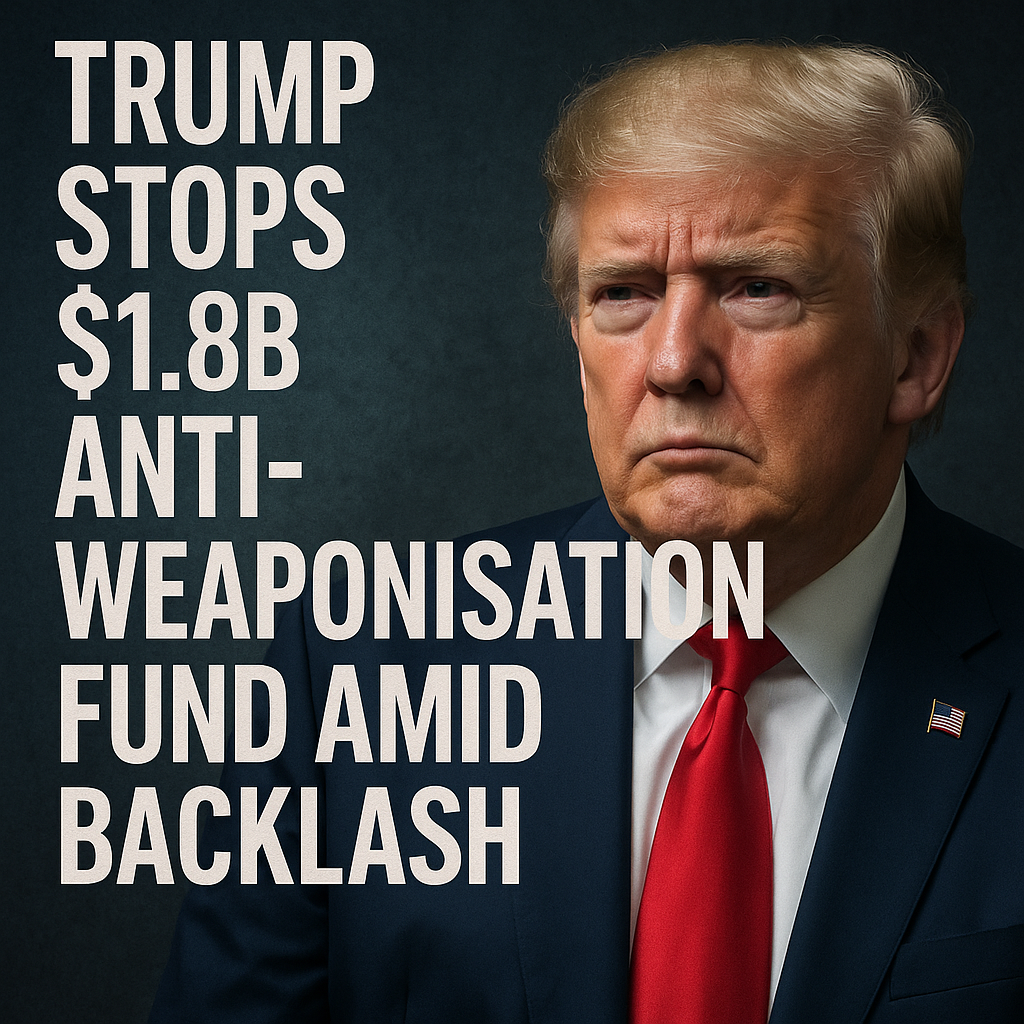
Trump Stops $1.8B Anti-Weaponisation Fund Amid Backlash
Trump Stops $1.8B Anti-Weaponisation Fund Amid Backlash
Former President Donald Trump’s recent decision to halt the $1.8 billion anti-weaponisation fund has ignited a firestorm of debate across the political spectrum. As one of the few economic initiatives tied to both domestic and international security goals, its suspension raises pressing concerns regarding governance and national safety.

Understanding the Anti-Weaponisation Fund
The anti-weaponisation fund was initially conceived as a tool to combat the proliferation of dangerous weapons technologies, particularly in the context of rogue states and terrorist organizations. Its objective was to funnel resources into research, development, and international partnerships that would work toward mitigating threats posed by advanced weaponry. Proponents of the fund emphasized its importance in safeguarding both national and global security. They argued that investing in preventive measures is far more economical than responding to crises after they arise.

In response to Trump’s announcement, a reactionary wave has swept through bipartisan quarters. Politicians and analysts alike raised concerns that pausing the funding could leave a void in the fight against emerging security threats. This sentiment was echoed in various news reports, highlighting that the cessation of the fund might weaken America’s position against nations that are aggressive in their military developments.

Bipartisan Backlash and Diverging Opinions
The backlash against the fund’s suspension isn’t confined to one party. A multitude of lawmakers from both sides of the aisle criticized Trump’s decision, emphasizing that bipartisan cooperation is crucial for enduring national security. Rep. Elizabeth Warren stated that the halting of funds demonstrates a disregard for the complex realities of modern warfare and terrorism. On the other hand, some conservative commentators have supported the decision, arguing for a reevaluation of how governmental funds are allocated. They suggest that often, funds in such large quantities could lead to inefficiencies and mismanagement, thus supporting the claim that a comprehensive review is necessary.
Despite this, many pundits predict that the long-term consequences of this decision could be severe. By cutting resources allocated to combatting weaponisation, Trump’s administration risks undermining preventive measures that are often more effective and less costly than military interventions. Critics warn that vacating funding now could lead to increased threats in the future—primarily because these funds were designed to get ahead of problems rather than merely react.
The Future of Military and Security Funding
The debate surrounding the fund’s cessation touches on broader themes of military and security funding in the U.S., where efficiency and effectiveness are often at odds. With many lawmakers expressing concern about America’s dwindling capability to counter international threats, the sector sits at a crossroads.
Analysts remark that if bipartisan cooperation can be achieved, it could serve as a springboard for new initiatives aimed at both reviewing existing programs and potentially re-establishing funding streams like the anti-weaponisation fund. However, skepticism remains regarding whether political factions can set aside their differences for collective good in what is an increasingly polarized atmosphere.
In the coming weeks, as Congress convenes to discuss the budget and potential reallocation of funds, it will be imperative to assess how political views influence decisions around national security spending. Without a concerted effort to understand the implications—both immediate and long-term—the potential for future danger may grow, undermining not only U.S. national interests but those of its allies as well.
Conclusion
Trump’s suspension of the $1.8 billion anti-weaponisation fund has opened a Pandora’s box of issues surrounding national security and military funding. As bipartisan backlash grows, the necessity for intelligent dialogue around advanced weaponry and preventive measures becomes crucial. The concerns aren’t merely political; they touch the very fabric of global safety and the efficacy of American military strategy. While Trump’s decision currently reignites divisions, it might also inspire a reevaluation of priorities in national security, holding potential lessons for future governance.