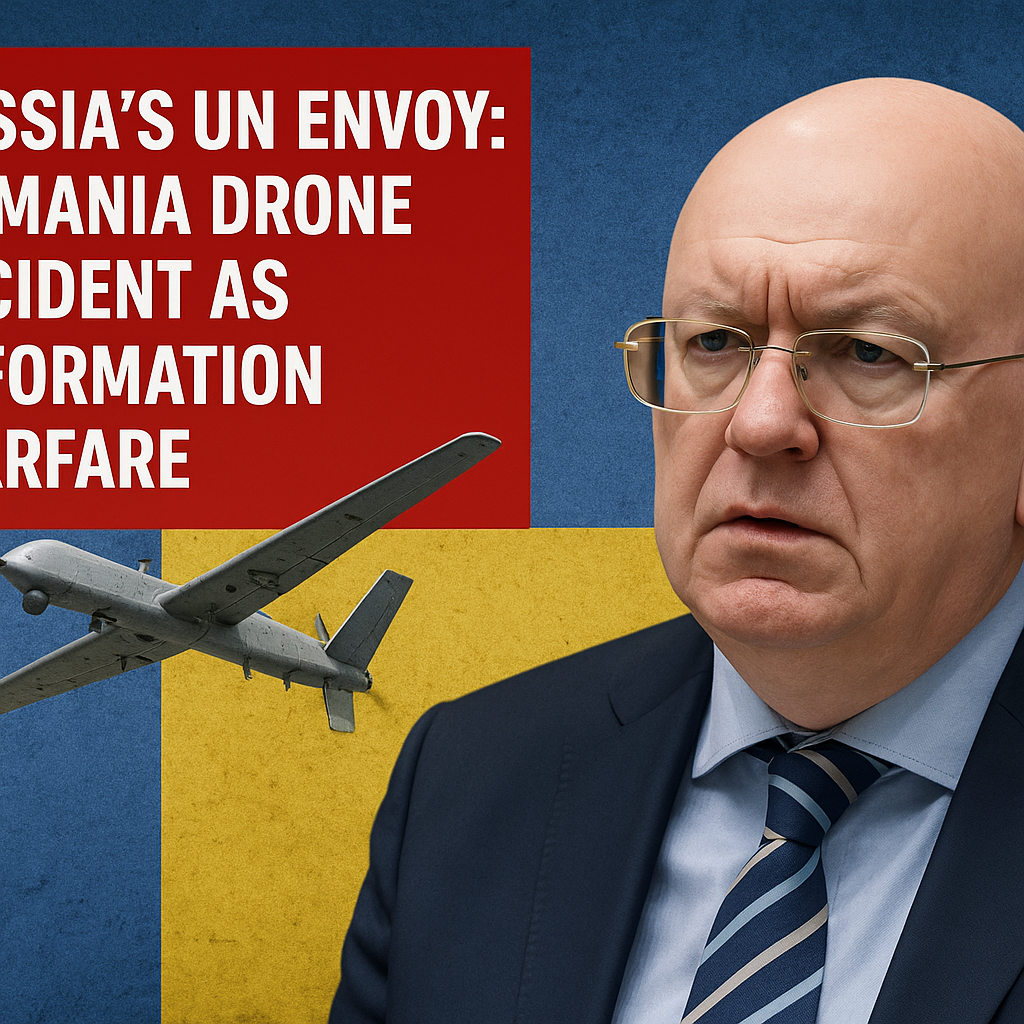
Russia’s UN Envoy: Romania Drone Incident as Information Warfare
Russia’s UN Envoy on the Romania Drone Incident: An Examination of Information Warfare
In the complex interplay of international relations, recent remarks from Russia’s UN envoy highlight the ongoing narrative around the Romania drone incident, framing it as a part of broader information warfare. This assertion has opened discussions about the dual role of media and information strategies in shaping public perception and influencing geopolitical stances.

The Context of the Drone Incident
The incident in question involves drones allegedly crashing on Romanian territory, which is located on NATO’s eastern flank. Russia’s UN Ambassador, Vassily Nebenzia, claimed this event is being manipulated by Western nations to serve their agenda, accusing them of exploiting the situation to incite fears and bolster military preparedness in Eastern Europe. He described the portrayal of Russia as a direct aggressor in this context as a clear attempt to distort reality, essentially labeling it as “information warfare.”

Nebenzia’s comments reflect a sentiment echoed in some Russian media outlets, which argue that Western narratives often simplify complex scenarios into black-and-white moral dichotomies, painting Russia as the villain in a geopolitical drama primarily directed by the U.S. and its allies. Such rhetoric suggests that the incident could be utilized to rally support for increased military presence in Romania and surrounding areas, raising concerns about inadvertent escalations in tensions with Russia.

Divergent Perspectives on Information Warfare
However, contrasting views are emerging from various sources that highlight the nuances of the incident and the larger narrative of information warfare. Articles from outlets like Al Jazeera recognize the complexity of the situation. While acknowledging Russian concerns, they also stress the importance of vigilance in evaluating the activities surrounding drone incidents. They argue such vigilance is warranted given the backdrop of rising tensions, particularly in light of Russia’s recent aggressive military actions in Ukraine.
The international community often scrutinizes the use of drones in conflict zones. For instance, NATO members regularly assess the implications of drone warfare and reconnaissance, emphasizing transparency in operations carried out by advocates and rivals alike. Here, the focus is not merely on the drones but also on the implications of these occurrences as part of ongoing military strategies and narratives employed by both sides.
It is evident that the portrayal of the Romania drone incident is influenced by various factors, including national interests, historical grievances, and the strategic goals of involved parties. The dialogue around the event illustrates how information can be weaponized, reflecting a classic strategy in asymmetrical warfare where the control of narratives often becomes as crucial as territorial control.
The Role of Media in Framing Conflict
In examining the roles of media and information dissemination, it becomes clear that narratives play a pivotal role in public perception and policy-making. The framing of the Romania drone incident serves as a case study of how incidents can be interpreted through various lenses, whether to foster unity among allies or to incite division.
Western narratives often emphasize the idea of collective security, framing incidents like this as necessary action in response to perceived threats. This approach can inadvertently or deliberately downplay the intricacies involved in each scenario, thus feeding into the broader discourse on information warfare. Analysts suggest that this polarization in narratives hinders the pursuit of peaceful resolutions and constructive dialogues.
Conversely, Russian state media tends to present narratives that position the West as aggressors seeking to encircle and undermine Russian influence. Nebenzia’s assertions about the Romania incident exemplify this tactic, where allegations of Western manipulation blend with genuine concerns about national security and military escalation.
Conclusion: Navigating the Complexity of Information Warfare
As the discourse surrounding the Romania drone incident unfolds, it becomes increasingly essential to navigate the complexities of information warfare. Amid contrasting narratives, there is a pressing need for critical evaluation of the information presented by all sides. While Russia positions the incident as a phase of information manipulation, Western nations highlight the necessity of transparency and accountability amidst rising geopolitical tensions.
Ultimately, the intersection of information and warfare represents a challenging domain where narratives not only inform public sentiment but potentially manipulate perceptions and actions on the global stage. The ability to discern fact from disinformation will be crucial as nations aim to mitigate conflict while fostering genuine dialogue in an increasingly polarized world.