
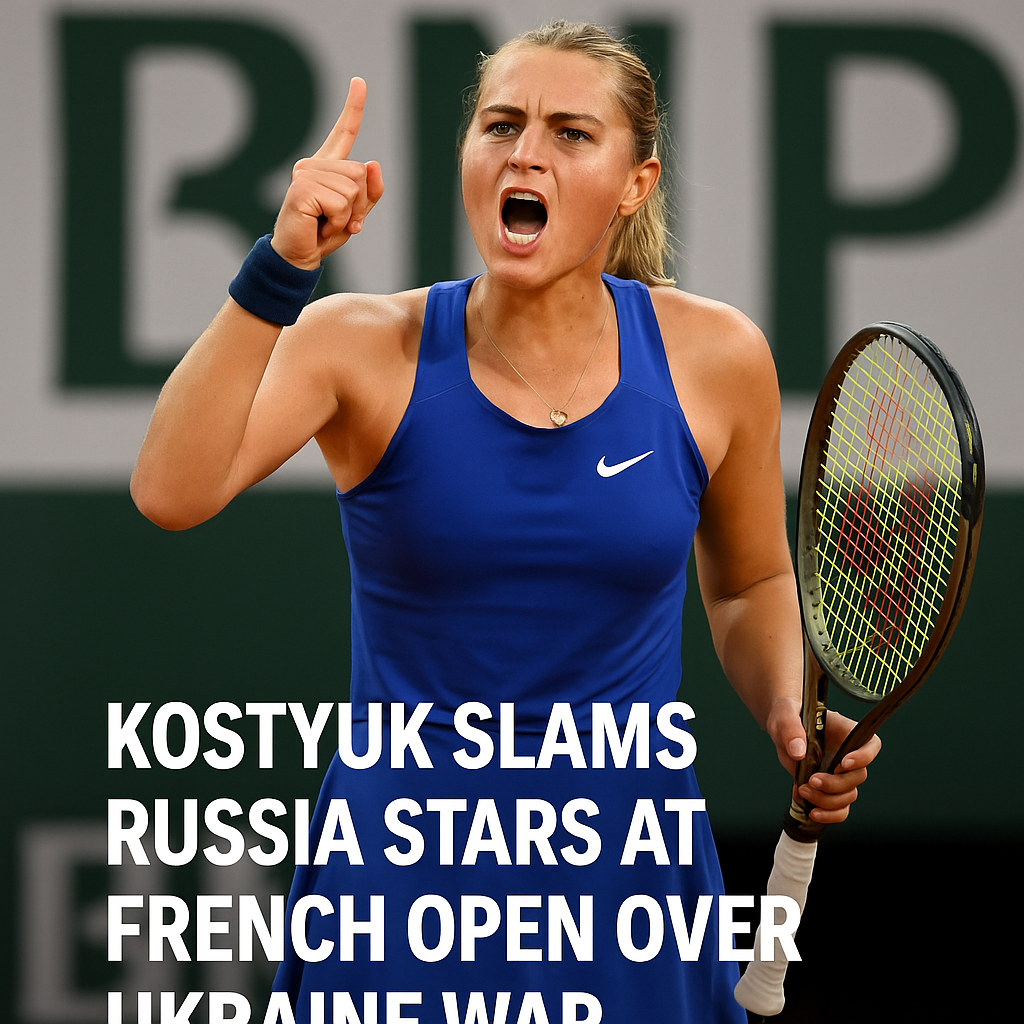
Kostyuk Slams Russia Stars at French Open Over Ukraine War
Controversy at the French Open: Kostyuk’s Outburst Against Russian Players
The ongoing conflict between Ukraine and Russia has seeped into various sectors, including sports, which have historically attempted to remain apolitical. An emblematic figure in this discourse is Ukrainian tennis player Marta Kostyuk, whose recent comments during the French Open have brought significant attention to the implications of national identity in sports.

Kostyuk’s outspoken critique of Russian players has sparked a heated debate about the boundaries of sport, nationalism, and personal responsibility amid geopolitical turmoil.

The Context of Kostyuk’s Criticism
Kostyuk, who reached the third round of this year’s French Open, expressed her disappointment with the Russian athletes who have been competing without openly denouncing their government’s actions in Ukraine. During a post-match interview, she articulated her stance, stating, “It’s very hard for me to see players from Russia not talk about the war, knowing that they have a platform, and they are not using it to speak out.” This sentiment reflects a growing frustration among Ukrainian athletes who feel that the broader sports community has not sufficiently acknowledged the conflict’s impact on their lives and careers.

The response to Kostyuk’s comments has been polarized. Some applaud her courage, arguing that athletes have a moral obligation to advocate for justice, especially given the human cost of war. Others, however, argue that sports should remain separate from political discourse. Russian players, such as Daniil Medvedev and Andrey Rublev, have faced scrutiny for maintaining a low profile regarding the war, with some fans perceiving their silence as complicity.
Varied Reactions and the Divisions within Sports
The reactions to Kostyuk’s remarks reflect a broader schism within sports regarding how athletes should engage with political issues. While some sporting bodies have introduced sanctions against Russian athletes, many believe such measures inadvertently politicize events designed to unite individuals through competition. Critics of Kostyuk’s viewpoint, including some fans and sports commentators, argue that placing political labels on athletes can lead to unfair scrutiny and stigmatization, thus harming the spirit of competition.
Furthermore, there’s a question of practicality. What responsibility do these athletes carry for their government’s actions? A considerable number of Russian athletes have stated they feel trapped by their nationality and the geopolitical situation, claiming they wish to compete without being judged for their government’s decisions. This highlights the complexity of national identity as it intersects with individual moral agency.
Kostyuk’s comments also ignited discussions about the effectiveness of silence in the face of oppression. Some observers argue that inaction aligns individuals with the status quo, leaving marginalized groups even more vulnerable. Yet, a faction within the sports community warns against forcing athletes into political discourse, emphasizing that it should be a personal choice rather than an obligation.
A Broader Impact: The Role of Athletes in Politics
Kostyuk’s stance is not just a local issue; it resonates on a global scale, prompting conversations about the role of athletes in societal change. The tennis community, like many other sport arenas, has historically been a platform for challenging oppression, as seen in instances like the activism of Muhammad Ali or Colin Kaepernick. Kostyuk’s outcry echoes these legacies, yet also serves as a reminder of the risks that come with using a public platform for political statements.
As Kostyuk continues to perform at high levels, her actions might inspire other athletes to find their voices or reconsider their silence regarding oppressive regimes. The responsibility lies not solely on the athletes but also on sports organizations to create environments where expressions of conscience are welcomed and necessary discussions can take place.
Conclusion: The Complexity of Athletes in Political Landscapes
The French Open, a prestigious venue for sporting excellence, has become a microcosm of the larger international conflict. Kostyuk’s strong statements raise critical questions regarding the roles athletes play in political dialogue, implicating not just individual responsibility but also societal expectations of engagement.
As the tennis season progresses and the conflict continues, it is essential for athletes, organizations, and fans to navigate these conversations with sensitivity and awareness. The landscape is complex, but through discourse, it may become possible to bridge divides and acknowledge the ongoing impacts of global events within the sporting world.















