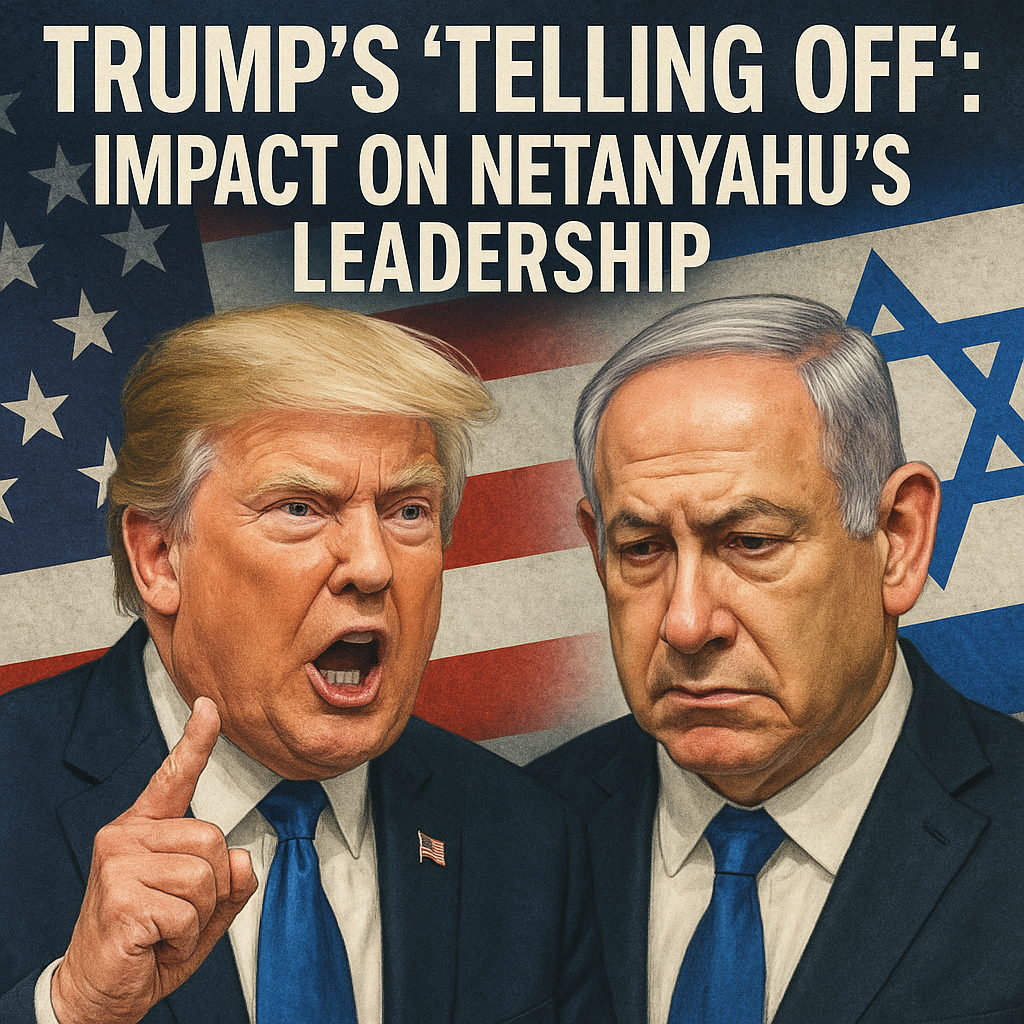
Trump’s ‘Telling Off’: Impact on Netanyahu’s Leadership
Trump’s ‘Telling Off’: Impact on Netanyahu’s Leadership
Former President Donald Trump’s recent public reprimand of Israeli Prime Minister Benjamin Netanyahu has ignited discussions about its ramifications for Netanyahu’s leadership, positioning, and the broader political landscape in both Israel and the United States. As a figure who has managed to pivot between controversial statements and international diplomacy effectively, Trump’s remarks could have serious implications for Netanyahu, whose political fortunes have waned in recent months.

The Context of Trump’s Criticism
In a recent public statement, Trump characterized Netanyahu’s leadership as lacking, emphasizing his disappointment over the Israeli leader’s failure to fulfill commitments made during his administration. This comment resonates particularly given Trump’s historical support of Netanyahu, which has often included public endorsements and considerable political backing. Trump’s rebuke comes at a critical moment, as Netanyahu contends with declining approval ratings amidst ongoing criticism regarding his government’s handling of various domestic issues, including the economy and social unrest.

Historically, Netanyahu has relied on strong ties with American leaders, especially those from Trump’s Republican Party, to bolster his position back home. Consequently, Trump’s remarks are more than casual criticism; they signify a potential shift in how American support for Israel can be influenced by the political climate in Washington, which appears increasingly at odds with Netanyahu’s strategy and actions.

The Domestic Ramifications for Netanyahu
Netanyahu’s government, marked by controversial policies surrounding settlement expansion and treatment of Palestinians, faces intense scrutiny domestically. Several Israeli lawmakers have highlighted the precariousness of his administration, suggesting that Trump’s ‘telling off’ could further embolden opposition parties. For many, the former president’s comments encapsulate a decline in legitimacy and support that Netanyahu can afford less and less.
Polls indicate that Netanyahu’s approval has dipped significantly over the past year. Opposition leaders have pointed to Trump’s words as evidence that even staunch allies in American politics are dissatisfied with his leadership. As a result, critics within Israel are leveraging this moment to question his capacity to navigate Israel’s complex relationship with the United States and advocate for its interests on the global stage.
A Divide in Perspectives
However, reactions to Trump’s criticism are mixed, reflecting a broader divide in perspectives on U.S.-Israel relations. Supporters of Netanyahu argue that Trump’s comments detract from the complexity of the Israeli political landscape. They assert that criticizing a leader while ignoring the broader context, such as regional security concerns and multi-faceted diplomatic strategies, overlooks the reality of governance in Israel.
On the other hand, voices from within the opposition proclaim that Trump’s intervention signals a pivotal moment where external critique could catalyze change in Israeli leadership. They argue that Netanyahu has been navigating a fragile political environment, and lack of support from influential figures like Trump could destabilize his standing preemptively.
The Global Political Landscape
The fallout from Trump’s comments extends beyond Israeli politics and has implications for U.S. foreign policy in the Middle East. Trump’s diminishing influence in politics could reshape alliances, as Netanyahu may be compelled to foster relationships with figures from different political establishments. Recent commentary across various news platforms suggests that many are speculating on the potential emergence of a new center in Israeli politics that could better respond to shifting American attitudes.
In this context, the dynamics of cooperation between the U.S. and Israel may shift towards a more contingent relationship, one where mutual support relies deeply on the political perceptions of leaders in both nations. The idea that America’s relationship with Israel might become less transactional and more values-based is simmering in political discourse.
Conclusion: The Uncertain Future
Trump’s public critique of Netanyahu is emblematic of deeper cracks in their traditional alliance, stirring debates about the future of Israeli governance and its international relations. As Netanyahu grapples with declining support domestically and externally, the political landscape remains fluid and intricate.
While some sections of the Israeli populace may welcome Trump’s newfound criticism as an opportunity for reform, others see it as a detrimental interference at a time of internal strife. Ultimately, what remains clear is that Trump’s remarks have introduced a layer of uncertainty in Netanyahu’s leadership journey, one that could lead to shifts in policy and alliances in the ever-complicated arena of Middle Eastern politics.