
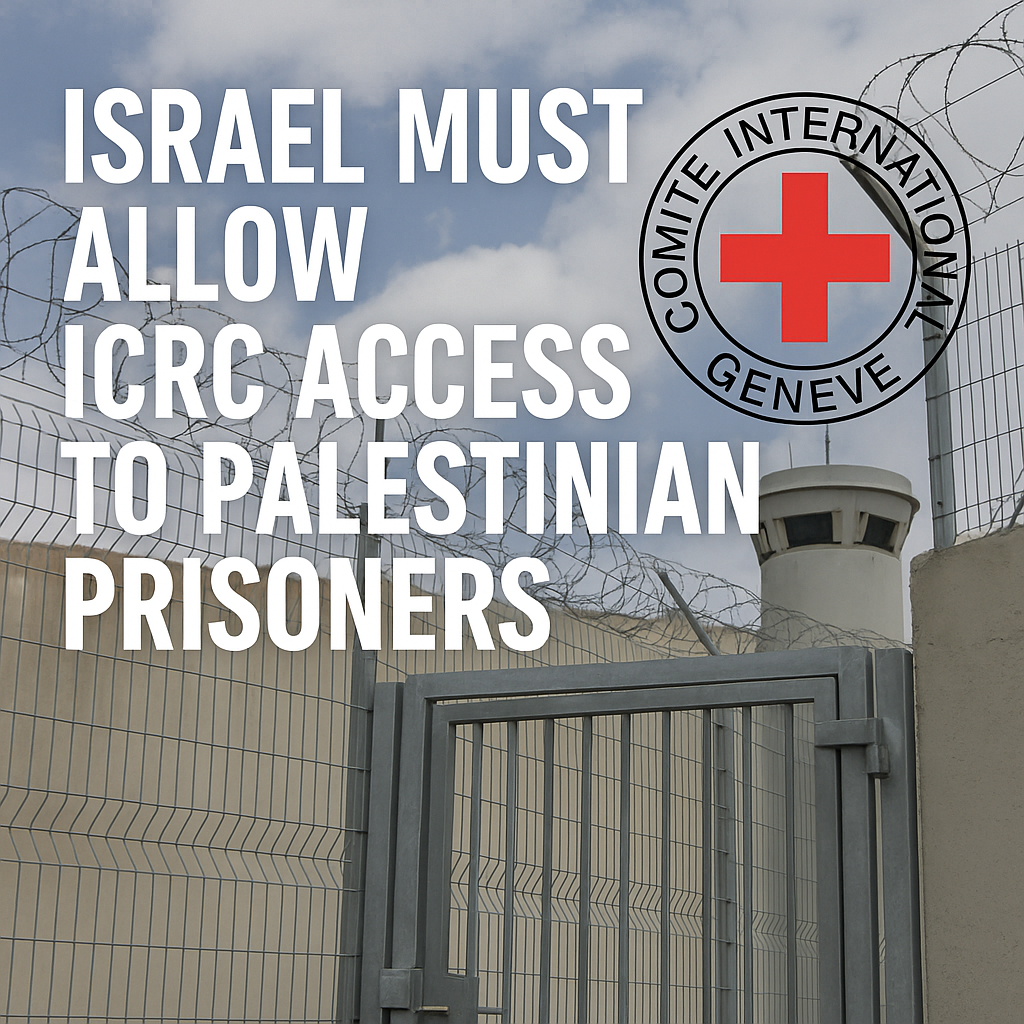
Israel Must Allow ICRC Access to Palestinian Prisoners
Israel Must Allow ICRC Access to Palestinian Prisoners
The issue of the International Committee of the Red Cross (ICRC) gaining access to Palestinian prisoners in Israel has resurged, particularly following a significant ruling by Israel’s Supreme Court earlier this month. This pivotal decision underscores the necessity of humanitarian oversight in complex geopolitical landscapes, where the rights and well-being of detainees can often be compromised.

The Legal Context and Current Developments
On June 4, 2026, Israel’s Supreme Court concluded that the ICRC must be permitted to visit Palestinian prisoners, reaffirming an obligation tied to international humanitarian law. This ruling has drawn widespread attention, as it lays the groundwork for potential improvements in the treatment conditions of prisoners, many of whom have been detained without formal charges under administrative detention laws.

Supporters of the ruling, including human rights organizations, argue that unrestricted access facilitates adherence to international standards of human rights and provides transparency about prison conditions. They assert that such oversight can act as a deterrent against potential abuses and ensure that prisoners’ rights are upheld. As Amnesty International noted, “Accountability mechanisms, including the ICRC’s access, play a crucial role in safeguarding human dignity.”

Conversely, some Israeli officials have expressed concerns regarding the security implications of allowing foreign organizations, like the ICRC, unlimited access to their prisons. They argue that such access could pose risks by providing valuable information to adversaries about security protocols within Israel’s detention facilities. Critics from this perspective emphasize the fragile nature of the geopolitical situation and suggest that operational security must take precedence over broad humanitarian mandates.
Divergent Perspectives on Humanitarian Access
The call for ICRC access to Palestinian prisoners is not without its complexities and differing opinions. Supporters highlight the ethical obligation to ensure humane treatment within prisons. Reports from Al Jazeera have highlighted instances where health conditions and overall treatment had come into question, suggesting that oversight can lead to improved conditions for prisoners.
On the other hand, RT News has reported on the Israeli government’s stance towards the ICRC and similar organizations, which it characterizes as potentially politicized entities. Critics assert that allowing access could be interpreted as a concession or a weakness in Israel’s national security stance, particularly in a region fraught with ongoing tensions and violence.
Moreover, the nuances of international law come into play. Many argue that Israel, as a state party to several international treaties, is bound to uphold the rights of prisoners and that denial of access raises significant legal and moral questions. The underlying premise is that humanitarian access is not solely a political tool; rather, it is a legal requirement that should supersede security concerns in matters pertaining to human rights.
The Humanitarian Implications
The implications of ICRC access extend beyond legal confines into the territories of humanitarian practices and human rights advocacy. Access to prisoners is crucial not only for the sake of accountability but also in providing emotional and psychological support for families, whose members are often left in darkness regarding their loved ones’ treatment.
The lack of access can lead to a humanitarian crisis, exacerbating feelings of alienation and diffidence among affected communities. This sentiment is reflected in the opinions of various humanitarian workers who argue for the importance of fostering trust. “Building confidence within the community is essential, especially if we want to encourage dialogue and peace,” highlighted a humanitarian organization, emphasizing that such trust could be more difficult to establish in the event of a perceived denial of rights.
Conclusion
The ongoing discourse surrounding the legal ruling requiring Israel to allow the ICRC access to Palestinian prisoners brings to the forefront several critical issues. While the ruling points to an important step towards transparency and accountability, it also reveals the intricate balance between humanitarian oversight and national security.
The complexities involved must be navigated thoughtfully, recognizing both the significant humanitarian needs and the realistic security concerns at play. In a region where tensions and historical grievances coexist, finding equitable solutions becomes not only a legal or political necessity but also a moral imperative. As the situation develops, the role of international organizations like the ICRC will remain pivotal in advocating for human rights and enhancing the overall humanitarian landscape.















