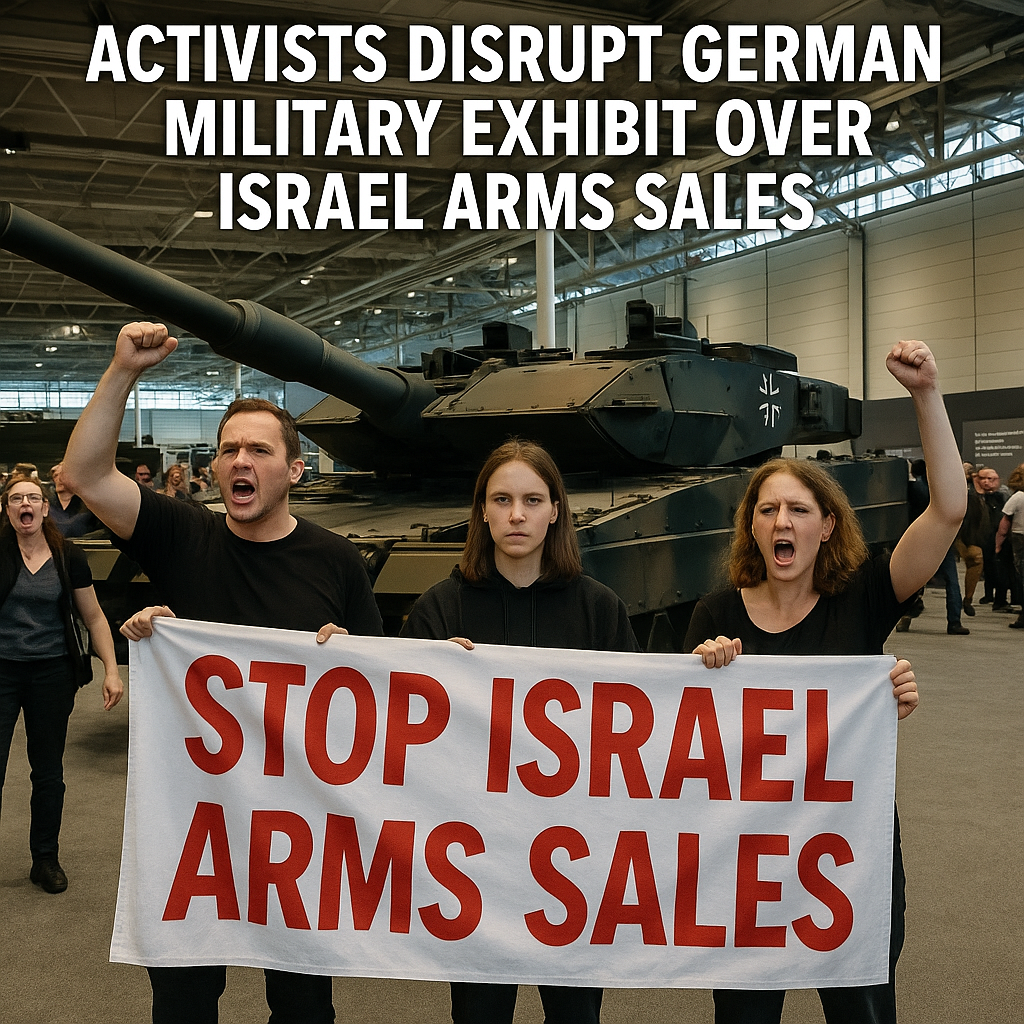
Activists Disrupt German Military Exhibit Over Israel Arms Sales
Activists recently made headlines by disrupting a military exhibit in Germany, targeting the country’s arms sales to Israel. This incident has sparked a complex conversation surrounding military ethics, foreign policy, and the responsibilities of nations in the international arms trade.

Controversial Arms Sales
The backdrop to this protest lies in Germany’s role in the global arms trade, particularly regarding its military agreements with Israel. Activists contend that these sales contribute to ongoing conflicts and human rights violations in Palestinian territories. The dissenters assert that equipping Israel with advanced weaponry exacerbates tensions in an already volatile region.

Videos from the Al Jazeera report show demonstrators vocally opposing the exhibit, stating that the arms sold to Israel are used in military actions that disproportionately affect civilians. They argue that continued support for Israel undermines Germany’s commitment to human rights and international law. The sentiment is echoed by various human rights organizations that have long criticized arms sales without stringent oversight.

The Defense Industry Perspective
In stark contrast, proponents of such arms sales, including figures from Germany’s defense industry, argue that military agreements with Israel are rooted in shared security interests. They point out that Israel is a valuable ally in the Middle East, a region increasingly fraught with instability. According to these advocates, the military collaboration helps to maintain a regional balance of power and is essential for mutual defense against common threats, including terrorism.
Industry representatives emphasize that Germany maintains rigorous export controls and only sells weapons to nations that abide by international laws. They argue that these sales are conducted transparently, promoting security partnerships essential to both nations.
The Broader Implications of Activism
The disruption of the military exhibit serves as a reminder of the active role citizens can play in influencing public policy and corporate behavior. Activists employ various strategies — from protests to social media campaigns — raising awareness about what they perceive as moral obligations in the arms trade. The incident also highlights the growing divide among citizens regarding military ethics and foreign policy.
While protests like the one in Germany do shine a spotlight on controversial issues, they can also polarize public opinion. Some individuals view such activism as essential advocacy, while others interpret it as an affront to national pride and security. The variety of responses reflects the complex interplay of ethical considerations and national interests.
The Path Forward: A Divided Perspective
As discussions surrounding arms sales and military partnerships intensify, one thing remains clear: there is no consensus on these issues. While activists advocate for a more cautious approach, emphasizing humanitarian concerns, others underscore the importance of national security and international alliances.
Germany, like many nations involved in the arms trade, finds itself at a crossroads where it must weigh the moral implications of its military transactions against strategic interests. The growing voices of dissent suggest a shifting paradigm, where ethical considerations are increasingly scrutinized alongside national policy.
In conclusion, the disruption of the military exhibit in Germany speaks to broader societal debates about military ethics in the context of international relations. As activists continue to challenge established norms, the discourse surrounding arms sales will undoubtedly remain contentious, reflecting the intricate balance nations must navigate between security and morality. The road ahead is fraught with challenges, as nations must adapt to an evolving landscape marked by passionate advocacy and complex geopolitical realities.